
In Africa’s highly competitive telecom industry, growth is never guaranteed. Rising operational costs, currency instability, and infrastructure demands continue to pressure telecom companies across the continent. Yet despite these challenges, Airtel Africa delivered one of its strongest financial performances to date in its Full Year 2026 results ending March 31, 2026.
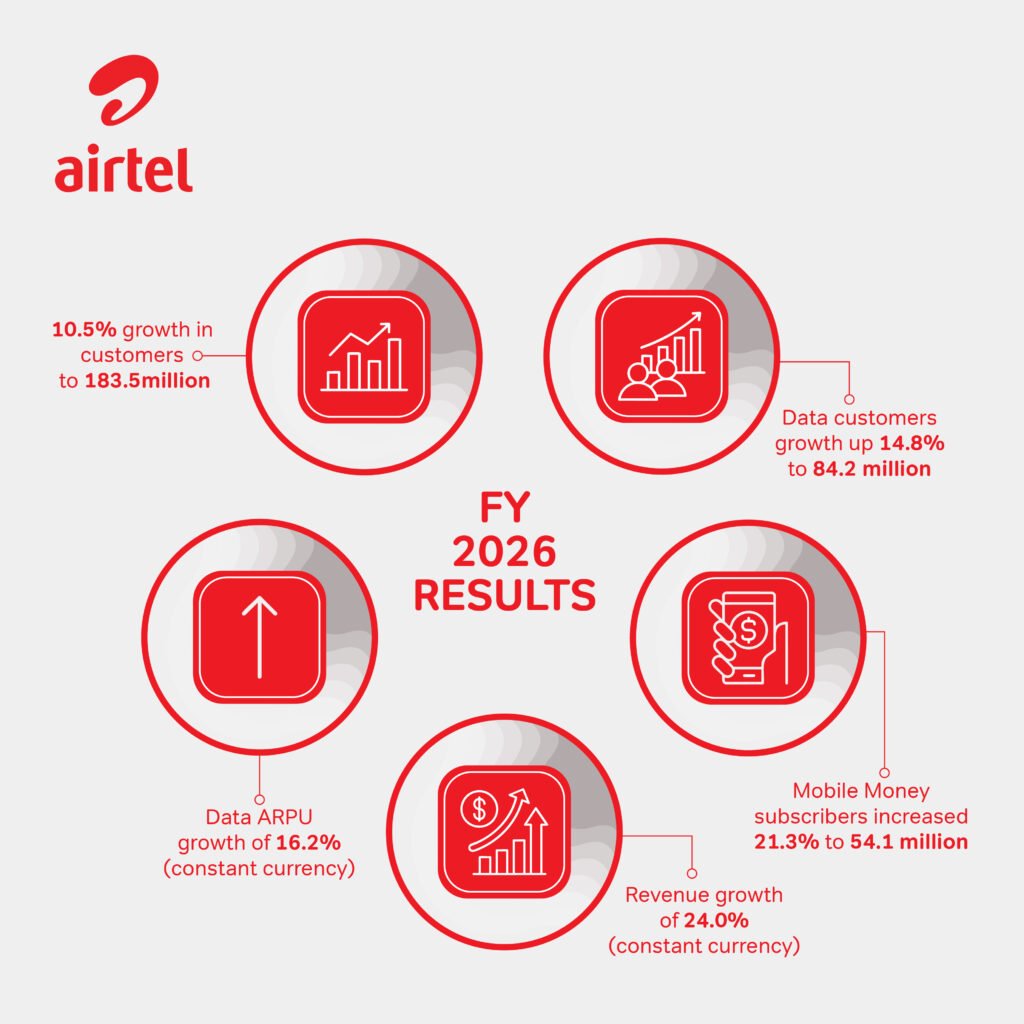
The company reported a 29.5% increase in revenue to $6.41 billion, alongside record customer growth across its markets. Beyond the numbers, the results reveal a business strategy built around digital expansion, mobile money, and operational discipline.
One of the clearest drivers of Airtel’s growth was data consumption.
The company did not simply increase subscriber numbers. It successfully changed how customers use their mobile phones. Average monthly data usage per customer rose from 7.0 GB to 8.9 GB, reflecting Africa’s growing digital appetite.
This growth was supported by increased smartphone penetration, which approached 50% across Airtel Africa’s markets. More smartphone users translated into higher consumption of video content, social media, online business tools, and digital services.
“Data revenue is no longer just an addition for telecom companies. It is becoming the core growth engine.”
As more customers moved online, Airtel’s data revenue continued to strengthen, proving that digital adoption across Africa is accelerating rapidly.
Equally significant was the continued growth of Airtel Money.
The platform processed an annualized transaction value of $215 billion, highlighting the growing importance of mobile financial services across African economies. With many communities still underserved by traditional banking systems, Airtel Money has increasingly become an alternative financial infrastructure.
Customers now use mobile money not only for sending cash, but also for paying bills, receiving salaries, shopping, and conducting business transactions.
The Airtel Money customer base grew to 54.1 million users, reinforcing the company’s evolution from a telecommunications provider into a broader digital and financial services platform.
The company’s performance also reflected strong operational discipline during a difficult economic period.
Operating across 14 African countries exposes Airtel Africa to multiple economic pressures, including inflation and currency devaluation in major markets such as Nigeria. However, the company managed to improve operational efficiency while maintaining growth.
Rather than expanding recklessly, Airtel focused investment in areas with strong demand and faster returns. This allowed the company to protect profitability while continuing to scale its network infrastructure.
The strong performance also benefited shareholders.
Airtel Africa increased its final dividend to 4.17 cents per share and launched a $100 million share buyback programme, signaling confidence in its financial position and long-term strategy.
Beyond telecoms, Airtel Africa’s results also reflect broader economic trends across the continent.
The sharp rise in data usage highlights how Africa’s digital economy continues to mature, while the growth of mobile money demonstrates the increasing shift toward cashless financial systems.
At the same time, the company’s ability to grow despite economic volatility shows how diversified business models can help companies remain resilient during uncertain periods.
“The future of business in Africa increasingly belongs to companies that combine digital innovation with operational discipline.”
Airtel Africa’s 2026 performance ultimately shows that success in Africa’s modern economy is no longer driven by connectivity alone. It is being driven by ecosystems that integrate communication, finance, and digital services into everyday life.
As Group CEO Sunil Taldar emphasized, the company’s focus remains on customer centricity and digitisation. In practical terms, that means building services that become essential to daily life and, in the process, creating sustainable long-term growth.
