
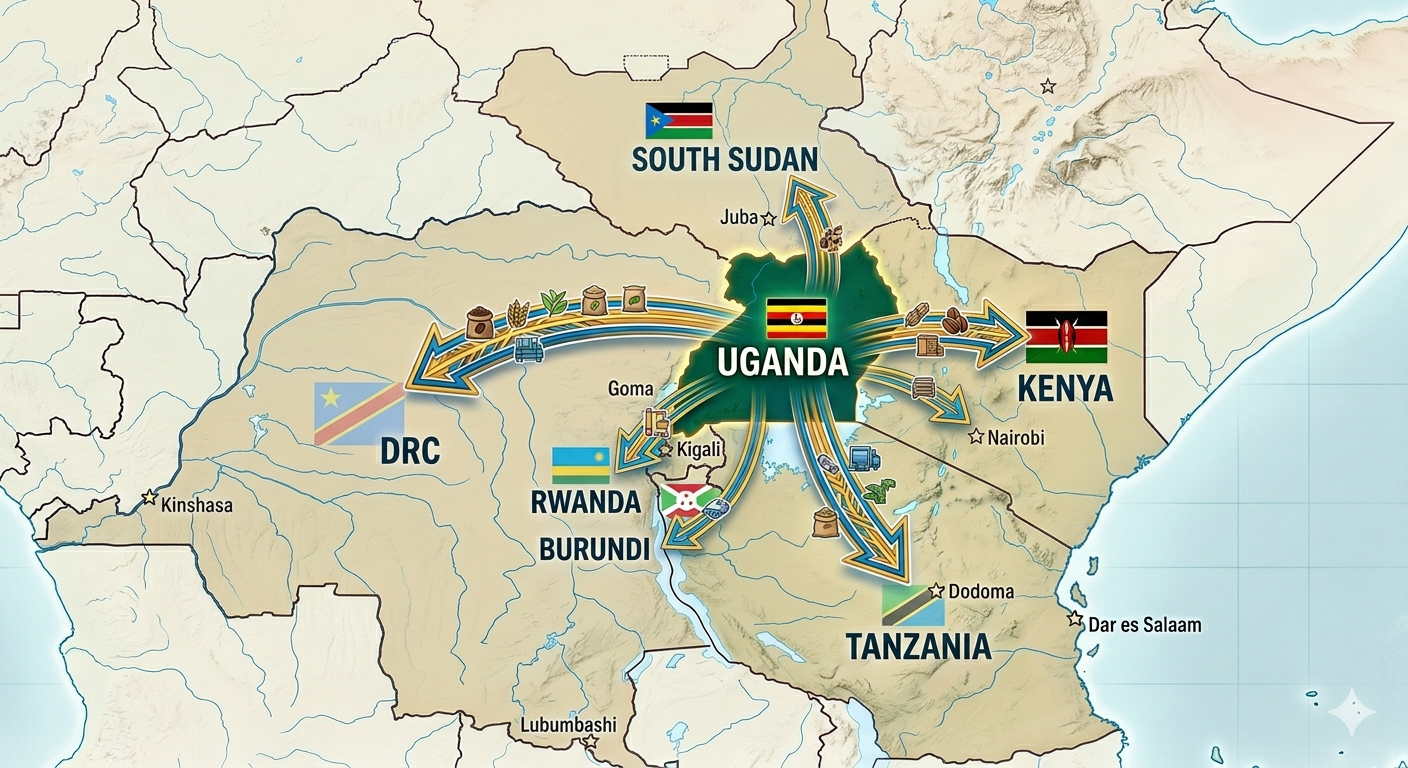
Uganda recorded a trade surplus of $41.52 million (Sh155.2 billion) with East African Community (EAC) partner states in January 2026, marking a sharp improvement from a deficit of $186.07m (Sh695.6b) registered in December 2025, according to the latest performance of the economy report from the Ministry of Finance.
This was largely driven by a sharp decline in imports from the EAC bloc, which fell by 53.0% from $465.43m (Sh1.74 trillion) in December 2025 to $218.91m (Sh819.0b) in January 2026. This represents a reduction of $246.52m (Sh922.0b) in import expenditure within a single month.
Exports to the region also declined, though at a much slower pace. They dropped by 6.8%, from $279.35m (Sh1.04 trillion) to $260.43m (Sh973.0b) over the same period, a decrease of $18.92m (Sh70.8b). The sharper contraction in imports compared to exports explains the shift from deficit to surplus in the month under review.
On an annual comparison basis, Uganda’s external position with EAC partner states also improved significantly. In January 2026, the country posted a surplus of $41.52m (Sh155.2b) compared to a deficit of $3.61m (Sh13.5b) recorded in January 2025. The improvement was attributed to a combination of rising exports and declining imports over the year.
At the country level, Uganda’s trade performance in January 2026 showed mixed outcomes across the region. The country recorded surpluses with the Democratic Republic of Congo (DRC), South Sudan, Rwanda, and Burundi.
Trade with the DRC yielded the largest surplus at $101.79m (Sh380.7b), followed by South Sudan at $45.76m (Sh171.1b). Uganda also posted a surplus of $30.24m (Sh113.1b) with Rwanda and $3.82m (Sh14.3b) with Burundi.
However, Uganda continued to record deficits with some key regional partners. Trade with Tanzania resulted in a deficit of $32.15m (Sh120.2b), although this was a significant improvement from a much larger deficit of $249.34m (Sh932.6b) recorded in December 2025. The reduction points to a moderation in import pressure from Tanzania during the month.
Uganda’s largest bilateral deficit in the region was with Kenya, where the trade gap stood at $107.95 million (Sh403.6 billion) in January 2026. This reflects continued high import demand from Kenya relative to Uganda’s exports to that market.
In particular, non-tariff barriers within the region continue to constrain Uganda’s export penetration, especially in the Tanzanian market.
Uganda Records Trade Surplus, Monthly Exports Hit Sh5.43 trillion
Uganda’s merchandise exports also increased to $1.453 billion (Sh5.43 trillion) in January 2026, up from $1.395 billion (Sh5.22 trillion) recorded in December 2025.
The growth in export earnings reflects stronger performance across key commodities, particularly gold, coffee, electricity and maize, which registered notable gains during the month and helped push the country into a trade surplus position.
According to the report, Uganda recorded a merchandise trade surplus of $147.26m (Sh550.8b) in January, a sharp turnaround from a deficit of $206.43m (Sh771.0b) in December, largely driven by improved export receipts.
Gold, which remains Uganda’s largest export, continued to dominate the export basket, accounting for the bulk of foreign exchange earnings. Export receipts from gold rose to $913.95m (Sh3.42 trillion) in January from $823.68m (Sh3.08 trillion) in December, representing an increase of about $90 million month-on-month.
The Ministry attributes this growth to both higher export volumes and rising global prices, with gold increasingly benefiting from its status as a safe-haven asset amid global economic uncertainties.
Coffee, Uganda’s leading agricultural export, also recorded improved performance during the month. Earnings from coffee exports increased to $160.99m (Sh602.1b) in January, up from $149.87m (Sh560.5b) in December, translating into a monthly increase of about $11.1 million.
The rise in coffee earnings was largely supported by higher export volumes. Coffee shipments increased to 0.566 million 60-kilogram bags in January, up from 0.503 million bags in December. The exports comprised 447,599 bags of Robusta worth $111.04m (Sh415.3b) and 121,855 bags of Arabica valued at $49.96m (Sh186.9b).
While Robusta continued to dominate the export basket, Arabica recorded the strongest growth, rising 84.68% in quantity and 134.17% in value compared to the same month last year. Robusta exports, however, declined by 9.10% in volume and 19.17% in value.
According to the report, the increase in volumes more than offset the decline in global coffee prices, which have been affected by improved supply prospects in major producing countries such as Brazil.
The report also notes that gold and coffee alone accounted for more than 74% of total export earnings, underlining their continued dominance in Uganda’s export structure.
Beyond the traditional exports, electricity exports to neighbouring countries also posted growth. Earnings rose to $7.23m (Sh27b) in January from $5.67m (Sh21.2b) in December, reflecting stronger regional demand for power.
Similarly, maize exports registered a significant rebound, with export receipts increasing to $7.91m (Sh29.6b) from $5.19m (Sh19.4b) over the same period.
Other agricultural exports showed mixed performance. Tea exports increased slightly to $4.72m (Sh17.7b) from $4.41m (Sh16.5b), while flower exports rose to $6.76m (Sh25.3b) from $5.53m (Sh20.7b) in December.
However, some commodities recorded declines. Tobacco exports dropped sharply to $7.14m (Sh26.7b) from $10.44m (Sh39.0b), while fish and fish products declined to $13.09m (Sh49.0b) from $16.63m (Sh62.2b) in the previous month. Similarly, beans exports fell to $9.22m (Sh34.5b) from $11.11m (Sh41.6b).
On the other hand, oil re-exports recorded one of the strongest increases among non-traditional exports. Earnings more than doubled to $29.18m (Sh109.1b) in January from $14.01m (Sh52.4b.
A year-on-year comparison further highlights the strength of Uganda’s export sector. Export earnings grew by 72.1%, rising from $844.6m in January 2025 to $1.453 billion in January 2026, driven by higher receipts from gold, coffee, industrial products and oil re-exports.
Export destination
Export destinations remained largely concentrated in a few key regions, with the Middle East accounting for 48.9% of total exports. The United Arab Emirates (UAE) dominated this market, taking almost all exports to the region, largely in the form of gold.
Asia was the second-largest destination, accounting for 18.4% of exports, followed closely by the East African Community (17.9%) and the European Union (10.4%). In terms of value, exports to Asia amounted to about $267.83m, which was slightly higher than the $260.43m exported to the EAC.
Key Asian markets included Hong Kong, China, India, Malaysia and South Korea, with exports largely comprising mineral products, coffee and other agricultural commodities. The continued dominance of the Middle East reflects sustained demand for gold, while regional markets remain critical for agricultural exports.
Imports
On the import side, Uganda’s merchandise import bill stood at about $1.31b (Sh4.90 trillion) in January 2026, reflecting a 23.2% increase on a year-on-year basis, driven mainly by higher private sector imports.
However, on a month-on-month basis, imports declined significantly from $1.57b (Sh5.87 trillion) in December 2025 to about $1.28–1.31b in January, largely due to reduced government and non-oil private sector imports.
The import structure remained dominated by Asia, which accounted for 33.9% of total imports, with China, India and Japan as the leading sources. Other key sources included the Rest of Africa (29.1%), the East African Community (16.8%) and the Middle East (11.5%). Major imports included mineral products, machinery and equipment, vehicles, petroleum products and base metals, reflecting strong demand from Uganda’s industrial and construction sectors.
