

Uganda has launched a five-year strategic framework aimed at strengthening regulation of the country’s gaming and lottery industry, with the government positioning the sector as an increasingly important contributor to national revenue, investment and employment.
The Minister of State for Finance (General Duties), Hon. Henry Musasizi, launched the National Lotteries and Gaming Regulatory Board’s (NLGRB) Strategic Plan, Client Charter and Service Delivery Standards for the financial years 2025/26 to 2029/30, describing the documents as more than policy instruments.
Musasizi said the framework represents a commitment to accountability, innovation, responsible gaming and national development, while aligning the regulator’s mandate with Uganda’s broader economic transformation priorities.
The three documents have been aligned with Uganda’s Vision 2040, the Fourth National Development Plan (NDP IV) and the government’s Tenfold Growth Strategy, positioning the gaming sector as part of the country’s long-term economic planning.
“The Gaming industry continues to play an increasingly important role in Uganda’s economy. Through effective regulation, enhanced compliance, technological innovation and stronger supervision, the sector has expanded its contribution to government revenue, employment and investment.”
Hon. Henry Musasizi, Minister of State for Finance (General Duties)
The launch comes as Uganda’s gaming industry continues to expand, driven by increased digital access, mobile money usage and the growth of online betting platforms. The government has increasingly focused on improving oversight of the sector to ensure operators comply with regulations while protecting consumers.
The new five-year strategic plan provides a roadmap for strengthening regulatory systems, improving service delivery, expanding oversight across the country and using technology to enhance monitoring and accountability.
The Client Charter and Service Delivery Standards are expected to improve transparency between the regulator, gaming operators and the public by setting clearer expectations around regulatory processes and service commitments.
While the launch highlighted the government’s confidence in the sector’s potential, officials stressed that successful implementation would be the true measure of the strategy’s impact.
Representing the Permanent Secretary and Secretary to the Treasury (PSST), Deputy Secretary to the Treasury Patrick Ocailap said the Ministry of Finance would continue supporting NLGRB within available fiscal resources and in line with government priorities.
However, he warned that strategic documents must be backed by action, accountability and consistent execution.
“A strategic plan without implementation remains a statement of intent. Service delivery standards without compliance remain aspirations. A client charter without accountability becomes only a public relations document.”
Patrick Ocailap, Deputy Secretary to the Treasury
Ocailap’s remarks reflect a wider government push for public institutions to move beyond policy development and focus on measurable outcomes, especially in areas linked to revenue mobilisation, efficiency and service delivery.

The NLGRB Board Chairman, Ken Kitariko, said the regulator has focused on strengthening the gaming regulatory framework, closing compliance gaps among operators and expanding nationwide oversight.
He added that technology adoption would remain central to improving transparency, accountability and revenue assurance within the sector.
“The Board has focused on strengthening the regulatory framework, closing compliance gaps, expanding nationwide oversight and deploying technology to enhance transparency, accountability and revenue assurance.”
Ken Kitariko, Chairman, NLGRB Board
A key highlight of the launch was the presentation of the NLGRB’s ISO/IEC 27001 certification to Minister Musasizi by Kitariko. The internationally recognised certification sets requirements for establishing, implementing and continuously improving an Information Security Management System (ISMS).
The certification demonstrates the regulator’s commitment to strengthening information security practices and improving confidence in the management of sensitive regulatory data.
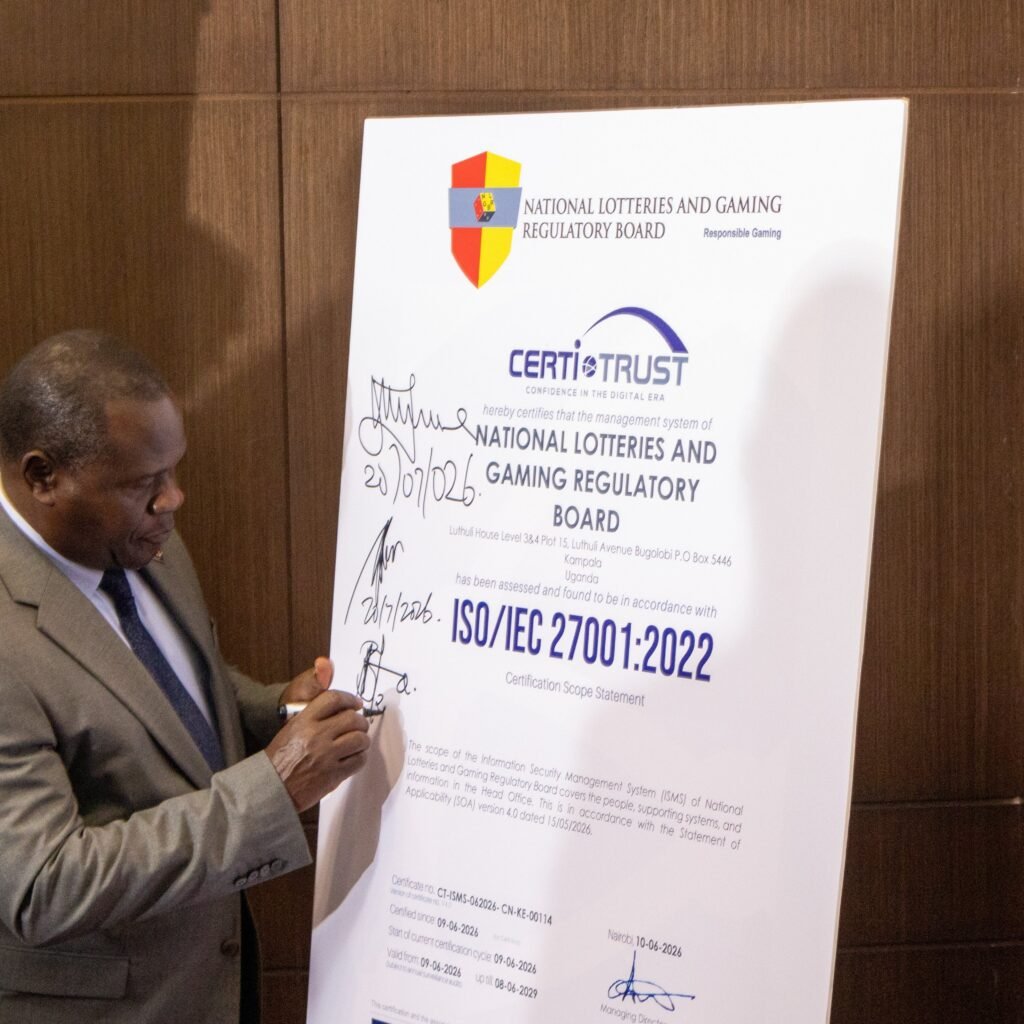
As gaming becomes increasingly technology-driven, the certification provides a foundation for stronger digital oversight, better information protection and improved regulatory operations.
The new strategic direction also places greater attention on responsible gaming, with the regulator expected to strengthen measures that promote safe participation while addressing social risks associated with gambling.
For businesses operating in the sector, the framework signals a shift towards a more structured and predictable regulatory environment where compliance, transparency and technology adoption will become central requirements.
The government believes that a well-regulated gaming industry can contribute significantly to economic growth while ensuring that consumer protection remains a priority.
With the launch of the FY2025/26 to FY2029/30 Strategic Plan, Client Charter and Service Delivery Standards, the NLGRB enters a new phase focused on stronger oversight, digital transformation and accountability.
The success of the strategy, however, will ultimately depend on the regulator’s ability to translate policy commitments into practical results through consistent implementation, enforcement and measurable improvements across the sector.
