
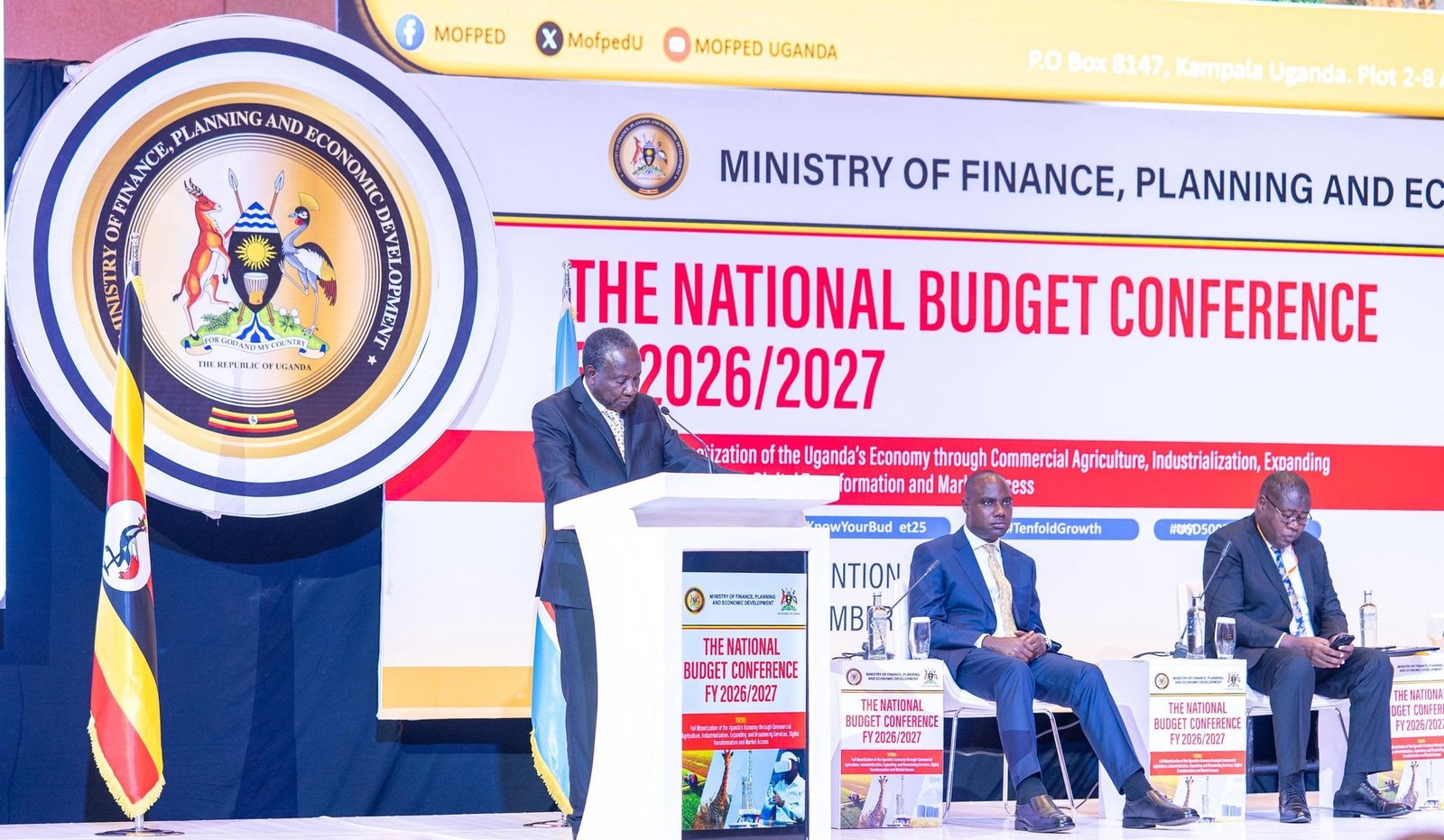
Government has proposed an Sh84.209 trillion national budget for the Financial Year 2026/27, signalling a major shift towards oil-driven growth, expanded domestic revenue mobilisation and increased public investment across key sectors.
The draft estimates, presented by the Minister of Finance, Planning and Economic Development, Matia Kasaija, were outlined during a National Resistance Movement (NRM) caucus meeting chaired by President Yoweri Kaguta Museveni at State House Entebbe on Friday.
The total draft budget represents an increase of Sh11.832 trillion from the originally approved Sh72.376 trillion for FY2025/26. Compared to the revised FY2025/26 budget of Sh80.48 trillion, which included a Sh8.104 trillion supplementary, the net increase stands at Sh3.729 trillion.
The proposed allocation is also higher than the Sh69.399 trillion earlier approved under the National Budget Framework Paper (NBFP) for FY2026/27–2030/31, which Parliament endorsed last month, reflecting a shift from earlier fiscal consolidation plans.
Kasaija attributed the expansion largely to projected domestic revenue growth, expected to increase by Sh6.856 trillion to Sh44.5 trillion. The growth is to be driven by administrative and policy measures implemented by the Uganda Revenue Authority aimed at raising the tax-to-GDP ratio from about 14% to 16%.
Government is also projecting Sh1.44 trillion in petroleum revenues following the anticipated commencement of commercial oil production. This marks a significant milestone in Uganda’s economic trajectory, positioning the oil sector as a key contributor to the national budget.
Additional financing will come from domestic borrowing, projected to increase by Sh593 billion to Sh11.97 trillion, while domestic debt refinancing is expected to rise by Sh3.94 trillion due to increased issuance of government securities. Local government revenues are projected to grow modestly by Sh12 billion.
On the expenditure side, the budget prioritises infrastructure development, human capital, and strategic investments. Government has allocated Sh1.38 trillion for counterpart funding to flagship projects, including the Kampala–Jinja Expressway, Standard Gauge Railway, Meter-Gauge Railway, electricity supply to industrial parks and national water systems.
Wage enhancements and addressing salary shortfalls across the public service will cost Sh1.16 trillion, targeting primary school teachers, secondary school arts teachers, Business, Technical and Vocational Education and Training (BTVET) staff, as well as specialised personnel including Uganda Peoples’ Defence Forces (UPDF) scientists.
Road infrastructure remains a key focus, with Sh918 billion allocated for completion of ongoing projects, national road maintenance, and rehabilitation of District, Urban and Community Access Roads (DUCAR). The health sector will receive Sh556.78 billion to strengthen specialised health facilities, including national and regional referral hospitals, and ensure adequate stocks of essential medicines.
Government has also earmarked Sh496.3 billion for multisectoral preparations for the 2027 Africa Cup of Nations (AFCON 27), while an additional Sh318.12 billion will address security financing shortfalls under the Ministry of Defence. Strategic investments through the Uganda Development Corporation will receive Sh267 billion.
Further allocations include Sh205 billion for infrastructure improvement and research capacity enhancement, and another Sh205 billion to fast-track oil sector readiness through the Uganda National Oil Company and the Petroleum Authority. Science, technology and innovation, including support to Kiira Motors Corporation, will receive Sh200 billion.
Parliament has been allocated Sh166.80 billion for vehicle purchases for Members of the 12th Parliament, while Uganda Airlines will receive Sh145 billion for operational requirements. Urban infrastructure under the Kampala Capital City Authority will take Sh111 billion for road rehabilitation, drainage and city clean-up, alongside Sh100 billion for cattle compensation in Northern Uganda.
Looking ahead, Kasaija projected strong economic growth of 10.4 percent in FY2026/27, expanding Uganda’s Gross Domestic Product (GDP) to $80.8 billion (Sh291.4 trillion), or $229.7 billion in purchasing power parity terms.
“This double-digit growth will be supported by commercial oil production starting in 2026, consistent with the tenfold growth strategy,” Kasaija said.
Under this strategy, government will allocate Sh41.2 trillion which is equivalent to 84% of the Sh50.74 trillion discretionary resource envelope to priority growth sectors under the Agro-Industrialisation, Tourism, Mineral Development including oil and gas, and Science, Technology and Innovation (ATMS) framework.
Agro-industrialisation has been allocated Sh1.745 trillion, tourism Sh493.3 billion, mineral-based industrial development Sh223.8 billion, and science, technology, ICT and creative industries Sh1.081 trillion. Government’s direct support to ATMS stands at Sh4.98 trillion, with implementation expected to be largely driven by private sector investment.
The broader enablers allocation of Sh36.18 trillion prioritises peace, security and rule of law at Sh9.759 trillion, transport infrastructure at Sh6.89 trillion, electricity at Sh1.89 trillion, and wealth creation programmes at Sh2.418 trillion.
These include the Parish Development Model (Sh1.059 trillion), Export Guarantee Scheme (Sh180 billion), GROW (Sh203 billion), Uganda Development Corporation (Sh304.1 billion), Uganda Development Bank (Sh414.7 billion), Emyooga (Sh100 billion), youth skilling under State House (Sh58.5 billion), microfinance (Sh48.5 billion), and the Agriculture Credit Facility (Sh50 billion).
Human capital development has been allocated Sh11.378 trillion, covering health, education, water for human consumption, and social protection. Additional allocations include Sh653.24 billion for manufacturing, Sh478 billion for environment and natural resources, Sh619.19 billion for administration of justice, and Sh1.059 trillion for legislation and oversight.
