
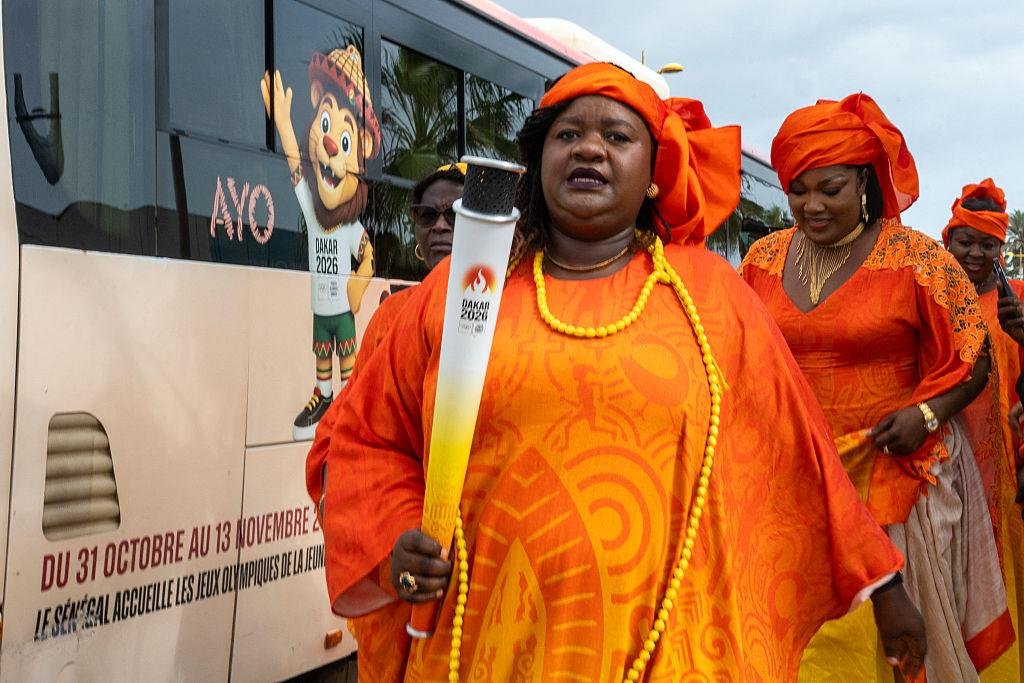
Senegal has begun a historic journey towards Africa’s first Olympic sporting event as the Dakar 2026 Youth Olympic Flame embarks on a 3,600-kilometre tour across the country, taking the Games beyond stadiums and into communities.
The Flame Tour, running from September 14 to October 30 under the theme “Pass the Energy,” will travel through all 14 regions of Senegal before returning to Dakar ahead of the opening of the Dakar 2026 Youth Olympic Games on October 31.
The tour is designed to build national excitement around the Games while using sport, culture and education to bring the Olympic movement closer to communities. The Flame was welcomed in Dakar on September 12 following its departure from Athens, where it was lit using the rays of the sun in accordance with Olympic tradition.
Its arrival was marked by the Marche des Linguères, a procession involving 100 Senegalese women representing different generations and sectors of society. The women carried the Flame to the Place du Souvenir Africain, where Senegalese basketball legend Mame Maty Mbengue lit the cauldron.
The national tour officially began on September 14 in Dakar Plateau before moving through other parts of the Dakar region. The Flame will spend September travelling through communities including Medina, Gueule Tapée, Almadies, Ngor, Yoff, Mermoz, Parcelles Assainies, Grand Yoff, Grand Dakar, Hann-Bel Air, Diamniadio and Keur Massar.
From September 29, the relay moves into Senegal’s wider regions, with stops including Thiès, Louga, Saint-Louis, Matam, Diourbel, Fatick, Kaolack, Kaffrine, Tambacounda, Kédougou, Kolda, Sédhiou and Ziguinchor. It will also pass through Saly, one of the territories hosting the Youth Olympic Games.
More than 400 torchbearers drawn from sport, culture, civil society and local communities are expected to participate in the relay, giving different parts of Senegal a visible role in the historic event.
Each regional stop will combine sporting activities, cultural performances, educational sessions and public entertainment, turning the torch relay into a community festival rather than simply a ceremonial procession. The approach reflects the wider ambition of Dakar 2026 to position young people at the centre of a sporting, cultural and educational celebration.
The Youth Olympic Games will run from October 31 to November 13 and are expected to bring about 2,700 athletes aged 15 to 18 together across 35 sports in Dakar, Diamniadio and Saly. For Senegal, however, the significance extends beyond the competition itself.
Hosting Dakar 2026 represents the first time an Olympic sporting event will be staged on African soil, allowing the country to showcase its sporting talent, culture and communities to an international audience.
The Flame Tour therefore serves as more than a countdown to the Games. By moving through Senegal’s regions, it is creating a national mobilisation around an event that could shape perceptions of Africa’s capacity to host major international sporting competitions.
The Flame will complete its national journey on October 30 in Dakar before taking centre stage at the opening ceremony the following day. By then, it will have travelled thousands of kilometres and passed through communities across Senegal, carrying with it the central message of Dakar 2026: “Pass the Energy.” For Africa, the symbolism is even bigger. The Flame is not only marking the countdown to another youth sporting competition. It is leading the continent towards a first in Olympic history.
