
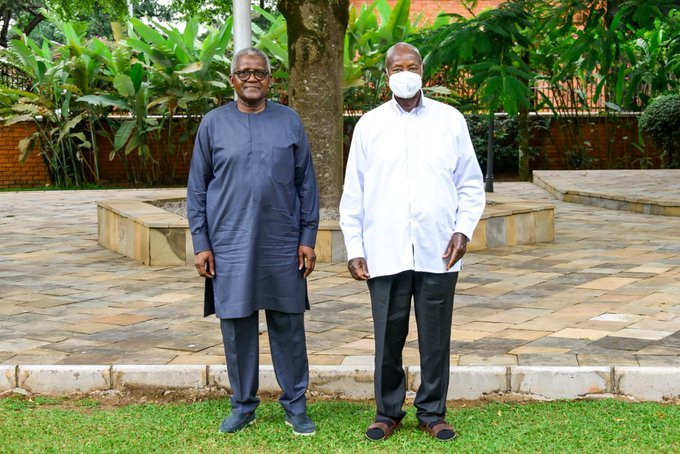
President Yoweri Kaguta Museveni has thrown Uganda’s full support behind a proposed 650,000 barrels-per-day East African regional oil refinery, telling African billionaire Aliko Dangote that Uganda is ready to help drive the project forward.
The high-level meeting held at State Lodge Nakasero on Sunday, May 17, 2026, signals a major strategic shift in how Uganda and the wider region want to manage oil resources: moving away from exporting raw crude toward refining, industrialisation, and regional value creation.
In his remarks after the meeting, Museveni reaffirmed Uganda’s long-standing position on value addition:
“From the very beginning, we have always opposed the export of raw materials without value addition. That is why Uganda delayed oil production because we insisted on first having a refinery.”
The proposed mega-refinery is about far more than fuel production. For Uganda, Kenya, Tanzania, and neighbouring markets, it represents a chance to build an integrated industrial ecosystem around energy. A large regional refinery could reduce dependence on imported petroleum products, improve energy security, stabilise fuel supply, and keep more value within East Africa’s economies.
For businesses and investors, the implications are substantial. Reliable access to refined petroleum products supports manufacturing, transport, logistics, agriculture, construction, and power generation. The project could also stimulate downstream industries such as petrochemicals, plastics, lubricants, fertilisers, and industrial chemicals.
Uganda’s support for the refinery also sends a broader signal to markets: the country wants to move beyond being a simple exporter of raw commodities and position itself as a regional industrial player.
“We cannot continue operating as fragmented and weak markets. If East Africa works together, such projects become more viable and beneficial to our people,” Museveni said.
Dangote’s involvement significantly raises the project’s credibility. Having delivered Africa’s largest refinery project in Nigeria, the businessman brings both capital and execution experience at a scale rarely seen on the continent. For institutional investors and financiers, this reduces some of the concerns that have historically slowed large infrastructure projects in Africa.
The timing is also important. Uganda is approaching first oil production, and decisions made now will shape whether the sector becomes a catalyst for industrialisation or another example of resource extraction with limited local benefit.
A successful regional refinery could help East Africa retain billions of dollars currently spent importing refined fuel. It could also improve trade balances, create thousands of direct and indirect jobs, and attract investment into infrastructure, engineering, logistics, and industrial services.
For Uganda specifically, the refinery strategy aligns with broader ambitions under industrialisation and value-addition policies. The government appears increasingly focused on ensuring that natural resources generate wider economic multipliers through local processing, manufacturing, and regional trade integration.
Still, the path ahead remains complex. Financing requirements will be enormous, and the project will require coordination between multiple governments, regulators, and private sector players. Questions around site selection, environmental safeguards, infrastructure connectivity, and regional political alignment will also need careful management.
Yet Museveni’s strong endorsement of both the regional refinery initiative and the ongoing Hoima refinery project suggests Uganda is pursuing a dual-track strategy: securing domestic refining capacity while also backing a larger regional industrial vision.
For investors, contractors, manufacturers, and energy companies, the message from Nakasero is increasingly clear: East Africa’s next growth phase will be built around larger regional markets, industrial infrastructure, and value-added production.
If successfully executed, the proposed mega-refinery could become one of the most transformative industrial projects in East Africa’s modern history, shifting the region from raw commodity dependence toward greater economic resilience, industrial capability, and strategic energy power.
