
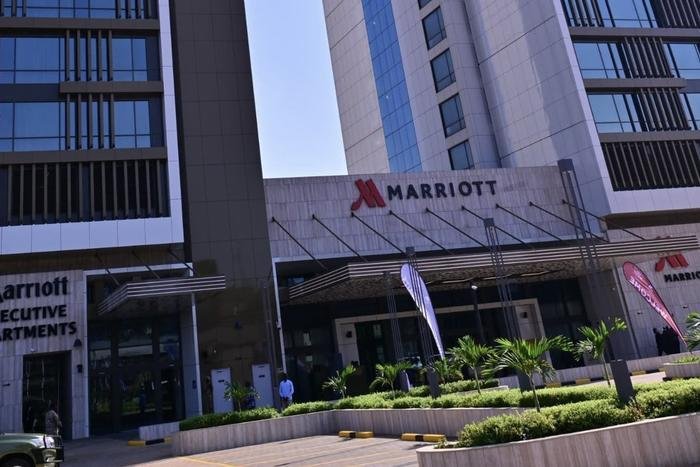
Parliament has questioned the National Social Security Fund’s (NSSF) decision to invest $50 million (about Shs185 billion) in the Kampala Marriott Hotel and Marriott Executive Apartments in Nsambya, demanding explanations over the property’s valuation, expected returns and protection of workers’ savings.
The questions were raised on Wednesday when NSSF Managing Director Patrick Ayota appeared before Parliament’s Committee on Commissions, Statutory Authorities and State Enterprises (COSASE), chaired by Muwada Nkunyingi. NSSF acquired a 30 per cent stake in CS Hospitality, the company behind the hotel development. The remaining 70 per cent is owned by businessman Ponsiano Ngabirano, founder of Capital Shoppers.
Lawmakers questioned whether the Fund conducted sufficient market research before committing the money, particularly given the prices at which other established hotels in Kampala have been valued or offered for sale.
Buzaaya County MP Martin Muzaale said the investment raised questions about the comparisons used to arrive at the purchase price.
“It defeats my understanding whether there was a market survey before going into this business. This price doesn’t seem to offer a useful comparison with the Marriott investment. NSSF seems to not have considered the performance and market value of established hotels in Kampala before committing the money,” he said.
The valuation question is central to determining whether the Fund paid a reasonable price for its stake and whether the expected income from the hotel justifies the amount invested. Ayota defended the transaction, saying the Fund’s assessment considered the hotel’s expected tourism income and future growth. He told MPs that the completed property has an estimated market value of $200 million.
He described the investment as one of NSSF’s strongest real estate deals, arguing that Uganda needs more high-end accommodation to attract large groups of visitors and retain business travellers.
“One of the studies we saw shows that a lot of people coming to the country were spending three to four days in Uganda, compared to five to seven in Rwanda or Kenya. One of the things Uganda has lacked is actually a very decent hotel that can accommodate big groups of tourists,” Ayota said.
The hotel development has 277 units, comprising 181 hotel rooms and 96 serviced apartments. NSSF’s argument is that the property will benefit from demand for premium accommodation, conferences and extended stays by visitors.
But MPs also questioned whether the Fund has enough influence over the business to protect its investment, given that it is a minority shareholder. Nkunyingi said the committee had received petitions from savers concerned about the safety of their contributions.
“People are sending in messages, these are the petitions, that NSSF also invested our money in Marriott. Let them assure us that our money is safe. You can find that you pay our money as the savers of the NSSF, and the shares are not protected,” he said.
NSSF’s senior manager for enforcement and litigation, Isaac Ogwang, told the committee that the Fund had secured contractual safeguards through the company’s governance documents. He said NSSF has two representatives on the five-member board and veto powers over selected decisions affecting the hotel’s operations. He added that changing the hotel operator, currently Marriott, would require approval representing at least 75 per cent of the company’s voting rights.
Ayota also explained that the investment passed through several approval stages before completion. These included the Money Banking Investment Committee, the board’s investment department, the full board, ministerial approval, and review of the contracts by the Attorney General.
“The way the fund invests, we have layers of approvals. It’s not a one-man decision; it first goes through the Money Banking Investment Committee, then the board’s Investment Department and the full board before being submitted to the minister for approval,” he said.
NSSF representatives also told the committee that the arrangement includes a 10-year revenue guarantee. The terms and conditions of the guarantee, including how the payments are calculated and what happens if the business underperforms, will be important in assessing the level of protection offered to the Fund.
The committee’s scrutiny has also extended to NSSF’s earlier investment in the hospitality sector. MPs directed the Fund to provide a detailed financial account of its 2007 acquisition of a 20 per cent stake in TPS (U) Limited, the company that operates Kampala Serena Hotel. NSSF bought the stake for $1.95 million at the time.
The committee wants the investment’s performance history to establish the returns generated over the years and assess whether the Fund has earned value from its participation in the hotel business. The review places two hospitality investments made nearly two decades apart under parliamentary scrutiny. The Serena records will offer MPs a basis for examining the Fund’s experience in the sector, while the Marriott transaction raises questions about the valuation and safeguards attached to a much larger investment.
For NSSF members, the key issue is whether the hotel will generate sufficient returns to justify the Shs185 billion commitment. The Fund’s explanations on approval procedures and shareholder protections address part of the concern, but the investment’s performance will ultimately depend on revenue, operating costs, occupancy, and the terms governing the relationship between the shareholders.
