
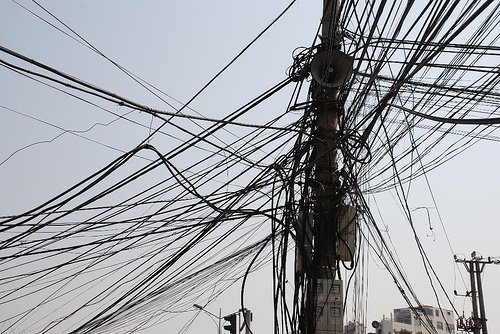
Kampala’s skyline has long been defined by a chaotic web of black cables hanging loosely between aging wooden poles. It is a familiar sight, but one that reflects deeper inefficiencies in urban planning. A recent inspection along Port Bell Road, however, signals that this era may be coming to an end. The Kampala Capital City Authority (KCCA) has issued a clear directive: telecom companies must abandon overhead cable installations and migrate to underground utility ducts integrated into new road infrastructure.
At first glance, this move appears to be a regulatory burden for telecom operators. That hesitation is not without reason. For years, overhead cabling has been the fastest and cheapest way to expand networks. Going underground requires coordination with road works, adherence to stricter standards, and a shift from quick deployment to long-term planning. It also reduces the level of independent control telecom companies have over how and when they roll out infrastructure, since they must now align with public infrastructure timelines.
However, the timing of this directive is not accidental. As Kampala accelerates its road upgrades and positions itself as a modern commercial hub, KCCA is embedding utility ducts directly into new road designs. This means the costly and disruptive process of digging up finished roads later can be avoided. In essence, telecom companies are being asked to transition now because the city is building the foundation for it in real time. Ignoring this shift would mean missing a rare window where the most expensive part of going underground, the civil engineering work, is already being handled.
Historically, stringing fiber optic cables on overhead poles was the fastest and cheapest way for internet service providers to expand coverage. It allowed companies to bypass the costs and delays associated with trenching and civil works. However, as Kampala continues to grow into a modern commercial hub, this “spaghetti network” has become increasingly problematic. It obstructs road expansion, creates safety risks, and undermines the visual appeal of the city, particularly in high-value commercial areas.
More importantly, it exposes a critical weakness in Uganda’s digital economy. Overhead cables are highly vulnerable to weather damage, vandalism, and accidental destruction. A single incident, such as a truck pulling down a fiber line, can disrupt operations for banks, factories, and logistics companies within minutes. In a digitally dependent economy, these interruptions carry real financial consequences.
Moving these networks underground addresses this vulnerability at its core. By embedding cables within protected utility ducts, the city effectively shields its digital infrastructure from surface-level risks. The result is a more stable and reliable network environment, which is essential for supporting business operations and economic growth.
For telecom companies, the shift is not just about compliance, it is a strategic advantage. Maintaining overhead networks is costly and unpredictable. Companies frequently deploy repair teams to fix cables damaged by storms, falling trees, or road accidents. Underground systems, by contrast, experience far fewer disruptions, significantly reducing maintenance costs and improving service reliability over time.
There is also the issue of theft and vandalism. Telecom infrastructure has long been a target, particularly where cables are easily accessible. Underground ducts create a more secure environment, making it much harder for vandals to access or tamper with network lines. This directly protects company assets and reduces recurring losses.
Perhaps the most overlooked benefit lies in infrastructure cost-sharing. Installing independent underground fiber routes is extremely expensive for any single telecom operator. However, by integrating utility ducts into public road projects, KCCA is effectively absorbing the most expensive part of the process, the civil engineering work. Telecom companies are then able to plug into this shared infrastructure at a fraction of the cost, lowering the barrier to network expansion.
What initially appears to be a constraint is, in reality, a coordinated infrastructure strategy that benefits both the city and the private sector. As KCCA continues to roll out road upgrades across Kampala, this model is likely to become standard practice. Future urban development will increasingly assume that utilities are not only modern but also invisible and protected.
For telecom operators, the implication is clear. Adapting to this underground system is no longer just about meeting regulatory requirements, it is about aligning with the future of urban infrastructure. In doing so, they stand to reduce costs, improve service delivery, and build more resilient networks.
In the long run, KCCA’s directive is not just about cleaning up Kampala’s skyline. It is about laying the foundation for a more efficient, secure, and investment-ready digital economy, one where the true value lies not in what is seen above ground, but in the infrastructure quietly powering it below.
