
With unemployment among young people continuing to rise in Uganda, stakeholders in the agricultural sector have urged youth to change their mindset and begin viewing agriculture as a profitable and sustainable business capable of creating jobs and wealth.
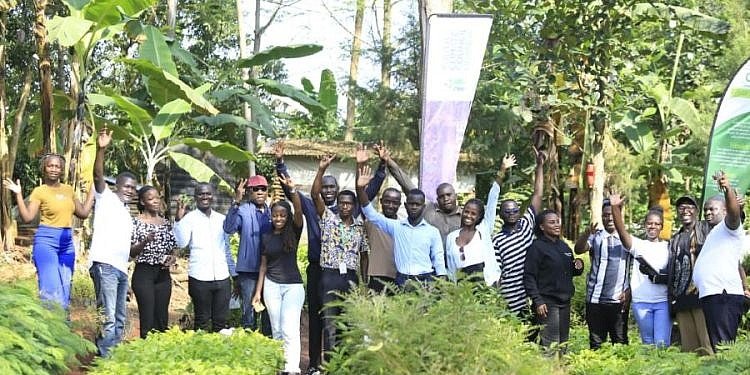
The call was made during a five-day circular regenerative agriculture mentorship programme organised by the Green Africa Youth Organization (GAYO) in partnership with Farm Radio International, Youth Climate Council Uganda, and Trinity Forestry Services. The programme brought together more than 200 young people from different parts of the country to equip them with knowledge and practical skills in modern agriculture.
According to Christopher Marvin Tumusiime, founder of Trinity Forestry Services, many young people shy away from agriculture due to long-standing negative perceptions that portray farming as a low-status activity meant for the uneducated.
“Many young people think agriculture is not a business. They see it the way our parents used to practice it—mainly for subsistence—and sometimes they even associate it with punishment in schools where children were forced to dig as a disciplinary measure,” Tumusiime said.
He explained that agriculture has greatly evolved and can generate significant income if approached professionally and managed as a business venture.
“Agriculture today is not just about digging. It involves innovation, technology, value addition and proper market planning. If young people adopt modern approaches and treat farming as an enterprise, they can earn a lot of money and create employment for others,” he added.
The training focused on circular regenerative agriculture practices that aim to restore degraded environments while improving agricultural productivity and building resilience against climate change. Tumusiime noted that regenerative agriculture promotes sustainable land use by integrating crops, trees and livestock in ways that support soil fertility, biodiversity and long-term productivity.
“We are training young people to adopt agricultural systems that ensure environmental restoration, increase productivity and support climate resilience and adaptation. Agriculture should not destroy the environment but rather protect and improve it,” he said.
Despite the vast opportunities in agriculture, Tumusiime pointed out that several barriers continue to limit youth participation in the sector. One of the major challenges is limited access to land and start-up capital, which makes it difficult for many young people to establish agricultural enterprises.
“Young people face serious obstacles such as lack of land and limited financial support. Many financial institutions hesitate to lend to them because they lack collateral or a track record in agribusiness,” he said. He also highlighted the lack of technical knowledge and limited market linkages as factors that discourage many young people from venturing into farming.
“Knowledge gaps and lack of reliable market networks can discourage young farmers from continuing in agriculture if they do not know how to market their products or access buyers,” he explained. During the mentorship programme, participants received training in agroforestry, soil and water conservation, integrated farming systems and strategies for developing profitable agribusiness ventures.
Jemimah Babirye Kasibbo, Lead Programs Officer at GAYO, said the initiative was designed to empower young people with skills that enable them to adopt environmentally friendly agricultural practices while improving their livelihoods.
“Circular regenerative agriculture restores the environment while supporting sustainable livelihoods. We want young people to adopt farming practices that protect nature while also earning income from agriculture,” she said.
Kasibbo added that the programme also aims to build a new generation of young farmers who understand the importance of sustainable farming in addressing climate change and food insecurity.
Meanwhile, Leticia Ahirirwe, an agriculture scientist and co-founder of the Food and Agribusiness Management Association of Uganda, emphasised the need for young farmers to combine indigenous knowledge with modern agricultural technologies.
According to Ahirirwe, traditional farming practices developed by local communities over generations can play an important role in protecting ecosystems and improving soil health.
“Many young farmers tend to ignore indigenous knowledge and focus only on modern technologies. However, indigenous knowledge has a lot to offer in terms of protecting land, conserving biodiversity and sustaining agricultural productivity,” she said.
She encouraged young people to take advantage of available opportunities in agriculture, noting that even small pieces of land can be used productively with the right planning and management.
“You can carry out many profitable agricultural projects even on a small piece of land. Agriculture is not a dirty job as many people think. It is a respectable and rewarding profession that can transform lives if approached with the right mindset,” Ahirirwe added.
Participants at the training expressed optimism that the knowledge and skills acquired would help them start or improve their agricultural enterprises, contributing to job creation, food security and environmental sustainability.
