
For any public project to succeed and deliver value for money, it must undergo rigorous evaluation backed by strong political leadership.
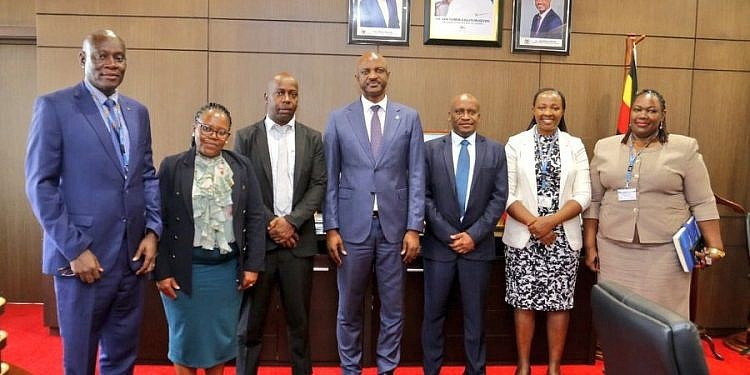
This message was emphasized by Ramathan Ggoobi, Permanent Secretary and Secretary to the Treasury (PSST) at Ministry of Finance, Planning and Economic Development, while addressing a delegation of senior government officials from Botswana’s Ministry of Finance.
The Botswana delegation was in Uganda on a peer learning mission aimed at strengthening Public Investment Management (PIM) systems and enhancing fiscal discipline in public expenditure. Ggoobi welcomed the officials and stressed that no project can succeed without strict adherence to evaluation standards and unwavering support from top political leaders.
“Projects must undergo rigorous evaluation to succeed,” Ggoobi noted, adding that political backing ensures that technically sound projects are protected from undue influence and implemented as designed. He explained that strong leadership provides direction, enforces accountability, and safeguards public resources from waste.
Ggoobi underscored the importance of building institutional capacity to sustain effective PIM systems. He said while policies and frameworks are critical, they can only function well if government technical officers are adequately trained and empowered to implement them.
“Our technical teams must not only master project appraisal methodologies but also cascade this knowledge across ministries, departments, and agencies,” he said. According to the PSST, equipping officers with skills in project identification, feasibility analysis, cost-benefit assessment, and risk evaluation is essential to ensuring that only viable and impactful projects are approved.
Uganda has, over the years, strengthened its project management systems by establishing structured frameworks to improve transparency, coordination, and accountability. Among these is the Integrated Bank of Projects, a centralized database designed to track and manage public investment proposals. The system ensures that projects are thoroughly appraised before they are admitted into the national budget.
In addition, the Development Committee plays a key gatekeeping role by scrutinizing project proposals to confirm their alignment with national priorities and fiscal sustainability. This process helps prevent politically attractive but economically unviable projects from consuming scarce public resources.
Ggoobi also highlighted Uganda’s approach of co-investing with the private sector as a strategy to mobilize additional resources while sharing risks. Public-Private Partnerships (PPPs), he said, have become an important avenue for delivering infrastructure and social services without placing excessive strain on the national budget.
The Botswana delegation expressed interest in understanding how Uganda manages the entire project cycle — from project identification and appraisal to implementation, monitoring, and fiscal oversight within expenditure ceilings. They were particularly keen on learning how Uganda rationalizes a bloated project portfolio amid budget constraints and ensures strict appraisal before approval.
The visiting team comprised Deputy Director Development Budget Edwin Tebangwa, Chief Economist Moemodi Max Sebudubudu, and Principal Economist Dimpho Baleseng. During their visit, they held discussions with Ggoobi alongside Acting Director Budget Hannington Ashaba and technical officers from the Projects Analysis and Public Investment Department.
Officials said Botswana is seeking practical insights into how Uganda manages its project database, integrates planning with budgeting, and enforces compliance with PIM guidelines. The peer exchange reflects growing regional cooperation in public financial management, as African countries increasingly recognize the need to maximize returns on limited public funds.
Experts note that weak project appraisal often results in cost overruns, stalled projects, and limited socio-economic impact. By contrast, rigorous evaluation ensures that projects are economically viable, socially beneficial, and fiscally sustainable.
Ggoobi reiterated that strengthening PIM systems is not a one-time reform but a continuous process that requires political will, technical expertise, and institutional discipline. “When evaluation is taken seriously and supported at the highest level, public investments can transform economies and improve citizens’ livelihoods,” he said.
The visit marks another step in knowledge-sharing among African governments committed to improving governance, enhancing accountability, and ensuring that every public shilling delivers measurable development outcomes.
