
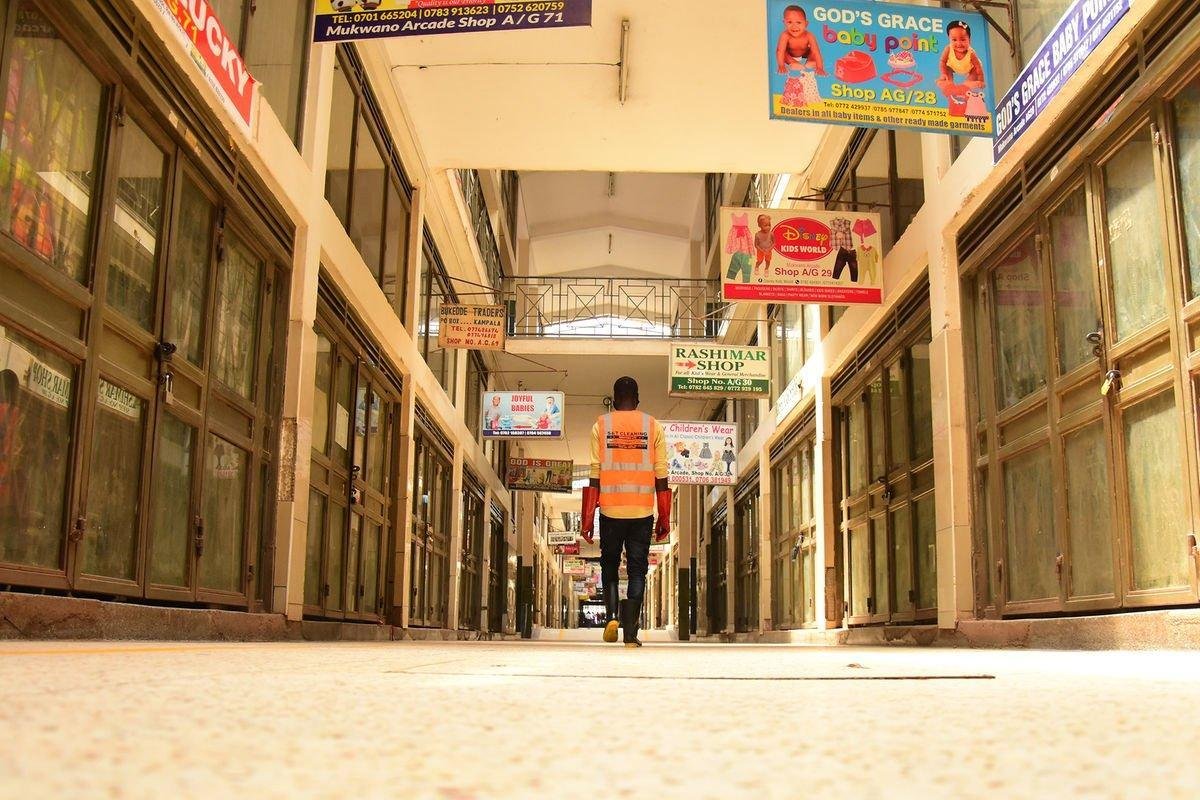
On Tuesday morning, November 17, downtown Kampala’s usually busy commercial streets presented an unusual picture. Metallic shutters remained locked across several shopping arcades, including Skylight, Dembe, Bypass, Nabukera, Pentagon, Qualicel, Mini Price and Park View, as well as sections of Nabugabo Road and Kampala Road. Outside the closed shops, traders sat on plastic chairs, waiting as police and security personnel maintained a heightened presence.
The closures marked the beginning of a month-long sit-down protest called by the Kampala City Traders Association (KACITA), led by acting chairman Hajji Issa Sekitto, over what traders describe as increasingly difficult operating conditions arising from tax assessments, customs clearance procedures and enforcement by the Uganda Revenue Authority (URA).
But the shutdown was far from universal. While several arcades participated, businesses at Mutaasa Kafeero Plaza, Pioneer Mall, Royal Complex and City Base Plaza continued operating after their respective leaders advised members against joining the protest.
The dispute comes at a particularly sensitive time for Uganda’s retail sector. With less than six weeks to Christmas, traders are approaching one of the busiest periods of the commercial calendar, when increased consumer spending traditionally provides an opportunity to recover capital, clear inventory and generate a substantial share of annual sales.
For businesses already dealing with rent, salaries, loan repayments and the cost of importing merchandise, an extended shutdown could create another layer of financial pressure. Yet traders participating in the protest argue that remaining open under the prevailing tax and customs arrangements is becoming equally difficult.
The cost of doing business at the centre of the dispute
At the heart of the disagreement is the cost of importing and selling merchandise in Uganda, particularly for small and medium-sized businesses that depend on regular stock turnover.
Traders have accused URA of applying customs valuations that disregard genuine supplier invoices in favour of higher reference values, resulting in increased import duty and Value Added Tax (VAT) obligations.
They argue that the practice makes it difficult to predict the actual cost of bringing goods into the country, complicating pricing decisions and reducing profit margins.
Customs clearance delays have added to those concerns. Importers say consignments can remain in bonded warehouses or at entry points for extended periods while awaiting verification and valuation decisions. During this time, businesses continue accumulating storage and demurrage charges, while money invested in merchandise remains tied up in goods that cannot be sold.
Changes to cargo clearance procedures have also become a major point of contention.
Traders have questioned the transition from the previous PB4 clearance framework to the WT8 system, arguing that the changes have complicated the importation of consolidated cargo. They have also raised concerns about restrictions affecting groupage, a common arrangement through which smaller importers combine their merchandise in shared shipping containers to reduce transportation costs.
Additional complaints concern the treatment of textiles transported across borders by passenger buses and procedures affecting goods routed through Kenya and Tanzania.
For smaller importers, these arrangements are particularly important because they provide an alternative to financing and importing entire containers independently.
The traders also accuse URA enforcement teams of impounding trucks and containers, seizing merchandise and imposing penalties in circumstances they consider excessive.
EFRIS remains a major flashpoint
Beyond customs administration, the Electronic Fiscal Receipting and Invoicing Solution (EFRIS) remains another significant source of friction between traders and URA.
The system, which enables electronic recording and monitoring of business transactions, has faced resistance from sections of the retail community since its introduction.
Traders argue that its implementation creates additional compliance costs and administrative demands, particularly for smaller businesses that lack the financial and technical capacity to maintain digital invoicing systems.
They have also complained about penalties arising from compliance failures and enforcement actions involving merchandise and trucks, including cases where importers maintain that the relevant taxes have already been paid.
Plans to extend EFRIS requirements to rental transactions have further heightened concerns. Traders fear that requiring commercial landlords to issue electronic receipts for rent payments could translate into higher rental costs as landlords pass additional compliance expenses on to tenants.
The disagreement echoes the April 2024 EFRIS-related standoff, when resistance from traders prompted presidential intervention and temporary administrative concessions.
However, URA maintains that EFRIS does not introduce a new tax or change existing statutory tax rates. Instead, the authority says the system is intended to improve record-keeping, strengthen VAT compliance and ensure that taxes collected from consumers are properly remitted to government.
A divided business community
Although KACITA has called for a month-long nationwide shutdown, the response has exposed significant divisions within Uganda’s trading community.
The National Entrepreneurs and Traders Association (NETA Uganda), led by Dr Thadeous Musoke Nagenda, has distanced itself from the action, arguing that businesses cannot afford to lose additional trading days when they are already facing high operating costs, declining sales, expensive credit and increasing tax compliance obligations.
The Federation of Uganda Traders Associations (FUTA) and MBACITA have also opposed the shutdown approach, favouring continued business operations alongside structured engagement with government.
The Mbarara City Traders Association has similarly distanced itself from the planned closure, saying its members were not adequately consulted before the decision was made.
Their position reflects concerns that shutting shops during the festive season could worsen the financial circumstances of businesses already servicing commercial loans and meeting other operating obligations.
The divisions have also played out at arcade level, where some traders have reportedly faced verbal pressure and intimidation over their decision to remain open.
Watchdog Uganda reported on November 15 that a message circulating among traders warned of a 10 per cent rent increase for businesses that continued operating during the protest. The claim had not been independently confirmed by the landlords concerned.
For traders who have not joined the shutdown, the situation presents a difficult choice between protecting their daily income and navigating pressure from sections of the business community supporting the action.
How talks between traders and URA broke down
The November 17 protest followed nearly two weeks of unsuccessful attempts to resolve the disagreements through dialogue.
On November 5, traders held a crisis meeting in Kampala and subsequently notified police of their intention to stage a peaceful sit-down protest.
A critical engagement with URA at its Nakawa headquarters on November 10 failed before substantive discussions could begin. Members of the KACITA delegation objected to a security requirement to surrender their mobile phones before entering the meeting and subsequently walked out.
URA later alleged that disruptive elements had been hired to infiltrate and destabilise the engagement.
Efforts to arrange another meeting subsequently encountered difficulties over timing and protocol. An earlier engagement was also affected by the bereavement of URA Commissioner General John Musinguzi Rujoki’s mother.
On November 16, URA issued another invitation for talks, but KACITA acting chairman Hajji Issa Sekitto declined, citing the short notice and the absence of a clear commitment to suspend the enforcement measures being contested by traders.
The following morning, traders began closing their businesses.
Government moves to contain the dispute
The scale of the closures quickly attracted political and government attention.
President Yoweri Museveni directed Prime Minister Robinah Nabbanja to engage trader representatives and relevant government agencies to address their concerns and restore normal business operations.
Minister of State for Finance Henry Musasizi subsequently convened an emergency meeting involving URA leadership and KACITA representatives, scheduled for Thursday, November 19.
Broader consultations involving other trader associations were also arranged through the Office of the Prime Minister, reflecting the need to accommodate business groups that have rejected the shutdown approach.
The dispute also featured prominently in parliamentary discussions on Tuesday.
Leader of the Opposition Joel Ssenyonyi called on government to change its approach to taxpayers, arguing that businesses should be treated as clients rather than adversaries.
He questioned why traders had to close their businesses to secure government attention, pointing to customs clearance delays, unpredictable tax assessments and concerns about foreign operators competing directly with local retailers.
Forum for Democratic Change leader Patrick Oboi Amuriat also criticised the circumstances surrounding the protest, linking the dispute to broader economic pressures affecting Uganda’s urban business community.
URA defends its enforcement approach
While traders say the current tax and customs environment is making business increasingly difficult, URA has maintained that its enforcement measures are necessary to protect government revenue and address longstanding compliance gaps.
The authority argues that stronger verification of imported goods is intended to prevent under-declaration of merchandise and ensure that importers pay the correct duties and taxes.
On consolidated cargo, URA has maintained that legitimate groupage arrangements have not been prohibited. Rather, its position is that enforcement is targeting intermediaries and container operators who allegedly exploit weaknesses in cargo verification to conceal merchandise or misdeclare imported goods.
The authority has similarly defended EFRIS as a compliance mechanism rather than an additional tax, arguing that digital invoicing improves transparency and reduces opportunities for VAT evasion.
The disagreement therefore reflects two competing concerns: traders want predictable, affordable and efficient systems that allow businesses to operate profitably, while URA insists that stronger enforcement is necessary to close revenue leakages and improve tax compliance.
A test for government and the private sector
The immediate challenge is whether Thursday’s meeting between government, URA and KACITA can produce practical commitments that address the traders’ concerns.
The issues requiring attention extend beyond EFRIS to include customs valuation, clearance timelines, groupage arrangements, enforcement procedures and the cost of compliance for smaller businesses.
There are also wider questions about competition in downtown Kampala, where local traders have raised concerns about foreign operators, particularly Chinese nationals, moving into direct retail trade. They argue that some foreign businesses benefit from preferential treatment or tax concessions, although such allegations require examination by the relevant authorities.
Other complaints involving textile smuggling and irregularities in container loading point to concerns about unequal enforcement, with compliant importers questioning how illicitly imported goods reach the market at prices they cannot compete against.
For government, the timing makes a prolonged dispute particularly costly. A sustained shutdown would affect not only shop owners but also employees, suppliers, transporters, landlords and customers who depend on the continued operation of Kampala’s commercial centre.
For traders, however, the immediate decision is whether to continue withholding their businesses from the market or return to trading without the assurances they have been seeking.
As negotiations approach, the central question is no longer simply whether downtown Kampala will reopen. It is whether government and the trading community can agree on a tax and customs administration framework that protects public revenue without undermining the businesses responsible for generating it.
