
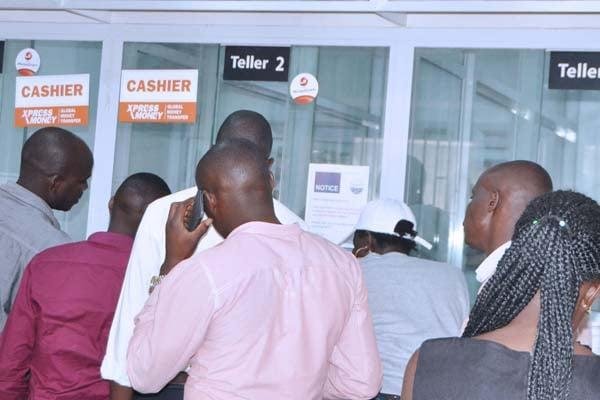
Your bank account tells a story that extends far beyond how much money you earn. It records the business you run, the loans you receive, the savings you accumulate and the money you send to family. For Uganda’s tax authorities, those transactions could offer valuable clues about undeclared income. For the account holder, they represent some of the most sensitive details of private financial life.
That is the tension at the centre of the government’s renewed push to secure parliamentary approval for the Uganda Revenue Authority (URA) to access individual bank accounts. Finance State Minister Amos Lugoloobi has told Parliament that the government will continue pursuing the necessary legal authority, reviving a dispute that previously ended in a significant Constitutional Court defeat.

The government’s objective is straightforward: collect more of the taxes legally due, strengthen compliance and reduce the country’s dependence on borrowing and external financing. The difficulty lies in determining whether broader access to banking information would deliver meaningful revenue gains without undermining the constitutional protections and public trust on which the formal financial system depends.
The question, therefore, is not simply whether URA should be allowed to see your bank account. It is when the authority should be allowed to see it, what evidence should justify access and who should ensure that the power is not abused.
Why URA wants a closer look at your money
Uganda’s tax-to-GDP ratio has remained around 13–14% in recent assessments, while the government is targeting 20% by the 2029/30 financial year. The gap reflects a broader fiscal challenge: raising sufficient domestic revenue to finance public services, infrastructure and debt obligations without placing ever-greater pressure on borrowing or introducing additional taxes.
Improving compliance among existing taxpayers offers one way to narrow that gap. Rather than relying exclusively on higher tax rates or new levies, the government wants to identify income that should already be declared and taxed under existing laws.
But much of Uganda’s economic activity remains difficult to capture through conventional tax records. Informal businesses, self-employed workers and cash-based traders may have limited engagement with formal institutions. Transactions conducted entirely in cash can leave little documentary evidence for investigators.
Bank accounts offer a potential source of additional information. Where business revenue passes through the financial system, URA could compare transaction patterns with declared income and investigate discrepancies that warrant further scrutiny.

That does not mean every deposit is taxable income. Money entering an account could represent a loan, a transfer between personal accounts, accumulated savings or funds received on behalf of another person. Establishing a tax liability requires evidence about the transaction and the applicable law.
The case for access is strongest when financial information helps investigators establish genuine non-compliance. It is weaker when the mere existence of a transaction or a substantial account balance is treated as evidence of tax evasion.
For the government, the challenge is to make tax enforcement more effective. For taxpayers, it is to ensure that the pursuit of revenue does not turn ordinary banking activity into grounds for suspicion.
The court case that changed the rules
Uganda has confronted this question before, and the outcome remains central to the current debate.
In March 2018, URA issued notices requiring commercial banks and other financial institutions to provide detailed information on accounts held between January 2016 and December 2017. The requests covered account numbers, balances, deposits and withdrawals, signatories and taxpayer identification details.
The notices were broad. They sought information across a large population of account holders rather than limiting requests to individuals already linked to specific investigations.
The Uganda Bankers Association and affected financial institutions challenged the notices in the Constitutional Court in ABC Capital Bank Ltd & 30 Others v Attorney General & Commissioner General, Uganda Revenue Authority, Constitutional Petition No. 14 of 2018.
In March 2023, the court held that the blanket notices violated Article 27(2) of the Constitution, which protects the right to privacy. It declared the notices unconstitutional, null and void.
The judgment did not eliminate URA’s statutory powers to obtain banking information for legitimate investigations. Instead, it rejected the indiscriminate approach used in the notices, reinforcing the need for an adequately justified and appropriately targeted basis for accessing sensitive financial records.
That distinction matters. The court did not establish that bank accounts are beyond the reach of tax investigators. It established that the government’s revenue objectives do not automatically override constitutional privacy protections.
The ruling also creates a test for any new legislation. Parliament must consider whether the proposed framework would enable properly grounded investigations or recreate broad access to financial information without sufficient justification.
Passing a new law would not, by itself, settle every constitutional question. The scope of the powers, the conditions governing their use and the safeguards against abuse would remain critical.
Does your NIN give URA access to your account?
The renewed debate has coincided with Uganda’s transition from Tax Identification Numbers (TINs) to National Identification Numbers (NINs) for individual taxpayers.
The reform is intended to improve taxpayer identification, eliminate duplicate registrations and create a more consistent register of individuals. By linking records to a common identifier, URA can more easily distinguish taxpayers and match information held across different systems.
As of 30 September 2026, the authority had reportedly linked approximately 2.13 million NINs to existing TINs out of about 5.4 million individual taxpayer records. That represents roughly 39.4% of the register. Officials also reported identifying nearly 192,000 duplicate records during the 2025/26 financial year.
But better identification does not automatically create a tax obligation, establish undeclared income or grant URA unrestricted access to an individual’s bank account.
Lugoloobi has sought to make that distinction clear. The NIN identifies the person; applicable tax laws determine whether that person owes tax and how much is payable. Broader access to bank information would require separate legal authority.
The distinction is important because a unified identification system can improve the administration of existing tax obligations without changing the underlying rules governing who must pay tax.
It can also make it easier for authorities to compare information from different sources. That is where the NIN transition intersects with the government’s wider ambition to expand access to financial data.
The technology may make matching records easier. The law must still determine which records can be accessed, for what purpose and under what conditions.
Uganda is already looking beyond its borders
The push for domestic banking information forms part of a wider shift towards data-driven tax enforcement.
Through the Automatic Exchange of Information framework, Uganda can receive specified financial account information from participating foreign jurisdictions. The country established a domestic legal basis for this system through the Convention on Mutual Administrative Assistance in Tax Matters (Implementation) Act, 2023, and commenced exchanges in September 2025.
In mid-October 2026, Lugoloobi told Parliament that preliminary analysis of the first exchange had identified approximately 120,000 offshore financial accounts associated with Ugandan tax residents. Their combined reported value was about Shs 7 trillion, linked to roughly 20,000 uniquely identified taxpayers.
The figures illustrate the potential reach of international information-sharing arrangements. URA can use the information to investigate whether relevant assets and income have been properly declared under Ugandan tax laws.
But an offshore account is not, by itself, evidence of tax evasion. Some accounts may be entirely legitimate, and reported account values are not equivalent to taxable income.
The value lies in the ability to investigate discrepancies and establish whether tax obligations have been met.
Domestic bank information could complement these international exchanges, allowing URA to compare declarations against additional records. Combined with improved taxpayer identification, the approach would give the authority more tools to identify potential non-compliance.
It would also increase the importance of rules governing access, interpretation, confidentiality and the ability of taxpayers to challenge incorrect conclusions.
The broader trend is clear: tax administration is becoming increasingly dependent on information gathered from sources beyond the taxpayer’s own declaration. The challenge is ensuring that the expansion of information access is matched by equally credible safeguards.
What happens if people stop trusting their banks?
The consequences of the proposed legislation would extend beyond URA and its investigations.
Banks depend on customers being willing to deposit savings, conduct transactions and use formal financial services. Their ability to mobilise deposits and extend credit supports businesses, investment and economic activity.
Customers understand that banking information may be disclosed under lawful circumstances. The concern arises when the boundaries of disclosure become unclear or when access appears excessively broad.
If people begin to believe that ordinary banking activity exposes them to arbitrary tax scrutiny, some may choose to hold more cash, reduce their use of formal accounts or move transactions into less transparent channels.
Such a response is not inevitable. It would depend on the final legislation, the safeguards in place and how authorities exercise their powers. But it presents a risk that policymakers cannot ignore.
A policy intended to improve tax compliance could become counterproductive if it weakens confidence in the formal financial system or discourages businesses from formalising their operations.
There is also a practical consideration. Giving URA access to more information does not guarantee that the authority can analyse it effectively. Broad requests may produce large volumes of data, increase administrative costs and generate disputes over transactions that have legitimate explanations.
A targeted approach could concentrate investigative resources on credible risks and produce more useful evidence. That would potentially benefit both revenue collection and the protection of compliant taxpayers.
The objective should be to make tax enforcement more precise, not merely more intrusive.
What should Parliament demand?
The debate should move beyond whether the government deserves greater access to financial information and focus on the conditions under which that access would be justified.
First, Parliament should establish a clear threshold for requests. The framework must distinguish investigations into suspected non-compliance from general searches across the banking population.
Second, it should define who authorises access and what independent oversight is available. Judicial authorisation or another credible review mechanism could help ensure that requests are justified and proportionate.
Third, the law should limit the information collected to what is relevant to a legitimate investigation. Access should not become an open-ended entitlement to examine a person’s financial history.
Fourth, strict confidentiality and data-security requirements should govern how information is stored, used, shared and retained. There should be meaningful consequences for unauthorised access or disclosure.
Finally, taxpayers should have effective ways to challenge unlawful requests or incorrect assessments, while appropriate oversight bodies should be able to examine how the powers are being exercised.
These safeguards would not prevent URA from pursuing tax evasion. They would establish the legal conditions under which it could do so while protecting individuals from unnecessary intrusion.
Parliament should also require the government to explain what additional revenue it expects the powers to generate, how that estimate was reached and why existing mechanisms are insufficient. The case for expanding state powers should rest on demonstrable benefits, not simply on the assumption that more data will produce more tax.
So, should URA be able to see your bank account?
The answer depends on what access means.
If it means obtaining relevant banking information through a properly justified investigation, under clear legal authority and with effective safeguards, there is a strong case for enabling the tax authority to pursue genuine non-compliance.
If it means indiscriminately accessing the financial records of individuals without a sufficient basis, the constitutional and economic risks are far greater.
Uganda needs to raise more domestic revenue. Better taxpayer identification, international information exchange and carefully targeted access to financial records could help the government achieve that goal. But none of these tools removes the need for due process or guarantees that additional information will translate into higher collections.
Lugoloobi has indicated that the government will continue returning to Parliament until it secures the necessary legal authority. The next stage of the debate will determine whether lawmakers can design a framework that improves enforcement without repeating the mistakes identified by the Constitutional Court.
For taxpayers, the issue is the protection of financial privacy. For banks, it is the confidence that makes formal financial services viable. For the government, it is whether a more data-driven tax system can deliver sustainable revenue gains.
The real test is not whether URA can see more bank accounts. It is whether the authority can collect taxes that are legally due without turning financial privacy into a casualty of revenue mobilisation.
