

Imagine an organisation preparing to close the year.
Leadership has reviewed performance. Employees have completed the engagement survey. Managers have held team meetings. The communication team has gathered feedback, compiled the findings and presented its report.
The process appears complete.
But somewhere in the organisation, an employee is still waiting for an answer to a concern raised months ago. A manager knows that a particular process is frustrating the team but has stopped escalating it. Another employee has noticed a recurring problem affecting customers but wonders whether speaking up will make any difference.
The organisation has collected the feedback. Has it listened?
There is a difference, and it matters more than we sometimes acknowledge.
The silence after the survey
Many organisations have become better at asking employees what they think. There are engagement surveys, town halls, focus groups, suggestion boxes, pulse surveys and open-door policies. The channels exist. The invitations to speak are sent.
Yet the existence of a channel does not guarantee that people will use it honestly. And even when they do, it does not guarantee that anything will happen.
Sometimes employees are afraid of the consequences of speaking. In other situations, they simply do not know where to raise a concern. But there is another, important reason for silence: they have spoken before, and nothing changed.
The Chartered Institute of Personnel and Development (CIPD) identifies both fear of negative consequences and the belief that speaking up is futile as barriers to employee voice. When employees see no meaningful response to previous contributions, they may become less willing to speak again.
This is an important distinction. An organisation may believe it has a listening problem because employees are not speaking. In reality, it may have a response problem because employees no longer believe speaking will make a difference.
An invitation to speak is only the beginning of a conversation.
What the evidence tells us
Gallup’s Employee Engagement Strategies for 2026 presents a sobering picture of the US workplace. Its February 2026 findings show that only 27% of employees strongly agreed that their opinions count at work. Fewer than half—49%—strongly agreed that they knew what was expected of them.
These figures relate to US employees, not Ghanaian or African workplaces, and should be interpreted accordingly. Nevertheless, they raise questions worth examining in any organisation: Do employees understand what is expected of them? Do they believe their perspectives matter? Can they see how their contributions influence decisions?
Research published in Harvard Business Review in November 2024 examined the challenge organisations face after collecting employee feedback. Leaders may invest considerable effort in listening activities but struggle to translate what they hear into meaningful insights and concrete action. Over time, that gap can undermine the value of feedback and discourage further participation.
The problem, then, is not simply whether organisations listen. It is whether listening leads somewhere.
When feedback fails, the consequences travel
Consider what happens when an employee repeatedly flags a problem with a process, but the concern remains unresolved.
The employee may eventually stop raising it. The manager may work around it. Another department may develop its own workaround. Before long, several teams are adapting individually to a problem that nobody is addressing collectively.
The customer, meanwhile, experiences the consequences: delays, inconsistent information, a repeated request for the same details, or a service failure that seems inexplicable from the outside.
This is where internal communication becomes more than the circulation of messages. It becomes part of how an organisation identifies problems, shares knowledge and coordinates its response.
Feedback must travel upwards, but it must also move across departments. A concern raised by a frontline employee may require action from operations, human resources, technology or senior management. If the information stops at the manager’s desk, disappears into a report or becomes trapped within a department, the organisation loses an opportunity to learn.
The result is a workplace where people are busy responding to symptoms while the underlying problem remains untouched.
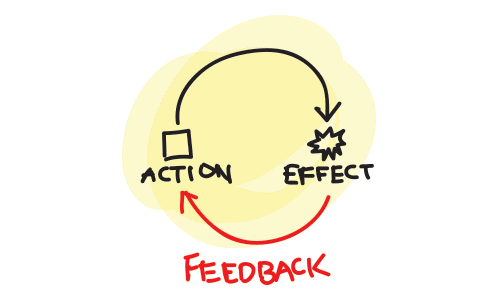
Closing the loop is a leadership responsibility
Closing the feedback loop does not mean every employee suggestion must be adopted. Some proposals will be impractical. Others may conflict with organisational priorities, budgets or legal obligations.
What matters is that the organisation responds.
Employees should know what was heard, what action will be taken, who is responsible and, where action is not possible, why. Even an explanation that a suggestion cannot be implemented is more meaningful than silence.
This requires more than a survey platform. It requires clear responsibilities, managers who can handle difficult conversations, channels that employees trust and a process for connecting feedback to decisions.
It also requires communication professionals to look beyond participation rates and the number of responses collected. Those figures tell us whether people engaged with a process. They do not tell us whether the process made a difference.
Before you ask employees for feedback again
As organisations review the year and prepare their priorities for 2027, there are five questions worth asking:
- Access: Do employees know where and how to raise concerns, including sensitive ones?
- Trust: Do they believe they can speak honestly without fear of negative consequences?
- Response: Is there a clear process for acknowledging, evaluating and responding to feedback?
- Connection: Can concerns raised in one team reach the people and departments responsible for addressing them?
- Evidence: Do we communicate what changed as a result of employee feedback—and explain when change is not possible?
These are not merely questions about employee engagement. They are questions about how effectively an organisation communicates, learns and works as one.
An open door is a policy. Trust is a climate. And a feedback channel, however sophisticated, is only as credible as the response that follows.
As an Internal Communication Consultant, I work with organisations to strengthen the systems behind effective workplace communication from manager communication and employee feedback mechanisms to the connections between teams and the quality of communication that ultimately reaches customers. For organisations reviewing their internal communication priorities for 2027, this is an opportunity to examine not only how they communicate, but whether their communication is producing the understanding, responsiveness and coordination their work requires.
Because the real measure of listening is not how many people spoke.
It is what became possible because they did.
