
For decades, internal communication has suffered from an image problem. Too often, it has been confined to company newsletters, occasional town hall meetings, and routine HR announcements. In many organizations, it is viewed as an administrative function rather than a strategic capability.
That perception is costing African organizations one of their most valuable competitive advantages: their people.
As businesses across Sub-Saharan Africa navigate rapid digital transformation, globalization, workforce diversification, and evolving employee expectations, a critical gap has emerged. Organizations are changing faster than their internal communication systems can adapt. The result is a growing disconnect between leadership intentions and employee experiences, one that directly affects trust, engagement, productivity, and organizational performance.
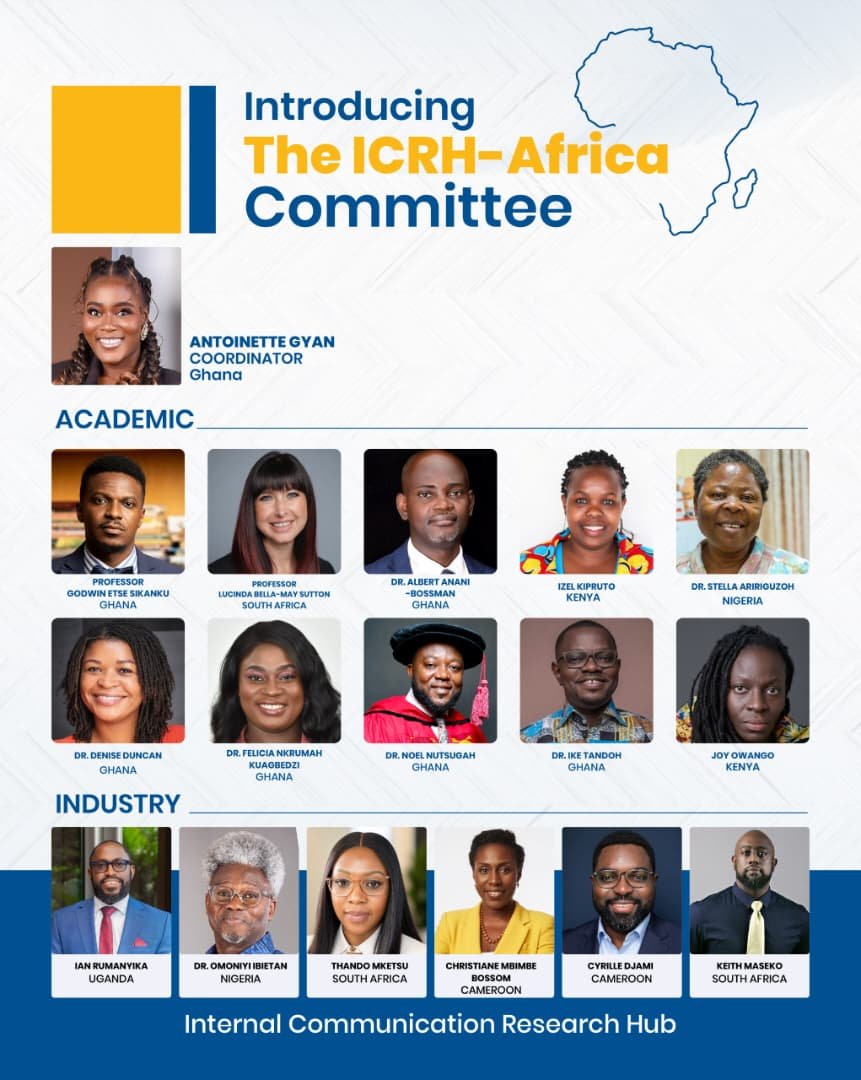
Recognizing this challenge, the Internal Communication Research Hub Africa (ICRH-Africa) has been established as Sub-Saharan Africa’s first dedicated academic and research platform focused exclusively on workplace communication. Headquartered at the University of Media, Arts and Communication (UniMAC) in Accra, Ghana, and connected to the Internal Communication Research Hub Global (ICRH Global) at the University of Florida, the initiative seeks to generate evidence-based insights that reflect the realities of African workplaces while contributing African perspectives to global conversations on organizational communication.
Across the continent, organizations invest heavily in external branding, marketing, customer engagement, and public relations. Yet the internal systems responsible for aligning employees with strategy often receive far less attention. This imbalance creates a hidden organizational risk.
“Internal communication is often treated as a secondary function, yet it directly shapes how organizations function, transform, and perform,” says Cyrille Djami, Head of Communications at ICRH-Africa. “In many African contexts, it remains a blind spot in both research and practice.”
When internal communication is weak, the consequences may not be immediately visible, but they are significant. Employees who feel uninformed or disconnected from leadership are less likely to trust organizational decisions. As trust declines, engagement suffers, productivity falls, collaboration weakens, and resistance to change increases.
The challenge is even more pronounced in African workplaces, where communication takes place within rich multicultural and multilingual environments. Many of the communication frameworks used by organizations across the continent were developed in Western contexts that assume relatively homogeneous workforces and a shared corporate language. While these models offer useful insights, they often fail to account for the linguistic, cultural, and social realities that characterize African organizations.
Periods of organizational transformation frequently expose these weaknesses. Whether implementing digital systems, restructuring operations, or introducing new strategic priorities, organizations depend on effective communication to secure employee understanding and commitment. Without transparency, dialogue, and meaningful employee voice, even the most carefully designed transformation initiatives can struggle to gain traction.
Historically, communication professionals and HR leaders across Africa have relied heavily on research, frameworks, and case studies developed in North America and Europe. Yet a communication strategy designed for a corporate office in Chicago cannot simply be replicated across organizations operating in Accra, Nairobi, Kampala, Johannesburg, Lagos, or Kigali.
This is where ICRH-Africa seeks to make a meaningful contribution. The hub serves as a bridge between academic research and professional practice, translating rigorous scholarship into practical tools, insights, and resources that organizations can apply in their daily operations. By combining global research standards with local evidence, the initiative aims to ensure that African workplace realities are reflected in both regional practice and international discourse.
Moving beyond theory, ICRH-Africa has launched its flagship research initiative, the Year One Mapping Study, a landmark effort to understand how organizations across Sub-Saharan Africa communicate with their employees, align leadership messages, foster employee voice, and manage organizational change. The study seeks to create the first comprehensive evidence base on the state of internal communication across the region.
For participating organizations, the value extends beyond research participation. Access to localized benchmarks and continental insights will help leaders evaluate their communication practices, identify opportunities for improvement, and strengthen organizational performance. More importantly, the study aims to reposition internal communication from a compliance-oriented activity to a strategic driver of culture, engagement, and business success.
The launch of ICRH-Africa marks the beginning of a broader effort to strengthen workplace communication research and practice across the continent. Over the coming months, the initiative will publish findings from the Year One Mapping Study, build a community of communication practitioners and researchers, launch the IC Africa Podcast, host a virtual African Internal Communication Symposium, and develop practical, context-specific toolkits. Longer term, the hub aims to publish an annual State of Internal Communication in Africa Report and expand into dedicated East and Southern African networks.
The future competitiveness of African organizations will depend not only on technology, infrastructure, or capital investment, but also on their ability to connect people to purpose. Organizations that communicate effectively build trust, navigate change more successfully, strengthen culture, retain talent, and achieve higher levels of performance.
Internal communication is not a support function operating on the margins of organizational life. It is the nervous system that connects leadership, strategy, culture, and people. For too long, it has been overlooked.
The time has come for African organizations to recognize internal communication as a strategic discipline worthy of investment, research, and leadership attention. Through initiatives such as ICRH-Africa, the continent now has an opportunity to develop its own evidence base, shape its own best practices, and elevate the role of internal communication in organizational success.
Because when employees are informed, connected, and heard, organizations do more than communicate better. They perform better.
