

Crusoe, an artificial intelligence infrastructure company that began as a cryptocurrency mining business, has raised $3.9 billion in a Series F financing round, pushing its post-money valuation to $30.9 billion as investors pour unprecedented amounts of capital into the infrastructure needed to power AI.
The Denver-based company announced the initial closing of the oversubscribed round on September 17, with Atreides Management, Mubadala Capital and Valor Equity Partners serving as co-leads. Other major investors include NVIDIA, Founders Fund, GIC, Qatar Investment Authority and TPG. The financing comes less than a year after Crusoe raised $1.38 billion at a $10 billion valuation, underlining the speed at which investor interest in AI infrastructure has increased. Crusoe says the latest capital will finance existing data-centre programmes, the expansion of its AI factories and the growth of Crusoe Cloud, its cloud-computing business.
Crusoe was founded in 2018 with a business model built around using stranded natural gas from oil production to generate electricity for cryptocurrency mining. As demand for AI computing exploded, the company shifted towards data centres, GPUs and cloud services. That transformation reflects a broader change in the technology industry. AI models require enormous amounts of computing power, and the availability of electricity, land, cooling systems and data-centre equipment has become a major constraint on how quickly companies can expand.
Crusoe has built its business around controlling several parts of that infrastructure chain. The company currently reports more than 6 gigawatts of gross contracted data-centre and cloud capacity, with about 1GW already delivered and operational. It also says its platform has more than $140 billion in total contracted value. That pipeline is giving investors exposure not only to AI software but to the physical infrastructure required to run it.
One of Crusoe’s biggest bets is its modular data-centre product, Crusoe Spark. Instead of constructing every facility as a large permanent complex, Spark units are manufactured in factories and transported to locations where substantial power is available. The approach is designed to address one of the industry’s biggest bottlenecks: connecting new data centres to electricity grids can take years in some markets.
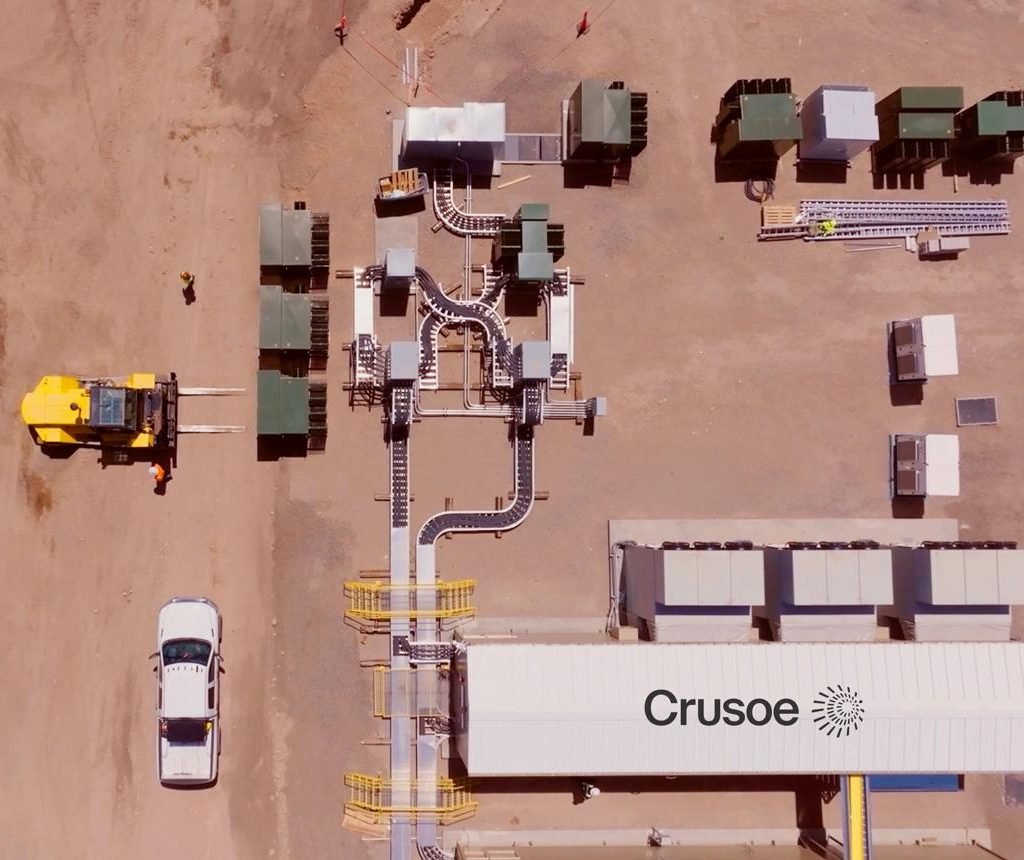
Crusoe says its modular approach can reduce field construction timelines from years to weeks, while allowing customers to expand computing capacity incrementally as demand grows. The company is continuing to build conventional large-scale facilities as well. Its projects include a major AI campus in Abilene, Texas, where it has worked with customers including OpenAI and Microsoft. Crusoe’s strategy is therefore not to replace massive data centres with small units, but to operate both models depending on customers’ requirements and the availability of power.
Crusoe’s business increasingly operates across three connected areas. First, it designs and leases data-centre capacity to customers that bring their own GPUs. Second, Crusoe Cloud rents computing capacity and GPU infrastructure directly to customers. Third, its Managed Inference business provides computing resources for running already-trained AI models.
The company says Crusoe Cloud bookings have grown more than 20 times year-on-year so far in 2026. Managed Inference, which launched late last year, has already contracted more than $100 million in annual recurring revenue. Crusoe attributes part of the inference growth to its MemoryAlloy technology, which is designed to reduce repeated data processing and improve the speed and efficiency of AI workloads. The model allows Crusoe to generate revenue from physical infrastructure while also capturing revenue higher up the technology stack.
Crusoe is also bringing more of its infrastructure manufacturing in-house. On September 14, the company opened a second 400,000-square-foot manufacturing facility in Tulsa, Oklahoma, expanding its US manufacturing footprint to roughly one million square feet. The Tulsa facilities manufacture equipment including medium-voltage switchgear, low-voltage switchboards, electrical enclosures and industrial controls. Crusoe says it has hired more than 300 local craft workers across the two Tulsa facilities.
This vertical integration is important because AI data centres require specialised electrical equipment in addition to computing chips. By controlling more of the supply chain, Crusoe aims to reduce dependence on outside construction and equipment suppliers and accelerate deployment.
The funding round illustrates how the economics of AI are expanding beyond model developers such as OpenAI and Anthropic. The next layer of competition is increasingly about who can secure electricity, build data centres, install computing equipment and deliver capacity quickly enough to meet demand.
Crusoe is not alone in attracting enormous amounts of capital. Investors are also financing new AI cloud providers and large-scale data-centre projects as technology companies race to secure computing capacity. For Crusoe, the $3.9 billion raise provides fresh capital to turn its contracted pipeline into physical infrastructure while expanding its cloud business.
The company has also reportedly held discussions with investment banks about a potential initial public offering, although no IPO has been announced. The immediate focus remains execution: converting billions of dollars of investment and a reported $140 billion-plus contracted pipeline into operational computing capacity. That makes Crusoe’s rise significant beyond one company’s valuation. It shows that the AI boom is increasingly becoming a race over the physical foundations of computing, where electricity, factories, chips and data centres are as important to growth as the algorithms running inside them.
