
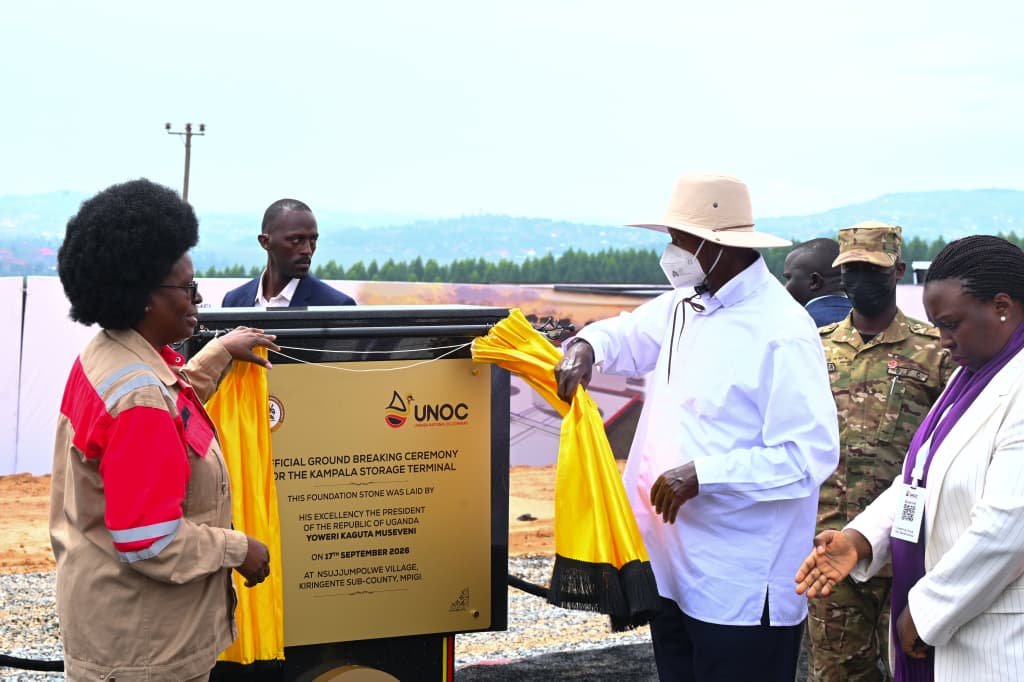
Uganda has begun construction of a US$310 million petroleum storage terminal in Mpigi that will more than double the country’s existing fuel storage capacity, marking a major expansion of infrastructure designed to protect the economy from disruptions along international supply routes.

President Yoweri Museveni broke ground on the Kampala Storage Terminal (KST) at Namwabula in Mpigi District on Thursday, September 17, with construction scheduled to formally begin on Friday. Developed by the Uganda National Oil Company (UNOC), the facility will have capacity to store up to 320 million litres of refined petroleum products. Uganda currently has about 159.7 million litres of combined petroleum storage capacity across government and private-sector facilities.
The scale of the new terminal is significant against Uganda’s consumption. The country uses approximately 240 million litres of petroleum products each month, meaning the terminal’s eventual capacity would be equivalent to more than a month’s national consumption.
The facility will store products including petrol, diesel, aviation fuel and kerosene and will serve Kampala, the Central Region and other parts of the country. It is also intended to function as a strategic reserve, a storage facility for oil marketing companies and a distribution hub. For Uganda, the investment addresses a structural weakness in the country’s petroleum supply chain.
The economy remains heavily dependent on imported petroleum products, leaving fuel availability exposed to disruptions along regional transport corridors, international supply constraints and global price shocks. Limited domestic storage also restricts the country’s ability to build reserves that can cushion consumers and businesses when imports are interrupted.
UNOC says the new terminal will strengthen the country’s ability to maintain adequate reserves and improve resilience against external shocks. The project is also being designed as part of a wider petroleum infrastructure network.
A proposed 211-kilometre multi-products pipeline will connect the terminal to the planned refinery in Hoima, creating a future link between domestic oil refining and downstream storage and distribution. The terminal is therefore intended to handle both imported petroleum products and, eventually, refined products produced in Uganda. That connection could become increasingly important as Uganda moves towards first oil and attempts to develop more of its petroleum value chain within the country.
UNOC’s investment is also being supported by its wider financing relationship with Vitol Bahrain. In December 2025, UNOC announced that it had secured approval to borrow up to US$2 billion over seven years from Vitol Bahrain to finance strategic projects and investments across the petroleum value chain, including greenfield storage facilities at Namwabula.
However, the new terminal faces an immediate challenge that has little to do with fuel markets. The facility is located close to a large waste-disposal site in Buyala, an area where residents have already raised environmental concerns. Energy Minister Monica Musenero acknowledged the proximity of the landfill as a challenge, while President Museveni called for the waste site to be relocated because of the potential risks associated with having the two facilities close together.
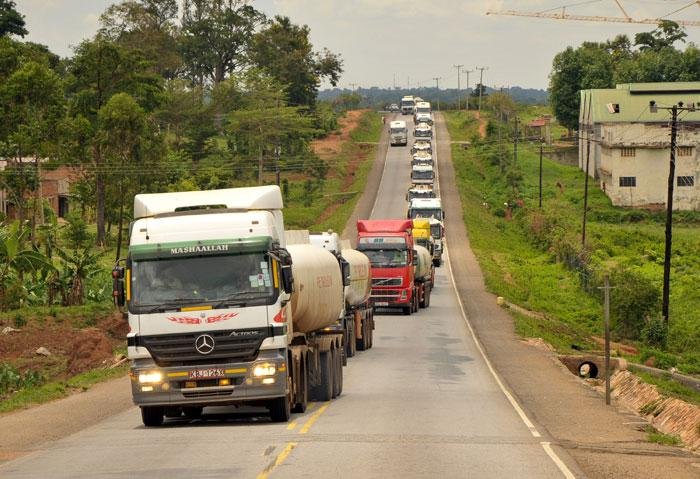
The concern is significant because the terminal is expected to handle hundreds of fuel trucks once fully operational, adding heavy industrial traffic to an area already receiving waste trucks. Government officials say zoning and land-use planning around the terminal will therefore be important to protect the facility and surrounding communities. The Energy Ministry’s master plan had previously identified the need to regulate development within a one- to two-kilometre radius of the site.
UNOC expects the terminal to be completed around September 2028, with detailed engineering scheduled to run into 2027.
The investment ultimately represents more than the construction of another fuel depot. It is an attempt to build a stronger buffer between Uganda’s economy and the external shocks that have historically determined how reliably fuel reaches the country.
But the terminal’s success will depend on more than its 320-million-litre capacity. Its value will ultimately be measured by whether Uganda can integrate storage, transport, refining and regional distribution efficiently while maintaining the safety and environmental standards required around such a major petroleum facility.
