
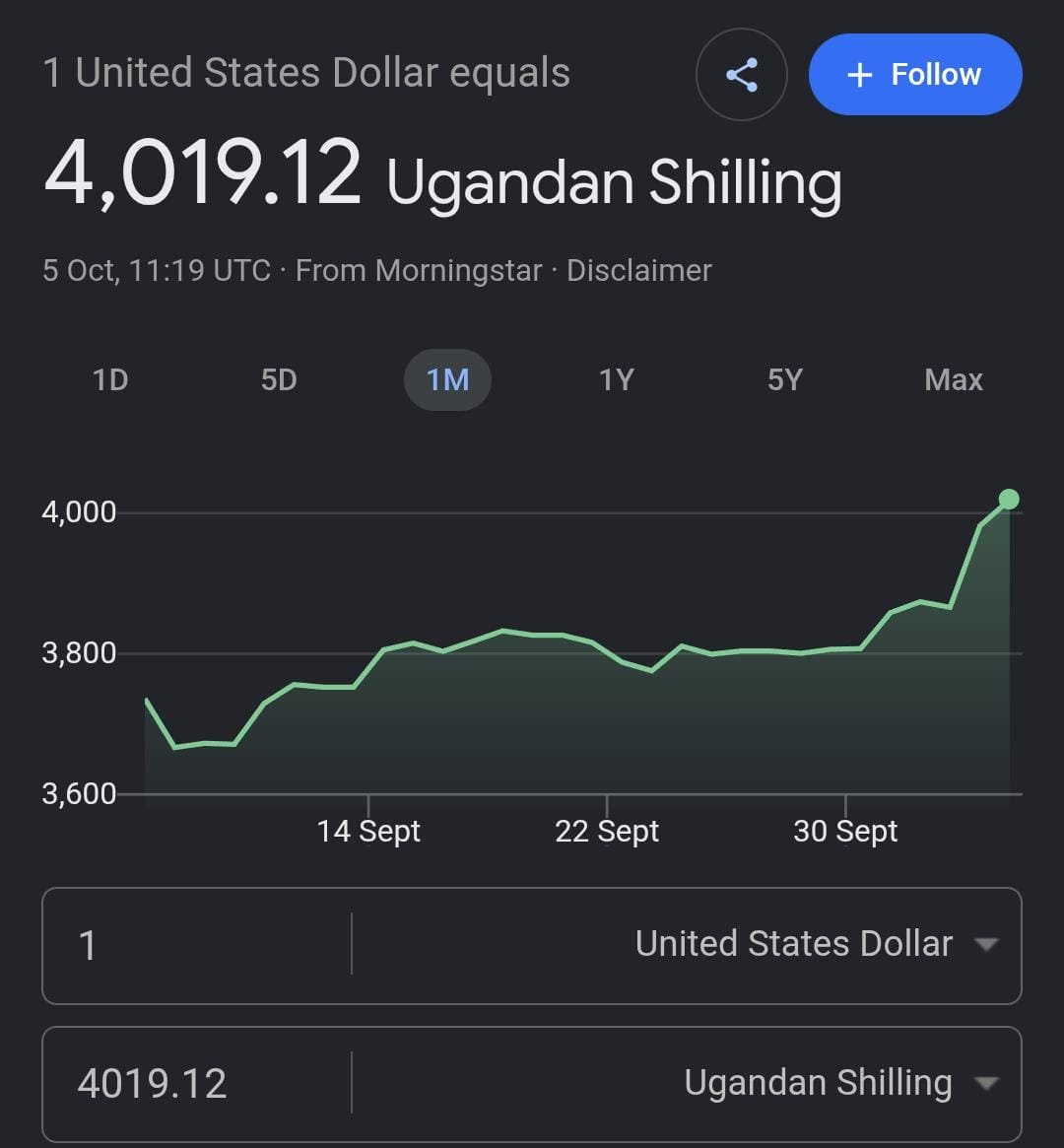
he payslip may look the same this month. The money behind the figure is buying less, as the shilling slips past UGX4,000 to the dollar and sterling holds above UGX5,200.
A Ugandan worker earning UGX3 million will, in most cases, still see UGX3 million land in the account. There is no deduction labelled exchange-rate loss, no line on the payslip, and no alert from the bank warning that the salary now buys less.
The loss is showing up elsewhere: in fuel, transport, imported goods, school fees, air tickets, business inputs and foreign-currency loans.
Monday’s slide past UGX4,000 has put a number on that squeeze. The shilling traded at about UGX4,025 to the dollar before recovering to about UGX4,018. Commercial banks were quoting roughly UGX4,017 buying and UGX4,027 selling.
UGX4,000 had long been treated as a psychological line. Crossing it matters less as a round number than as proof of how many more shillings are now needed to pay for goods, services and bills tied to the outside world.
In March, the shilling traded at about UGX3,604 to the dollar. By mid-September, it was around UGX3,919. At current levels, it has lost roughly 11 percent against the dollar in seven months.
That is not a formal 11 percent pay cut. It helps explain why an unchanged salary can feel smaller.
The salary that buys less
Uganda is exposed to the forex market because homes and firms depend on imports. Fuel, vehicles, machinery, electronics, medicines and industrial inputs are priced, directly or indirectly, off the dollar. Importers now need more shillings to buy the same amount of foreign currency.
Those costs do not stop at the importer. A manufacturer paying more for machines or raw materials has higher production costs. A distributor paying more for fuel has higher delivery costs. A retailer restocking imported goods needs more shillings for the same shelf.
Some of that cost reaches the consumer.
A commuter does not need to hold dollars to feel the dollar rate. If fuel is dearer in shillings, operators face higher costs, and those costs can pass into fares. Food follows the same path. Fuel moves produce from farm to market, and traders move goods across the country. A weaker shilling can raise the cost of ordinary life without anyone walking into a forex bureau.
The result is a quiet cut in what is left at the end of the month. A worker on UGX3 million may still earn UGX3 million. If more of it goes to transport, food, fuel and rent, less remains for savings, school or anything else. The salary has not changed on paper. Its purchasing power has.
The pound makes the squeeze harder to ignore
Sterling makes the same point in another currency. It traded on Monday at about UGX5,266 to UGX5,273, against roughly UGX4,540 a year ago. The shilling cost of the pound is up about 13 percent.
For a family paying a £10,000 school or university bill in Britain, the gap is plain. The bill now needs about UGX52.7 million, against about UGX45.4 million a year ago. The invoice in Britain need not have changed. The household in Uganda needs about UGX7.3 million more to settle the same £10,000.
That is the exchange rate turning into a household bill. Treatment abroad, professional fees, machinery, vehicle parts and other sterling payments all cost more shillings when the local currency weakens.
Families receiving money from Britain get an offset because each pound converts into more shillings. For households mainly paying foreign-currency bills, the weaker shilling is a direct cost.
Why the shilling is under pressure
Several forces are meeting in the market.
Forex dealers point to strong dollar demand from importers, manufacturers, energy companies and traders stocking up. Reliance on imported fuel and other goods creates a standing need for foreign currency. Higher crude prices add to it because petroleum is bought in dollars.
Offshore investors cutting exposure to government securities can add to the demand. When they sell local assets and take the money out, they convert shillings into dollars. More buyers are looking for dollars while supply is under strain.
The central bank’s choice

The Bank of Uganda has so far avoided an aggressive sale of dollars from its reserves. It has tightened liquidity instead.
The cash reserve ratio was raised from 9.5 percent to 11 percent earlier this year, then to 13.5 percent from 24 September. Governor Michael Atingi-Ego has said the first increase removed an estimated UGX700 billion to UGX800 billion from the banking system. The central bank rate has stayed at 9.75 percent for seven consecutive meetings.
Selling reserves can steady the rate for a while, but reserves are also the buffer against external shocks. Draining liquidity is another way to lean against the pressure without spending that buffer.
The choice still reaches beyond the forex market. When more deposits are locked up as reserves, banks have less room to lend. Firms can face higher borrowing costs. Households seeking mortgages or personal loans can feel it too.
Not everyone loses
A weaker shilling creates winners as well as losers. Exporters paid in dollars receive more shillings when they convert. Coffee, tea and fish can gain. The gain is not automatic. Exporters also pay more for fuel, fertiliser, machinery, packaging and transport, so part of the extra shilling revenue is absorbed by higher costs.
Government faces a different exposure. External debt is owed in foreign currency, so a weaker shilling means more domestic revenue is needed to service the same dollar obligation. The rate reaches from the household budget to the national budget.
The number on the board and the cost in your pocket
The mistake is to treat UGX4,000 as a milestone only for forex dealers.
For a worker paid in shillings, the question is not what the dollar costs at the counter. It is what the monthly salary can buy after the rate has moved. A salary can stay the same while transport rises. A school invoice can stay the same while the shilling cost of paying it rises. A dollar loan can stay the same in dollars while needing more shillings every month.
The figure on the payslip stays put. The value behind it does not.
Stronger inflows, including expected oil revenues and foreign investment, could eventually add dollars to the market. Until those inflows are large enough, households and firms remain exposed to oil prices, investor flows and local demand for foreign currency.
For millions of Ugandans paid in shillings, UGX4,000 is more than a psychological line. It is a reminder that an employer does not have to cut a salary for the worker to be poorer. The currency can do it quietly.
