
In today’s corporate environment, effective governance depends on more than financial statements and performance dashboards. Boards must understand the realities behind the numbers: how operational decisions affect profitability, where risks are emerging, how capital is being deployed and whether business strategies are delivering sustainable value.
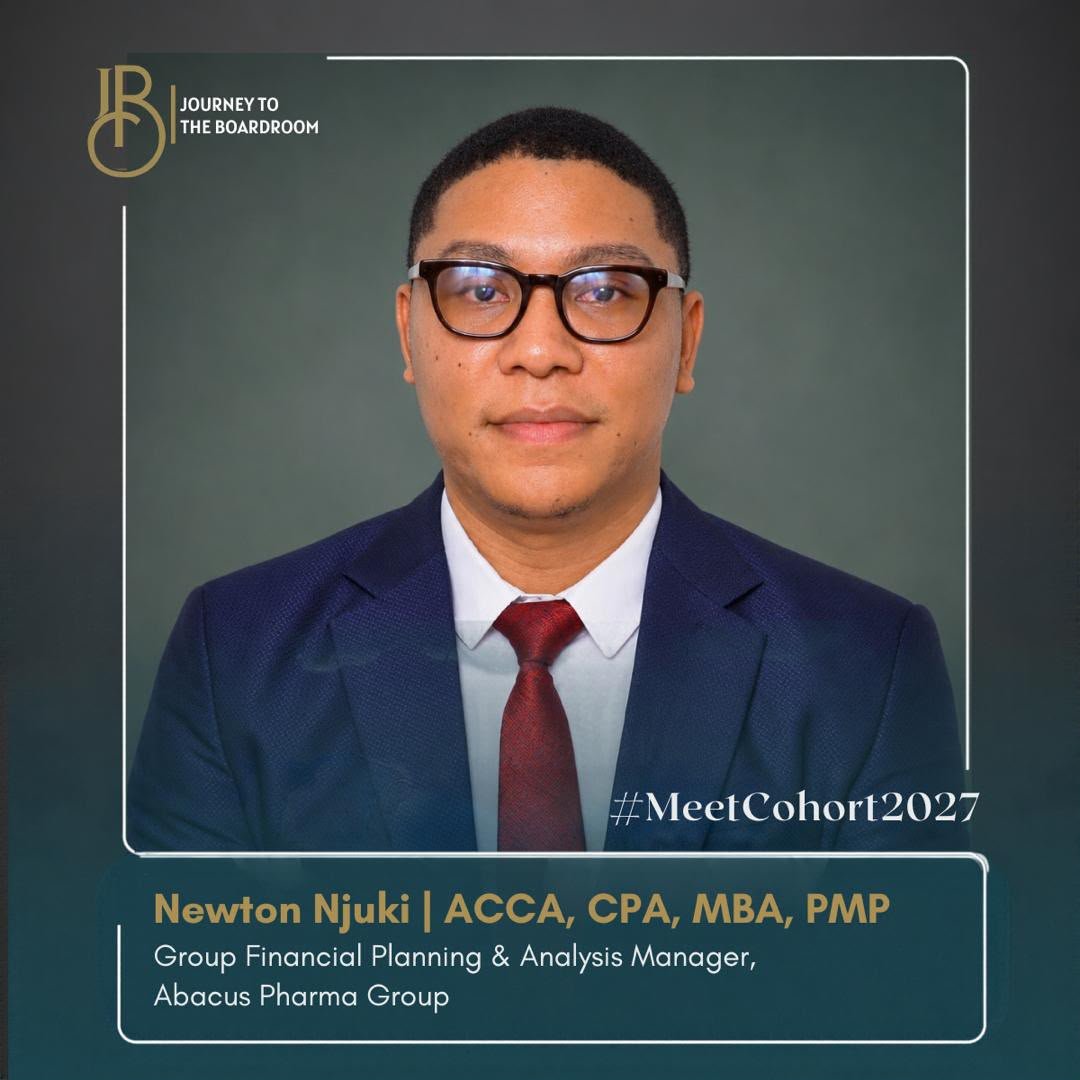
For Newton Njuki, this intersection between financial information, operational performance and corporate governance has shaped more than eight years of professional experience across banking, pharmaceutical manufacturing, corporate finance and business transformation.
As Group Financial Planning and Analysis (FP&A) Manager at Abacus Pharma Group, a multi-entity business operating across five East African markets, Njuki works closely with executive leadership and the Group Chief Financial Officer on financial strategy, capital allocation, performance management and board-level reporting. His role involves translating complex financial and operational information into insights that support strategic decisions, investment evaluation and sustainable business growth.
His experience extends beyond financial reporting into mergers and acquisitions, enterprise resource planning (ERP) implementation and business transformation. These areas have broadened his exposure to strategic investment, organisational change and enterprise risk, positioning him at the intersection of financial management and corporate strategy.
Building Financial Discipline at Centenary Bank
Njuki’s professional foundation was built at Centenary Rural Development Bank, where he developed a progressive career over six years, moving from Personal Banker through loan reconciliations and accounting into management reporting and senior finance responsibilities.
He began on the frontlines of banking, gaining exposure to the transactional processes that underpin financial institutions. His early responsibilities introduced him to the importance of accurate financial records, credit administration, interest calculations and reconciliation processes. This experience provided a practical understanding of how individual transactions contribute to the integrity of an institution’s financial position.
As his career progressed, his responsibilities expanded to enterprise-level financial planning, budgeting and performance management. He worked across more than 100 business units and branches nationwide, contributing to financial reporting and planning in an institution whose balance sheet exceeded UGX 8 trillion.
Operating within Uganda’s regulated banking environment required a strong appreciation of financial controls, reporting accuracy and compliance with prudential requirements. It also exposed him to the challenge of consolidating complex financial information into reports that could support management decisions across a large organisation.
One of the important areas of his work involved improving management reporting processes. Through process automation and reporting improvements, he contributed to reducing manual workflows, improving reporting efficiency and strengthening the alignment between business-unit cost centres and institutional targets. His work in cost optimisation and process improvement also supported the bank’s broader focus on operational efficiency.
This experience gave him an understanding of financial management from the transactional level to enterprise-wide performance oversight. It also established a foundation for his subsequent work in financial planning, strategic investment and business transformation.
Applying Financial Strategy to Manufacturing and Regional Trade
His move to Abacus Pharma Group expanded his professional experience beyond banking into pharmaceutical manufacturing and regional distribution, where financial decisions are closely connected to physical operations and cross-border supply chains.
The pharmaceutical industry presents a different set of financial and operational considerations. Manufacturing capacity, imported raw materials, active pharmaceutical ingredient costs, foreign exchange movements, customs processes, inventory management and regional logistics all influence business performance. Financial planning in this environment must therefore account for operational realities alongside conventional financial indicators.
At Abacus Pharma Group, Njuki supports executive leadership in financial strategy, capital allocation and performance management across a business operating in five East African markets. Working closely with the Group CFO, he contributes to evaluating investment proposals and assessing the financial implications of business expansion across manufacturing and distribution operations.
This work involves applying capital appraisal techniques such as Internal Rate of Return, payback period and Return on Invested Capital to assess the commercial viability of proposed investments. It also requires consideration of the external conditions that can influence projected returns, including currency movements, import costs, freight delays and disruptions across regional supply chains.
His involvement in corporate finance and mergers and acquisitions adds another dimension to this responsibility. M&A experience requires an understanding of strategic investment, financial evaluation and the risks associated with organisational integration and expansion. Combined with his exposure to ERP implementation and business transformation, it gives him a broader perspective on how financial decisions translate into organisational change and long-term enterprise performance.
By incorporating financial analysis, scenario planning and operational considerations into the decision-making process, his work supports the assessment of growth initiatives against changing market conditions.
Professional Qualifications and Technical Foundation
Njuki’s experience is supported by professional qualifications spanning accounting, finance, business management and project management.
He holds professional accounting credentials from the Association of Chartered Certified Accountants (ACCA) and the Institute of Certified Public Accountants of Uganda (ICPAU). He also holds a Master of Business Administration from Edinburgh Business School at Heriot-Watt University, alongside an undergraduate qualification from Makerere University.
His Project Management Professional (PMP) certification from the Project Management Institute adds another dimension to his professional background, particularly in managing projects that require coordination between financial planning, operational execution and expected business outcomes.
Together, these qualifications provide a technical foundation for his work in financial analysis, enterprise budgeting, investment appraisal and performance management. They also complement his experience in business transformation, where financial discipline must be matched by effective implementation.
Preparing for the Boardroom
Njuki’s selection for the Journey to the Boardroom (JTB) 2027 Cohort represents a further step in the development of his corporate governance experience.
His professional background is particularly relevant to board responsibilities involving financial oversight, investment governance, risk management and strategic accountability. His experience in enterprise budgeting and management reporting provides a foundation for examining financial performance, interrogating forecasts and understanding the assumptions behind management decisions.
His exposure to banking and pharmaceutical manufacturing also offers perspectives from two sectors with distinct regulatory, operational and capital requirements. In banking, he gained experience in financial controls, reporting and prudential oversight. In pharmaceutical manufacturing and distribution, his work involves the financial implications of production, working capital, regional logistics and capital investment.
His experience in M&A, ERP implementation and business transformation further broadens this perspective by connecting financial decisions with organisational strategy and execution.
As boards face increasingly complex investment and risk decisions, directors need to understand not only what financial results show but also the operational conditions and strategic assumptions that produce them. Njuki’s professional trajectory provides a foundation for contributing to these discussions, particularly where financial analysis, capital allocation and enterprise performance intersect.
The Next Chapter
African businesses are expanding across borders while navigating currency volatility, supply chain pressures, changing regulatory environments and the demands of regional integration. In this environment, growth requires more than access to capital. It requires disciplined investment decisions, effective financial controls and the ability to assess risk without losing sight of long-term commercial opportunities.
For boards, this means financial expertise must extend beyond interpreting historical results. Directors need to examine the assumptions behind forecasts, understand how operational decisions affect performance and assess whether proposed investments can deliver sustainable returns.
Newton Njuki’s career reflects this broader evolution of the finance function. From his early experience in banking to enterprise financial planning, pharmaceutical manufacturing, corporate finance and business transformation, his professional journey has increasingly connected financial intelligence with strategic decision-making.
Through the Journey to the Boardroom 2027 Cohort, he is extending that experience towards board-level governance, where financial stewardship, strategic judgement and accountability are central to long-term enterprise value creation.
