
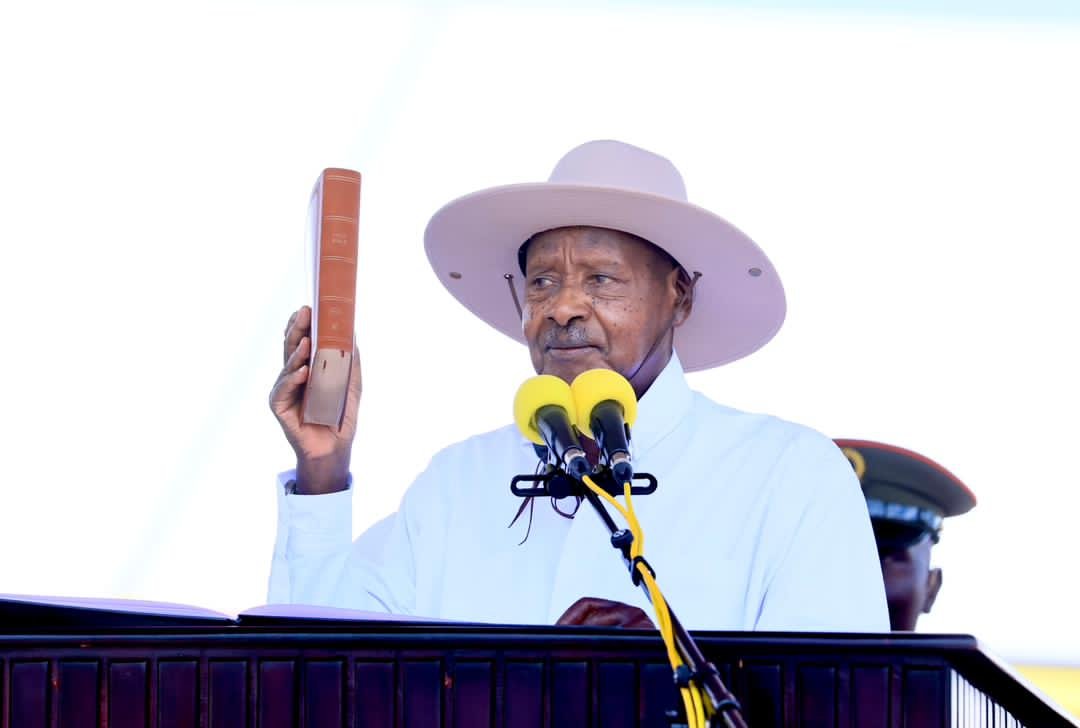
President Yoweri Museveni has officially been sworn in for his seventh term at Kololo Ceremonial Grounds, launching what he described as a new phase of accelerated economic transformation, industrial growth, and wealth creation for Uganda.
Held under the theme “Protecting the Gains: Making a Qualitative Leap into High Middle-Income Status,” the inauguration was not just a political ceremony. It was a statement about Uganda’s long-term economic direction and the government’s vision for the next five years.
The celebrations began even before the swearing-in itself. On the eve of the inauguration, Kampala’s skyline lit up with a large-scale drone show that displayed patriotic imagery, messages of progress, and symbols tied to Uganda’s future ambitions. The display reflected a broader message from the government: Uganda is positioning itself as a modern, investment-ready, and forward-looking economy.

At 81, Museveni remains one of Africa’s longest-serving leaders, having governed Uganda since 1986. During his leadership, Uganda has experienced relative stability, infrastructure expansion, regional integration, and economic growth.
In his inaugural speech, Museveni described the new term as the “kisanja of no sleep,” calling for productivity, discipline, and urgency across government and society.
“We are entering kisanja no more sleep and kisanja no corruption,” Museveni declared.
He emphasized that Uganda’s next phase of development would depend heavily on industrialization, commercial agriculture, value addition, infrastructure development, and household wealth creation.
“We are not just protecting the past; we are architecting the future,” he said.
For businesses, investors, and policymakers, the inauguration matters because it signals policy continuity with stronger urgency around execution and economic expansion.
One of the biggest areas to watch during this term will be oil and energy development. Uganda is expected to begin commercial oil production within this period, positioning the country for what could become one of its most transformative economic phases. Government officials have repeatedly stated that oil revenues will be used to fund infrastructure and human capital development.
This is expected to accelerate investment around the Albertine region while creating opportunities in logistics, transport, engineering, local content, construction, hospitality, and technical skills development. Businesses aligned with the oil value chain are likely to benefit significantly if implementation moves at the expected pace.
Infrastructure development is also expected to remain central to the government’s agenda. Roads, electricity expansion, railway systems, industrial parks, and digital connectivity are likely to receive increased investment as Uganda positions itself as a regional trade and logistics hub.
The President’s “no sleep” message also signals faster execution and potentially increased public-private partnerships. Companies operating in construction, renewable energy, ICT, manufacturing, and engineering could see expanded opportunities tied to infrastructure and industrialization.
Museveni also placed strong emphasis on wealth creation through agro-industrialization. His government continues to push for the transition from subsistence farming to commercial agriculture, particularly in sectors such as coffee, dairy, tea, maize, and horticulture.
This could create opportunities for agribusinesses, processors, exporters, irrigation companies, mechanization providers, and agricultural input suppliers. The broader goal is to increase household incomes while creating jobs for Uganda’s youthful population.
Governance and anti-corruption also featured prominently in the President’s message.
“Corruption is a parasite that eats the fruit of our labor,” Museveni warned.
Analysts say stronger enforcement, digital systems, and improved accountability could strengthen investor confidence and improve the ease of doing business if consistently implemented.
Regional trade and integration are also expected to shape Uganda’s economic strategy during this term. With Uganda strategically positioned within the East African Community and the African Continental Free Trade Area (AfCFTA), the government is expected to continue prioritizing exports, logistics, tourism recovery, and regional market access.
For businesses, the message is increasingly clear: Uganda wants to position itself not only as a stable economy, but as a regional production, energy, and logistics hub.
Still, the challenges remain significant. Uganda continues to face pressure around unemployment, debt management, governance, and inclusive growth. The country’s rapidly growing youthful population will require sustained job creation, innovation, and investment to fully benefit from the opportunities being projected.
Ultimately, the success of Museveni’s new term will depend less on speeches and more on execution. The next five years will test whether the vision of a “kisanja of no sleep” can translate into measurable improvements in jobs, infrastructure, industrial growth, and household incomes.
The drone displays may have lit up Kampala’s skies, but the real test of Uganda’s new economic era begins now.
