
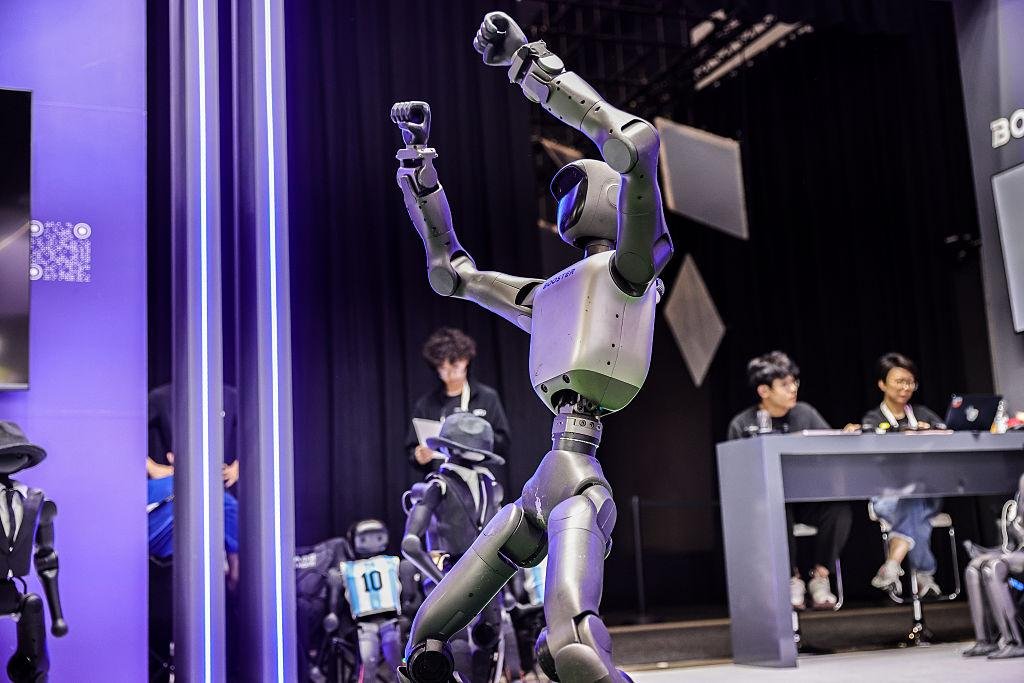
A humanoid robot dances across a stage, drops into a split, performs a backflip and gets back on its feet to applause.
At IFA Berlin 2026, held September 4 to 8, scenes like this were no longer unusual. Humanoid robots occupied a more prominent place at the technology show than at previous editions, with companies demonstrating machines that could perform Tai Chi, interact with audiences and execute increasingly complex movements.
The demonstrations were designed to impress. But their real significance was less about what the robots could do on stage and more about what the technology could eventually do away from it.
The industry is moving toward what it calls Physical AI, the combination of artificial intelligence with sensors, robotic bodies and motors that allows machines to perceive and act in the physical world. The question is no longer simply whether AI can write an email, generate an image or answer a question. It is whether AI can pick something up, move through a building, follow instructions and complete a physical task without constant human supervision.
That is why the growing capabilities on display at IFA matter. They offer a glimpse of a technology that could eventually move from demonstrations into warehouses, factories, hotels, retail stores and other workplaces.
The backflip is not the breakthrough
The spectacular movements may be the easiest part of the story to understand, but they are not necessarily the most important.
IFA’s “Robots on the Runway” demonstrations featured companies including AGIBOT, Unitree, EngineAI and DEEP Robotics. Their robots danced, performed martial-arts-inspired movements and demonstrated athletic abilities that would have seemed extraordinary in consumer technology exhibitions only a few years ago.
Those demonstrations nevertheless took place in controlled environments. The robots knew where they were, the tasks were predetermined and the conditions were designed for a successful performance.
A workplace is different.
A robot that can execute a backflip under controlled conditions is demonstrating balance and motion control. A robot that can enter an unfamiliar warehouse, identify an object, understand an instruction, navigate around workers, recover when something goes wrong and complete the task safely is demonstrating something much harder: reliable autonomy.
That distinction could determine whether humanoid robots become useful workers or remain expensive technological showcases.
AGIBOT shows where the industry is heading
Among the companies at IFA, Shanghai-based AGIBOT offered one of the clearest examples of how the industry is trying to turn humanoid robotics into a commercial product.
Its A3 humanoid, which stands 173 centimetres tall and weighs 55 kilograms, received IFA’s top innovation award. The company demonstrated a battery system that allows the robot to swap batteries without stopping work, addressing one of the practical limitations facing mobile robots.
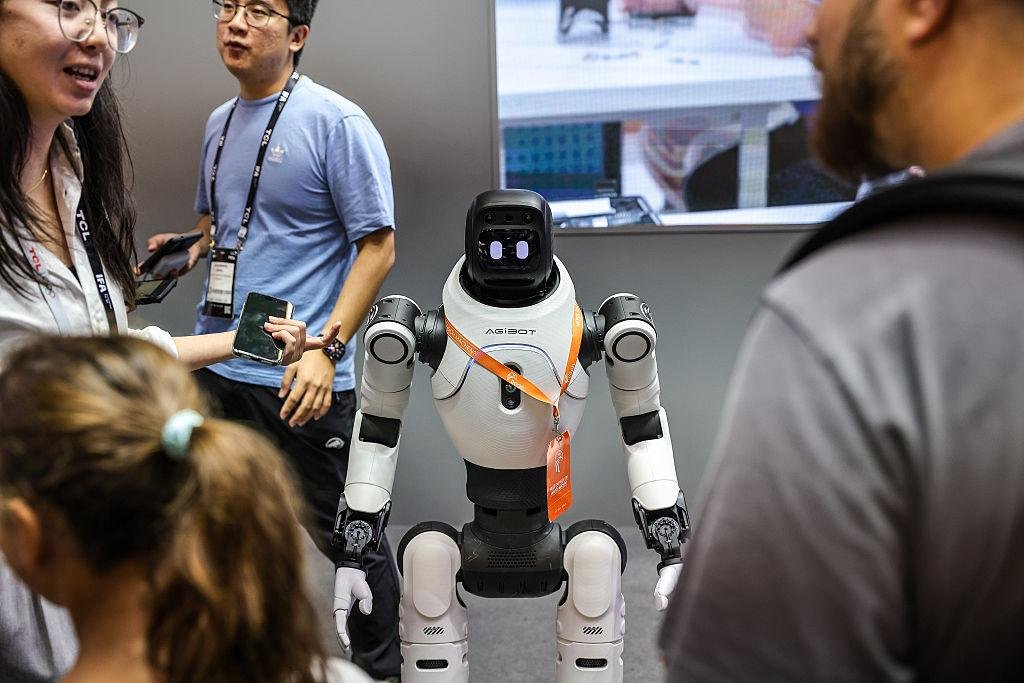
AGIBOT also demonstrated multiple robots coordinating in groups of more than 100 using wireless tracking technology. Its OmniHand system was used to demonstrate fine motor tasks, including calligraphy.
These capabilities point toward a broader objective: robots that can operate for longer periods, work alongside other machines and handle tasks requiring increasingly precise physical movements.
The commercial opportunity is also becoming clearer. AGIBOT is positioning the A3 for retail, industrial operations and commercial cleaning, rather than presenting it primarily as a futuristic household companion.
That distinction matters.
The first serious market for humanoid robots is unlikely to be the average living room. It is more likely to be the workplace.
The real test is whether humans can stop watching
Germany’s NEURA Robotics is approaching the problem from another direction.
At IFA, the company demonstrated robots designed to learn household routines, including cooking and eating habits, rather than simply execute a predetermined sequence of movements.
The broader message emerging from the industry is that walking, balancing and lifting are becoming increasingly manageable engineering problems. The harder challenge is teaching robots to understand what humans want when circumstances change.
That is the difference between automation and general-purpose robotics.
A traditional industrial robot can perform the same welding operation thousands of times because its environment is tightly controlled. A humanoid robot operating in a hotel, shop or warehouse faces a constantly changing environment.
Boxes move. People walk into its path. Objects are placed in different locations. Instructions change. Something falls. A task takes longer than expected.
The robot has to recognise the change and decide what to do next.
Until machines can handle those situations consistently, human workers will remain part of the system, either operating the robots, supervising them or intervening when they fail.
Cost could determine how quickly the technology spreads
Even if the technology works, economics will determine whether businesses actually adopt it.
Humanoid robots require sophisticated sensors, motors, batteries and computing systems. Running increasingly capable AI models on a mobile machine also creates significant demands for processing power and energy.
That makes cost a major obstacle.
Figures of $20,000 to $30,000 have circulated as potential future prices for humanoid robots around 2027. Those numbers should not be mistaken for established market prices. They represent the industry’s expectations that manufacturing scale, cheaper components and more efficient supply chains could eventually bring costs down.
For businesses, however, the calculation will be straightforward.
A robot does not need to be cheaper than a human worker in absolute terms. It needs to deliver enough productive value, reliably enough, to justify the investment and operating costs.
That means the economics will probably favour repetitive tasks first.
The first jobs at risk are likely to be narrow and physical
If humanoid robots begin replacing workers, the first impact is unlikely to be evenly distributed across the economy.
Controlled commercial environments offer the clearest opportunity.
Warehouses, factories, logistics centres, retail floors and hotels contain tasks that are repetitive, physically demanding and relatively predictable. Those are precisely the conditions in which a robot can generate measurable economic value.
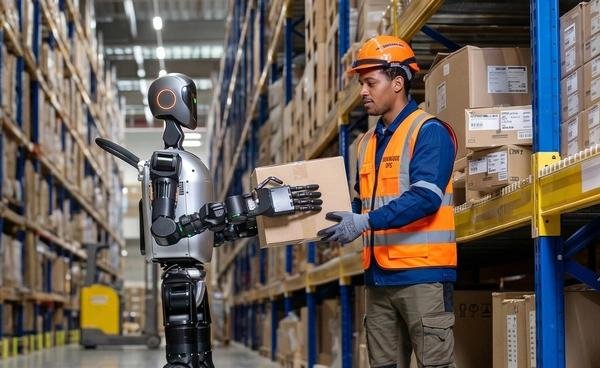
A machine that repeatedly moves goods, cleans an area, transports materials or performs basic stock-handling tasks does not need to understand the entire world. It needs to perform a defined job reliably.
That makes these environments more attractive than occupations requiring complex judgment, creativity, negotiation or highly variable human interaction.
For workers, that does not mean the immediate arrival of mass unemployment. It means the nature of automation may be changing.
Previous generations of industrial robots largely replaced specific physical movements. Humanoid robots are being designed to operate in spaces built for people, potentially allowing automation to enter workplaces without requiring companies to redesign the entire environment around machines.
That could eventually broaden the range of tasks that can be automated.
The next milestone will be boring
IFA 2026 demonstrated that humanoid robotics has moved well beyond the era of machines that could barely walk.
The more difficult question is whether that progress can survive contact with the real world.
The next breakthrough will not necessarily be another backflip. It will be a robot that spends eight hours in a warehouse and completes its assigned tasks without repeatedly needing a human to intervene.
It will be a machine that can understand an unfamiliar instruction, recover from an unexpected problem, work safely around people and perform the same task tomorrow with the same reliability.
That is the threshold separating an impressive demonstration from a commercially useful worker.
For now, humanoid robots are not about to take most people’s jobs. But the distance between a robot that can perform a backflip and one that can perform useful work is shrinking.
And that is why the backflip is worth watching.
