
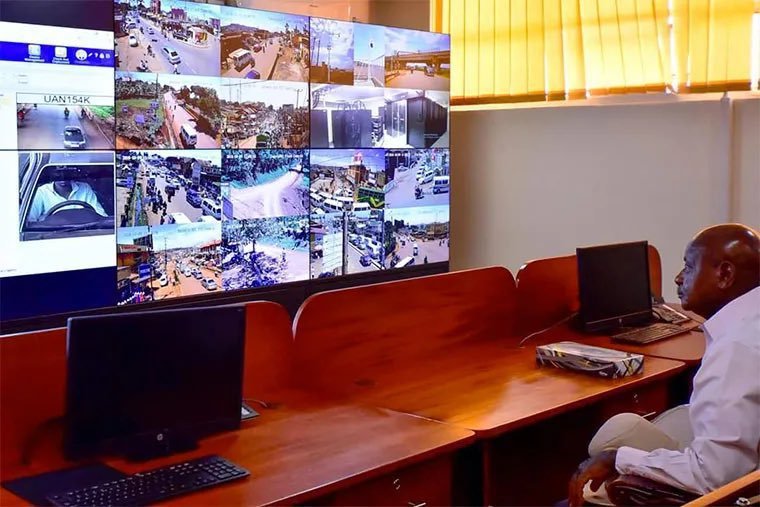
Uganda’s multi-billion-shilling CCTV surveillance network was built to strengthen public safety, improve crime detection, and restore confidence in national security after years of high-profile assassinations. Today, however, the same system has become the center of a major corruption investigation involving some of the country’s most senior security and administrative officials.
President Yoweri Museveni’s decision to suspend top officials over the alleged Shs31.37 billion CCTV maintenance scandal marks one of the most significant anti-corruption interventions within Uganda’s security sector in recent years. The move not only exposes alleged irregularities in the management of critical public funds, but also raises broader questions about accountability, procurement oversight, and the protection of strategic national infrastructure.
At the center of the controversy is a system that was originally introduced as a solution to Uganda’s urban crime challenges. Between 2014 and 2018, the country witnessed a wave of high-profile killings, including the murders of senior prosecutor Joan Kagezi and former police spokesperson Andrew Felix Kaweesi. The incidents exposed major surveillance and response gaps within Uganda’s security structure, increasing public pressure for stronger crime-monitoring systems.
In response, government launched a large-scale national CCTV project worth approximately $126 million. The initiative involved the installation of thousands of surveillance cameras across Kampala and other urban centers. The system, implemented with support from Huawei Technologies, was designed to support real-time monitoring, facial recognition, and automated vehicle tracking through a central command center in Naguru.
The CCTV network quickly became one of the country’s most visible security investments, with government presenting it as a critical tool in combating urban crime and improving intelligence gathering.
The current scandal, however, centers not on the installation of the cameras, but on the maintenance phase of the project.
Following operational and geopolitical adjustments, maintenance responsibilities were reportedly transferred to a local contractor, Dealan Associates Limited. According to emerging reports, the Ministry of Finance released Shs31.37 billion intended to facilitate maintenance and operational support for the surveillance system.
Investigations now suggest that despite the release of funds, the contractor allegedly failed to receive payment due to internal administrative bottlenecks and alleged bribery demands within the system.
Reports further indicate that intermediaries were allegedly used to solicit bribes before authorizing the release of funds to the contractor. A middleman identified as Hassan Serunjoji has been mentioned prominently in the unfolding investigation.
The alleged payment breakdown effectively created a scenario where public funds had been released, but operational obligations remained stalled.
Acting on intelligence reports submitted to State House, President Museveni ordered three senior officials to proceed on six months’ forced leave as investigations continue.
The officials include Lt. Gen. Joseph Musanyufu, the Permanent Secretary in the Ministry of Internal Affairs, Aggrey Wunyi, the Under-Secretary of the Uganda Police Force, and AIGP Felix Baryamwisaki, the Director of ICT at Uganda Police.
The State House Anti-Corruption Unit has since been tasked with spearheading investigations into the matter, while directives have reportedly been issued to ensure that the contractor receives payment and that any individuals implicated in wrongdoing face legal action.
The significance of this intervention goes far beyond the immediate allegations.
For years, Uganda’s anti-corruption efforts have faced criticism over perceptions that accountability mechanisms mainly target lower-ranking officials while senior administrators remain insulated from serious scrutiny. By moving against high-ranking officials linked to critical security systems, the latest crackdown signals a more aggressive posture toward institutional accountability.
It also highlights the growing sensitivity surrounding public security infrastructure. CCTV systems are no longer viewed simply as policing tools; they have become central components of urban stability, commercial security, and economic confidence.
A compromised or poorly maintained surveillance network has broader implications for the economy. Businesses, logistics operators, investors, and urban commercial centers rely heavily on stable and secure operating environments. Any disruption to national surveillance capacity can increase private security costs, weaken public confidence, and raise concerns among investors regarding institutional reliability.
The scandal also raises important questions about Uganda’s broader localization agenda under the “Buy Uganda Build Uganda” framework. While shifting strategic contracts toward local companies is viewed as an important step toward economic empowerment and technological independence, the CCTV case demonstrates how weak oversight mechanisms can expose local procurement systems to exploitation and administrative abuse.
Beyond procurement concerns, the scandal reflects a larger governance challenge facing many developing economies; ensuring that large-scale public investments are matched by equally strong accountability structures.
Uganda is currently expanding its digital and security infrastructure, including proposals for additional surveillance systems and body-worn cameras for law enforcement personnel. How government handles the current investigation will therefore likely shape public confidence in future security modernization projects.
Ultimately, President Museveni’s intervention marks a defining moment in Uganda’s ongoing anti-corruption agenda.
The move sends a clear signal that even senior officials overseeing strategic national systems are not beyond scrutiny when allegations of financial misconduct arise.
However, the deeper challenge extends beyond suspensions and investigations. Uganda’s long-term success will depend on whether institutions can strengthen transparency, streamline procurement oversight, and protect critical public infrastructure from internal manipulation.
If handled decisively and transparently, the Shs31 billion CCTV scandal could become more than just another corruption case. It could mark a turning point in strengthening institutional accountability within Uganda’s security and governance systems.
