
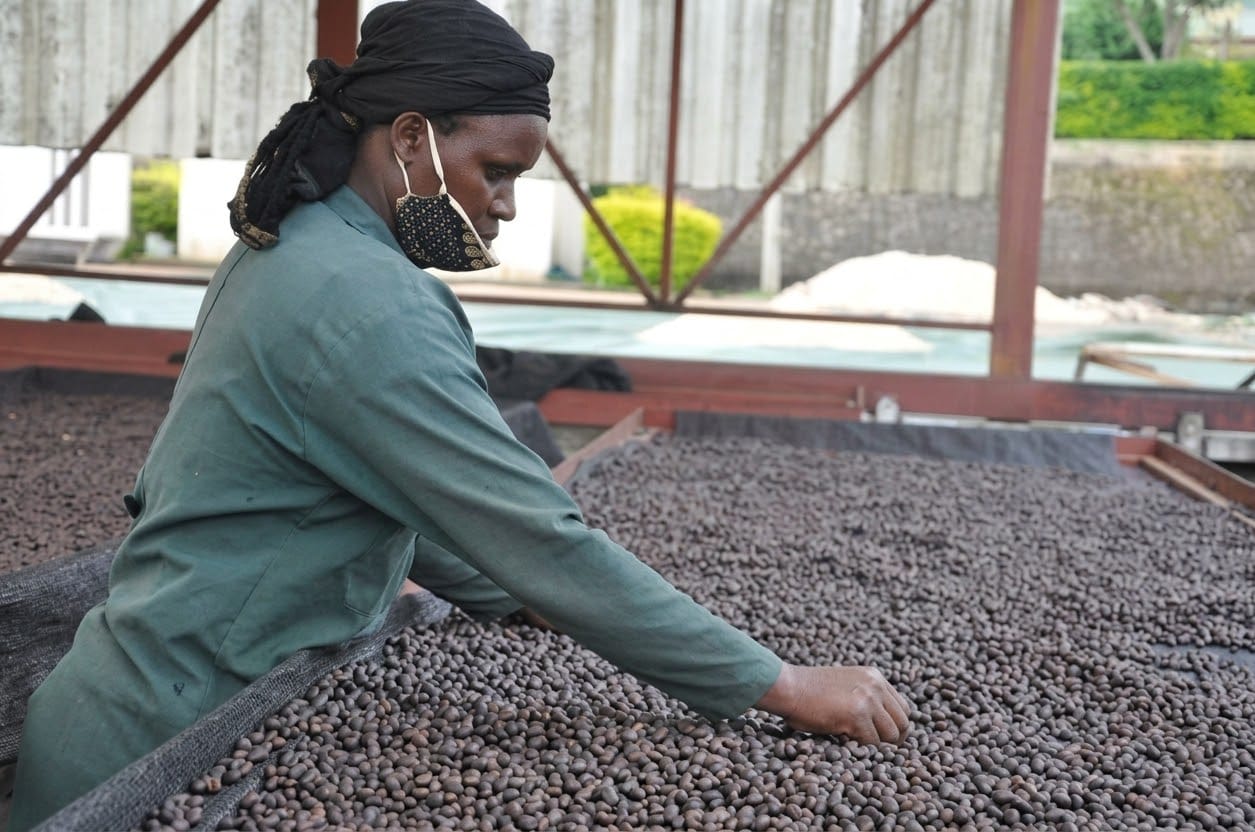
For anyone tracking Uganda’s export performance, agriculture appears to be enjoying one of its strongest periods in recent years.
Coffee exports have surged to record levels, generating billions of dollars in foreign exchange and strengthening Uganda’s position as one of Africa’s leading coffee exporters. The crop has become a bright spot in the country’s economic story, benefiting from strong global prices, improved production, and growing international demand.
Yet beyond the export figures lies a more complicated reality.
While coffee farms are thriving, the food crops that sustain millions of Ugandan households are struggling. The result is a widening divide within the agricultural sector that is beginning to weigh on economic growth, household incomes, and long-term food security.
Recent data from the Uganda Bureau of Statistics (UBOS) reveals the extent of this imbalance. According to the Q3 FY2025/26 Quarterly GDP report, agriculture, forestry, and fishing grew by just 2.1% year-on-year, a sharp slowdown from the 10.3% growth recorded during the same quarter a year earlier. On a seasonally adjusted basis, the sector actually contracted by 1.3%, with real value added falling from Shs 10.08 trillion in Q2 to Shs 9.95 trillion in Q3.
The slowdown is particularly striking because it occurred during a period when Uganda’s cash crop sector continued to perform strongly.
Cash crop activities, driven largely by coffee, expanded by 7.2% year-on-year, only slightly below the 9.0% growth recorded in the previous year. According to data from the Uganda Coffee Development Authority (UCDA), Uganda’s coffee exports have exceeded 8 million 60-kilogram bags in recent periods, generating between USD 2.2 billion and USD 2.4 billion in export earnings. Production forecasts for 2025/26 remain positive, supported by new plantings, improved varieties, favorable weather conditions in major growing regions, and government-backed distribution of seedlings.
The coffee industry has therefore become a major contributor to foreign exchange earnings and rural incomes. More than 1.8 million households are estimated to participate in coffee production either directly or indirectly.
However, coffee’s success is masking weakness elsewhere.
The majority of Uganda’s farmers are not primarily engaged in coffee production. Instead, they grow staples such as maize, beans, cassava, bananas, millet, sorghum, and sweet potatoes. These crops form the backbone of national food security and provide livelihoods for millions of rural households.
It is within these food production systems that the greatest challenges are emerging.
UBOS data indicates that poor performance in food crops, combined with weakness in forestry and fishing, largely offset gains from cash crops. Agriculture’s share of nominal GDP fell from 23.4% to 22.5%, highlighting the sector’s declining contribution to overall economic output despite strong coffee exports.
Several structural factors explain the divergence.
Climate variability remains one of the most significant challenges. Irregular rainfall patterns, prolonged dry spells, and increasing weather unpredictability continue to affect yields across food-producing regions. Farmers are also grappling with recurring pest outbreaks such as fall armyworm, declining soil fertility, and limited access to irrigation infrastructure.
At the same time, rising input costs have placed additional pressure on smallholders. Fertilizers, improved seeds, pesticides, and transportation costs have become increasingly expensive, reducing profitability for food producers. Many farmers lack access to affordable credit, limiting their ability to invest in productivity-enhancing technologies.
The consequences extend far beyond the agricultural sector.
For households, weaker food production raises the risk of higher food prices and reduced food availability. This is particularly significant in a country where rural populations remain heavily dependent on agriculture for both income and nutrition.
The broader economy is also affected.
Household final consumption expenditure, which represents the largest component of domestic demand, slowed sharply to 2.5% growth in Q3 FY2025/26, down from 21.8% during the same period the previous year, according to UBOS. When food production weakens, rural incomes decline, reducing purchasing power and limiting demand for manufactured goods, retail products, and services.
The slowdown also creates challenges for policymakers.
The Bank of Uganda maintained the Central Bank Rate at 9.75% and the Cash Reserve Requirement at 11% in May 2026 as part of efforts to preserve macroeconomic stability. However, monetary policy alone cannot address supply-side agricultural constraints. Higher borrowing costs may, in some cases, make it more difficult for farmers and agricultural enterprises to access financing.
This places greater emphasis on structural interventions.
Experts argue that boosting food production will require expanded irrigation, improved access to quality inputs, investment in rural roads, stronger extension services, climate-smart farming practices, and better post-harvest storage infrastructure. There is also growing consensus that successful approaches used in the coffee sector, including improved seedlings, organized value chains, and market linkages, should be replicated across food crop systems.
The challenge facing Uganda is therefore not whether coffee can continue growing. Current indicators suggest it can.
The bigger question is whether the country’s food production systems can keep pace with population growth and rising domestic demand.
Uganda’s agricultural sector is increasingly exhibiting what economists describe as a “K-shaped” trajectory. One track, led by coffee and other export-oriented cash crops, is moving upward. The other, driven by food production, is struggling to maintain momentum.
Unless this imbalance is addressed, strong coffee earnings may continue to boost export statistics while deeper vulnerabilities emerge across rural communities and domestic food markets.
Uganda’s coffee boom is undoubtedly a success story. But sustaining long-term agricultural growth will require ensuring that the crops feeding the nation grow as strongly as the crops being exported abroad.
