
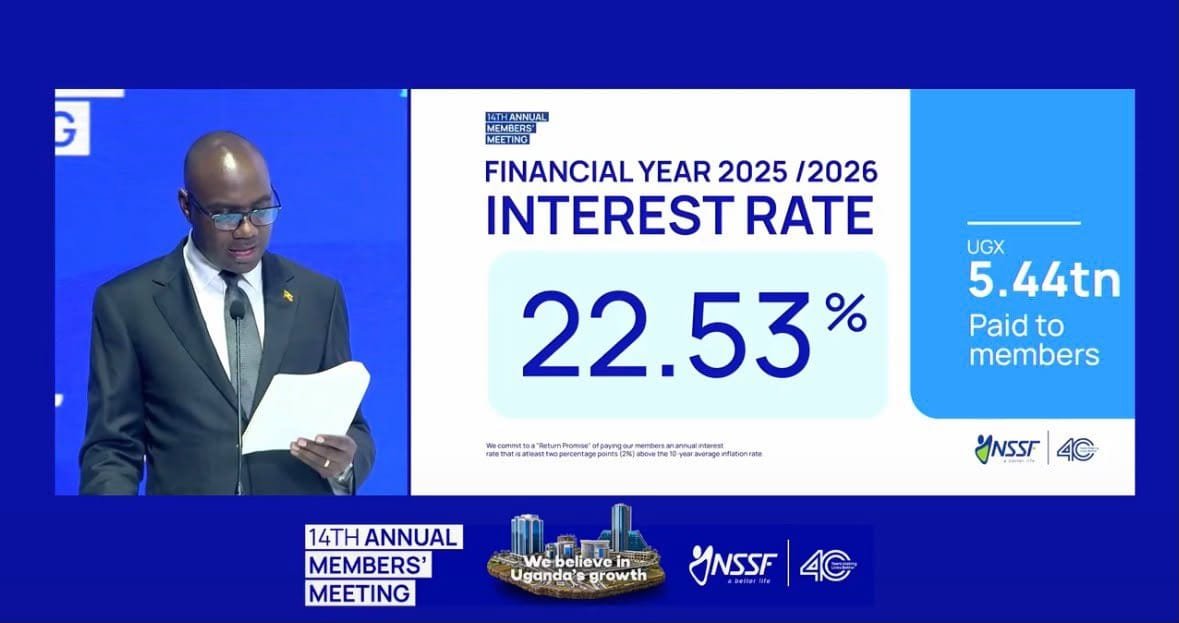
The celebration was almost inevitable. At the National Social Security Fund (NSSF) 14th Annual Members’ Meeting on September 24, Finance Minister Henry Musasizi announced an interest rate of 22.53 percent for the financial year ended June 30, 2026, the highest rate in the Fund’s 40-year history.
The declaration means Shs5.44 trillion will be credited to members’ accounts, compared with about Shs2.79 trillion at a rate of 13.5 percent the previous year. The numbers are impressive. But beyond the screenshots of growing balances and congratulations, there is a more important question: how did NSSF actually get there?
The answer is not one spectacular investment. It is the combination of a large fixed income portfolio, stronger dividend income, substantial valuation and foreign exchange gains, growing member contributions and a steadily expanding asset base.
The Foundation: A Huge Fixed Income Portfolio
NSSF remains, above all, a large fixed income investor. By the end of June 2026, about 76.5 percent of its assets were invested in fixed income, down from 80.5 percent a year earlier. Equities accounted for 18.4 percent, while real estate represented 5.1 percent.
That allocation matters because fixed income investments provide the dependable income at the heart of the Fund’s performance. Interest income rose from about Shs2.88 trillion to approximately Shs3.5 trillion during the year. The Fund also invested about Shs4.32 trillion in Uganda, with government securities continuing to account for a significant portion of its investments.
This is the less glamorous part of the story, but arguably the most important. A portfolio approaching Shs32.8 trillion can generate substantial income even without extraordinary movements in financial markets. NSSF’s asset base had grown from about Shs26 trillion a year earlier, giving the Fund a much larger pool from which to generate investment income.
Equities Added Another Layer
The second contributor was the Fund’s equity portfolio.
Dividend income from listed equities increased by 55 percent, from Shs238.14 billion to about Shs369 billion. Managing Director Patrick Ayota pointed to the Fund’s investments across East African markets and its focus on quality, dividend paying companies.
Equities represented less than a fifth of the portfolio, but their contribution became more significant during a favourable market period. The combination of dividend income and changes in market valuations helped lift overall investment earnings.
Real estate, by contrast, was not a major driver of the record result. Property income stood at about Shs16 billion, slightly below the Shs16.6 billion recorded the previous year.
Then Came the Market Gains
This is where the 22.53 percent story becomes particularly interesting.
NSSF’s total income rose by about 85 percent to Shs6.51 trillion, while realised income was approximately Shs3.88 trillion, up from Shs3.13 trillion.
The difference was largely associated with fair value movements and foreign exchange gains. When the market value of investments rises, or when regional currencies in which the Fund has investments appreciate against the Uganda shilling, the value of those holdings can increase in the financial statements.
These gains are legitimate components of investment performance, but they are different from recurring coupon or dividend income. They are also more sensitive to market conditions.
That distinction is important. The 2025/26 result was therefore not simply the product of NSSF collecting more interest. It reflected a strong underlying income stream combined with a significant market tailwind.
A Bigger Contribution Base
Investment performance was supported by growth in the Fund itself.
Member contributions increased to about Shs2.42 trillion, up from approximately Shs2.13 trillion. NSSF registered 311,000 new members, exceeding its 300,000 target, while another 55,000 dormant accounts were reactivated.
By year end, the Fund had about 3.6 million registered members, with approximately 2.7 million holding balances. Member funds increased by 24.7 percent to Shs31.85 trillion.
At the same time, benefits paid increased by about 17 percent to Shs1.55 trillion, benefiting 50,499 members. The Fund was therefore receiving substantial new contributions while continuing to meet its obligations to members.
What the 22.53 Percent Really Tells Us
Put simply, NSSF entered the year with a much larger pool of assets, generated more recurring income from its predominantly fixed income portfolio, collected more dividends from equities and benefited from favourable market valuations and currency movements.
That combination produced an exceptional year.
But it also provides context for the headline rate. Not every component of the 2025/26 performance is equally repeatable. Interest and dividend income can provide recurring support, while fair value and foreign exchange gains depend more heavily on market conditions.
NSSF’s long term strategy is built around continued growth in membership and assets. Its Vision 2035 targets include expanding coverage significantly and growing the Fund’s asset base while maintaining investment discipline.
So members should certainly take note of the 22.53 percent. But the more useful story is what sits underneath it.
The record return was built on scale, steady investment income, stronger contributions and an unusually favourable market environment arriving at the same time.
The real test now is not whether NSSF can celebrate 22.53 percent. It is whether the underlying engines of that performance, particularly recurring investment income and continued growth in the contribution base, can remain strong when the market conditions are less generous.
