
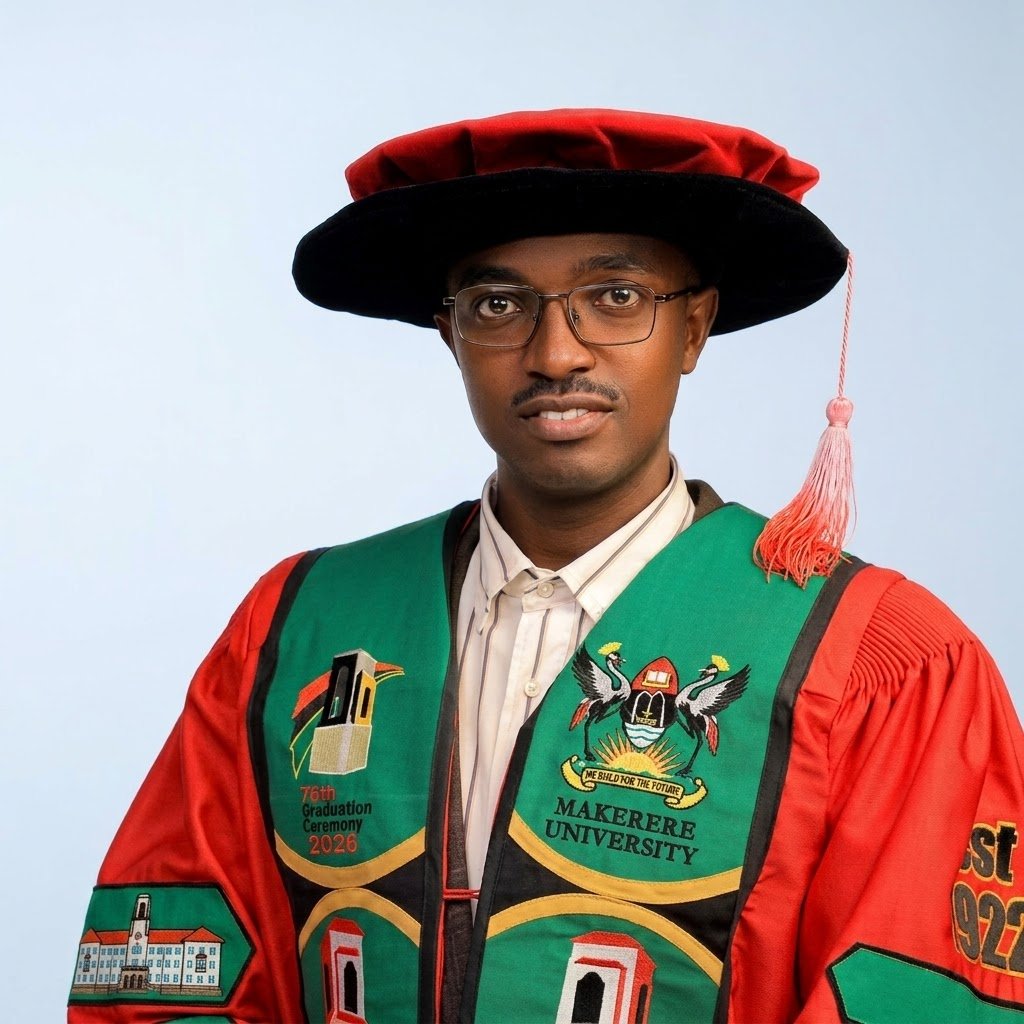
Uganda’s newsrooms have produced editors, publishers and broadcasters. They have rarely produced a Speaker’s spokesman with a PhD in the very industry he once chased deadlines for. Dr. Arinaitwe Deo Rugyendo is now that rare case: a journalist who spent two decades asking institutions to explain themselves, and who must now do the explaining himself, from inside Parliament’s walls.
In August 2026, Rugyendo was appointed Principal Press Secretary to Speaker Jacob Marksons Oboth-Oboth, succeeding Joseph Sabiti. The timing was almost poetic. He had completed a PhD in Journalism and Communication at Makerere University only months earlier, defending his thesis in January and graduating that February. It capped a career that has rarely moved in a straight line, taking him through newsrooms, media boardrooms, lecture halls, football administration and now the corridors of Parliament.
To understand how he got here, it helps to go back to where he started.
A Childhood Shaped by Hardship, a Career Shaped by Curiosity
Rugyendo was raised by his mother, a primary school teacher, after his father died when he was still an infant. He came of age during a difficult stretch of Uganda’s economic history, later attending Kitabi Seminary before finding his way into journalism as a cub and freelance reporter for the Daily Monitor.
It was there, covering stories such as the harrowing 2000 Kanungu tragedy, that he learned what the profession demanded of those who practised it seriously.
That early education in the newsroom would not stay confined to reporting for long.
The Tabloid That Changed Everything
In 2001, at just 23, Rugyendo made a decision that would define the next chapter of his career: he left the Daily Monitor to help co-found Red Pepper, a publication that would go on to become Uganda’s first English-language tabloid.
He rose to become chief marketing officer and director, a role that pulled him away from pure reporting and into the commercial and strategic side of building and sustaining a media business.
It was a formative period, but not one without risk.
In November 2017, Rugyendo was among several Red Pepper directors and editors arrested after the paper published a 20 November article alleging that President Yoweri Museveni was plotting to overthrow Rwandan President Paul Kagame.
Charges followed, including libel, offensive communication and publishing information prejudicial to security. Police initially mentioned treason, but the charge was later dropped. Rugyendo was eventually granted bail.
It was one of the more difficult episodes in a career that has otherwise been marked by institution-building, scholarship and professional reinvention. It also reflected the complex environment in which Uganda’s media has operated.
Turning Research Into Something People Could Actually Read
By 2019, Rugyendo had set his sights on a different problem: the gap between what researchers discover and what the public ever gets to know about it.
His answer was ResearchFinds News, a venture built around what he calls the “newsification” of research taking dense academic findings and turning them into something readable, useful and relevant to wider audiences.
The platform has since produced policy-focused content and supported graduate students navigating academic writing and research communication.
The same instinct that knowledge is only valuable if people can access and understand it shaped his work in education.
Through e2 Young Engineers Uganda and the ASIST initiative, which he helped launch around 2015 and 2016, Rugyendo has worked to get young Ugandans interested in engineering, science and problem-solving before they reach university.
Whether the audience is a newspaper reader, a researcher, a policymaker or a schoolchild, the underlying idea has remained similar: make knowledge accessible and create pathways for people to engage with it.
The Scholar Behind the Journalist
While building these ventures, Rugyendo was also building an academic career.
He holds a bachelor’s degree in Social Sciences from Makerere University, a postgraduate diploma in mass communication from the University of Leicester in the United Kingdom, and a master’s degree in marketing pursued through Salford University and Robert Kennedy College.
His doctoral research brought him back to the industry where his professional journey began.
His thesis, “From Print to Digital: Evolution, Adoption and Contribution of ePapers in the Ugandan Press,” examined the transformation of Uganda’s newspaper industry from traditional print to digital publishing.
Funded by the Makerere Research and Innovations Fund and supervised by Associate Professor William Tayeebwa and Professor Adolf Mbaine, the research gave Rugyendo a scholarly lens on a transformation he had experienced firsthand in the newsroom and media business.
His public defence took place on 30 January 2026 at Makerere University’s School of Languages, Literature and Communication, and he graduated during Makerere’s 76th graduation ceremony in February.
His wider academic work has extended into institutional communication and digital marketing. In 2025, he published research examining social-media marketing among Ugandan universities, separate from his doctoral study.
He has also taught as a Senior Lecturer at Victoria University and worked with the Network for Multidisciplinary Research Africa.
A Résumé That Refuses to Stay in One Lane
Journalism and academia have hardly been the limits of Rugyendo’s ambitions.
He has served as board chairman of the Uganda Premier League and the FUFA Super League, placing him in a senior leadership role within one of Uganda’s most visible sporting institutions.
He has also chaired the Jada Coffee Board, linking his experience to Uganda’s agricultural and export economy.
The pattern is notable. Across media, academia, sport and business, Rugyendo has repeatedly occupied positions that require him to navigate institutions, manage competing interests and communicate with different audiences.
International recognition has followed.
He was part of the 2012 cohort of the Archbishop Desmond Tutu Leadership Fellowship, received the Crans Montana Future Leaders’ Award in Switzerland in 2013, and was honoured with the African Young Social and Development Entrepreneur PAP Award in 2017.
Now, a New Kind of Newsroom
Oboth-Oboth was elected Speaker of Uganda’s 12th Parliament on 25 May 2026. Rugyendo now joins his office at a time when Parliament’s relationship with the public is shaped not only by traditional media but also by social media, digital platforms and rapidly changing expectations around transparency and access to information.
It is into this environment that Rugyendo steps as Principal Press Secretary.
Following his appointment, he laid out a straightforward set of priorities: diligence, hard work and total loyalty to the Speaker, alongside commitments to transparency, integrity and the fight against corruption.
He also pledged closer collaboration with both traditional and online media, signalling an intention to make Parliament’s communication with the public more active and responsive.
“We shall set the agenda together,” he said.
The phrase captures the collaborative approach he hopes to bring to the role, but it also reflects the instincts of someone who has spent much of his career building bridges between institutions and the people who depend on them.
For years, Rugyendo stood outside institutions, reporting on their decisions, questioning their choices and helping the public make sense of what they did.
Now he stands inside one of Uganda’s most important institutions, with the responsibility of helping it communicate clearly, openly and effectively.
That is the unusual arc of his career.
The cub reporter became a media entrepreneur. The media entrepreneur became a researcher. The researcher became an academic and a communicator of research. The journalist moved into institutional leadership.
And now, the man who spent years asking institutions to explain themselves has been given the job of helping one of the country’s most consequential institutions do exactly that.
