
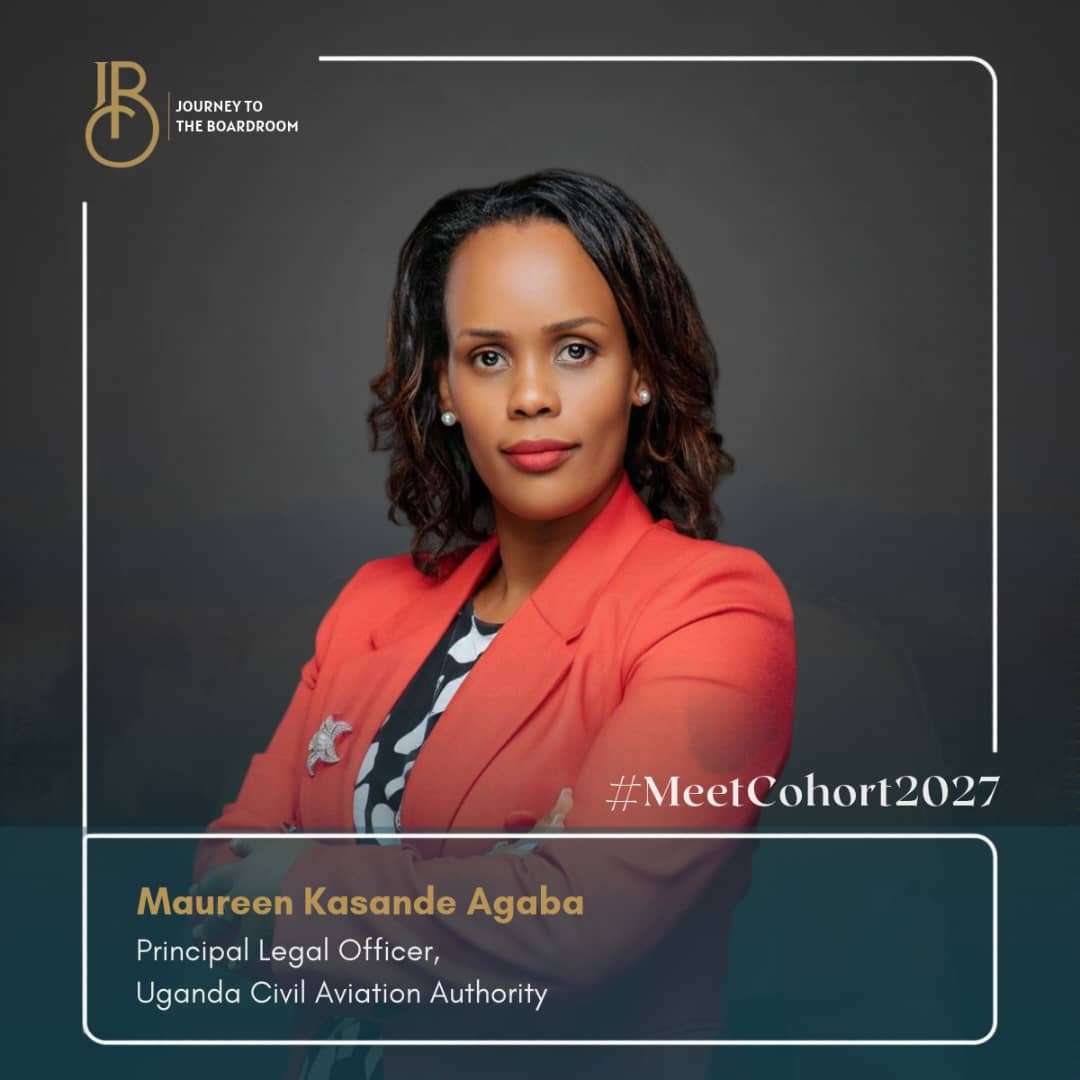
In aviation, every flight operates within a framework of laws, regulations and international agreements that determine how aircraft move, how operators conduct business and how countries manage their airspace. Behind this complex system are legal professionals whose work ensures that aviation institutions remain compliant, commercially sound and accountable.
For more than 15 years, Maureen Kasande Agaba has built her career within this environment, developing expertise in aviation law, regulatory compliance, corporate governance, contract management and commercial risk.
She currently serves as Principal Legal Officer – Board Affairs at the Uganda Civil Aviation Authority (UCAA), where she works closely with the Corporation Secretary and senior management to support the governance of the Authority’s Board and its committees. Her responsibilities place her at the intersection of institutional oversight, statutory compliance and the legal frameworks governing Uganda’s aviation sector.
Her professional journey reflects a progression from operational legal work to strategic institutional governance, with an important regional contribution to the harmonisation of civil aviation regulations across the East African Community.
Building Expertise Within Aviation Law
Agaba’s career at UCAA has taken her through the positions of Legal Officer, Senior Legal Officer and Principal Legal Officer – Board Affairs. This progression has given her experience across different dimensions of aviation administration, from legal advisory work and contract management to board governance and regulatory oversight.
In her earlier roles, she worked on aviation-related agreements, statutory instruments, procurement matters and legal disputes. Her exposure to bilateral air services arrangements and air navigation service agreements provided an understanding of the legal foundations underpinning international aviation operations.
She also gained experience in public procurement litigation and contentious labour and civil matters, including representing institutional interests before Uganda’s courts. This combination of advisory, contractual and litigation experience strengthened her understanding of the legal risks facing public institutions and the importance of ensuring that administrative decisions are properly grounded in law.
Her transition into the Board Affairs function expanded that responsibility from individual legal matters to institutional governance. Working alongside the Corporation Secretary and senior management, she supports the effective operation of the UCAA Board and its committees, helping ensure that decisions are properly guided by the relevant statutory and regulatory frameworks.
This work requires an understanding of the relationship between board procedures, public-sector accountability, financial oversight and institutional performance. It also places legal compliance within the broader responsibility of ensuring that governance decisions are transparent, properly documented and defensible.
Contributing to East Africa’s Aviation Integration
One of the defining dimensions of Agaba’s career has been her contribution to regional aviation integration.
Across the East African Community, differences in national aviation regulations and licensing requirements have historically created administrative barriers for aviation professionals seeking to work across borders. Harmonising these frameworks is important for improving professional mobility, strengthening regulatory cooperation and supporting the development of a more integrated regional aviation market.
Nominated by the Republic of Uganda, Agaba served on the regional committee established to implement the Automatic Validation of Personnel Licences (AVPL), where she was appointed Vice Secretary.
The initiative sought to establish a framework for recognising aviation personnel licences across participating EAC Partner States, reducing the need for professionals to navigate separate validation processes in each jurisdiction.
Agaba contributed to the development of three important regional legal instruments: the Model EAC Civil Aviation Act, the EAC Model Agreement on Automatic Validation of Personnel Licences and the EAC Model Civil Aviation Regulations.
These instruments address different but complementary aspects of regional integration. The Model Civil Aviation Act provides a legislative reference for harmonising national aviation laws, while the agreement on automatic validation establishes a framework for mutual recognition of personnel licences. The model regulations support greater consistency in technical aviation safety and security requirements.
Her contribution extended to supporting the domestication of these regional instruments within Uganda’s national legal framework. This work illustrates the practical relationship between regional policy development and national implementation, where agreements and model laws must be translated into enforceable domestic arrangements.
It also reflects an important dimension of her professional experience: the ability to work across legal, technical and institutional boundaries in pursuit of regional regulatory cooperation.
Bringing Legal Discipline to the Boardroom
Agaba’s current role places corporate governance at the centre of her professional responsibilities.
At UCAA, the Board provides institutional oversight within a sector where decisions have significant implications for public infrastructure, aviation safety, regulatory compliance and commercial operations. Supporting this work requires more than knowledge of legislation. It demands an understanding of board procedures, committee responsibilities, statutory mandates and the accountability obligations attached to public institutions.
Her experience in Board Affairs has given her exposure to the governance processes of the Authority’s Board and its committees, including Audit and Governance, Technical and Safety, Human Resources, and Finance.
Through this work, she contributes legal guidance that supports institutional decision-making and helps align governance processes with the applicable legal and regulatory requirements.
Her background in procurement, contracts and litigation also provides an understanding of how legal risks can emerge from institutional decisions, particularly where public resources, infrastructure investments and contractual obligations are involved.
This combination of legal practice and board governance provides a foundation for contributing to corporate boards, especially those operating in highly regulated sectors or engaging with complex public-private and cross-border relationships.
Preparing for Board-Level Leadership
As a member of the Journey to the Boardroom 2027 Cohort, Agaba is extending her experience in statutory governance towards broader board-level leadership.
Her professional background offers a perspective that combines legal interpretation with institutional accountability. She understands how legislation shapes organisational decisions, how board procedures support oversight and how regulatory obligations influence the strategic choices available to an institution.
Her experience in regional aviation integration also brings an international dimension to her governance profile. Having contributed to the development of legal instruments across multiple jurisdictions, she has worked within the complex relationship between national interests, regional cooperation and international aviation standards.
For organisations operating in regulated industries, this experience is particularly relevant. Boards must increasingly consider how legislation, regulatory changes, contractual obligations and stakeholder relationships affect their ability to execute strategy and manage risk.
Agaba’s career has given her practical exposure to these questions, both within a national statutory authority and through regional regulatory cooperation.
The Next Chapter
Africa’s economic integration depends partly on the strength of its transport networks and the institutions responsible for regulating them. As regional trade expands and aviation markets become more interconnected, the need for consistent legal frameworks, effective oversight and accountable institutions will continue to grow.
Maureen Kasande Agaba’s professional journey reflects the importance of legal expertise in building and sustaining these institutions. From aviation contracts and litigation to board governance and regional regulatory harmonisation, her experience has developed around the structures that enable complex organisations to operate within clear and accountable frameworks.
Through the Journey to the Boardroom 2027 Cohort, she brings this experience into a broader conversation about corporate leadership and governance. Her contribution lies in understanding that sound boards do more than make decisions: they ensure those decisions are legally grounded, institutionally responsible and capable of withstanding scrutiny.
