
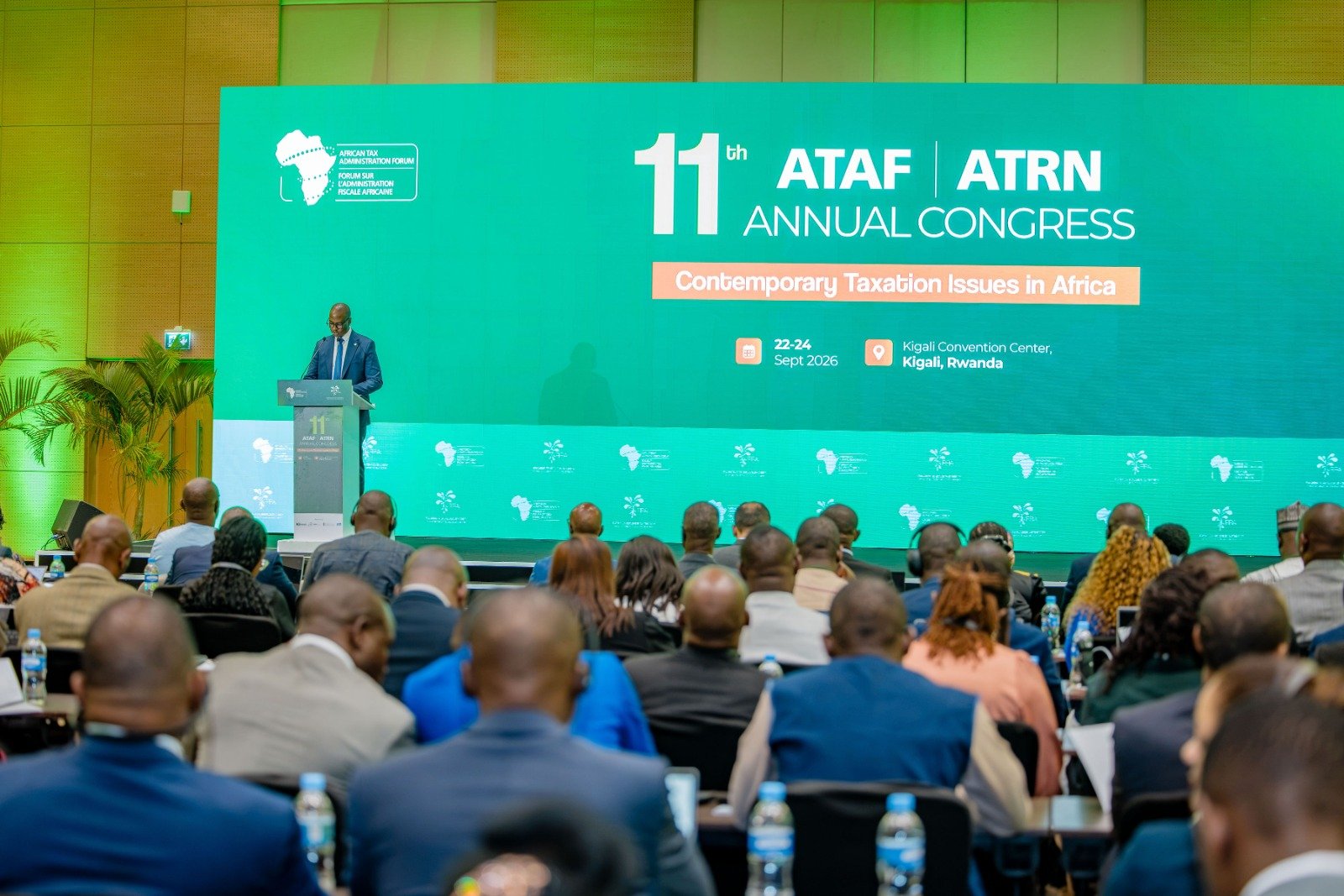
African tax administrators, policymakers and researchers have called for stronger use of locally generated evidence to improve domestic resource mobilisation and address the continent’s growing development financing needs. The call was made at the opening of the 11th Annual Congress of the African Tax Research Network (ATRN), held at the Kigali Convention Centre from 22 to 24 September 2026 under the theme, “Contemporary Taxation Issues in Africa.”
The Congress has brought together tax administrators, researchers, policymakers, legal practitioners, development partners and other stakeholders to examine the challenges and opportunities facing African tax systems. Opening the Congress, Rwanda’s Minister of Finance and Economic Planning, Yusuf Murangwa, said effective tax policies depended on research that was honestly collected, rigorously tested and decisively applied. “A government that governs by instinct will sooner or later misallocate the resources its people have entrusted to it,” he said.
The Minister warned that policymaking without adequate evidence could lead governments to grant incentives whose costs had not been measured, tax activities that had not been properly mapped or defend reforms whose effects had not been evaluated. He said forums such as the ATRN Congress were important because they enabled researchers, tax administrators and policymakers to test their assumptions against evidence and the experiences of other countries.
Domestic resources the foundation for financing Africa
Minister Murangwa said domestic public resources must remain the foundation for financing Africa’s sustainable development, while international support should complement rather than replace national efforts. He noted that official development assistance was declining, borrowing costs remained high for many African countries and private financial flows were not increasing at the scale or on the terms required to meet the continent’s development priorities.
Referring to commitments made at the 2015 Financing for Development conference in Addis Ababa and reaffirmed at the Fourth International Conference on Financing for Development in Sevilla in July 2025, he said Africa would need to mobilise more resources from within the continent. “The greater part of that gap will have to be closed from within,” he said.
The Minister also referred to the African Union’s Agenda 2063, which places the financing of the continent’s development from its own resources at the centre of Africa’s long-term development ambition.For Rwanda, he said, domestic resource mobilisation was essential to achieving the objectives of Vision 2050 and the country’s Second National Strategy for Transformation, which runs until 2029.
Rwanda’s tax-to-GDP ratio currently stands at approximately 15 per cent, and the country aims to increase it to around 19 per cent by the end of the current planning period. Minister Murangwa said the necessary measures would be introduced gradually over several fiscal years to avoid imposing sudden pressure on households and businesses. He added that proposed measures would be selected on the basis of analysis. “Where the evidence did not support a measure, the measure falls. Where the evidence was incomplete, the commission worked to complete it,” he said.
ATAF urges greater reliance on African evidence
Speaking on behalf of Mary Baine, Executive Secretary of the African Tax Administration Forum (ATAF), ATAF Head of Domestic Tax and Capacity Building Emeka Nwankwo said locally generated research must play a more central role in Africa’s tax reforms. According to Nwankwo, tax revenue averaged approximately 15 per cent of gross domestic product across 39 African countries in 2024, compared with averages of 33.9 per cent in OECD countries, 21.3 per cent in Latin America and the Caribbean, and 19.6 per cent in Asia and the Pacific.
He said the figures reflected both the scale of Africa’s revenue challenge and the opportunity available to governments. “On a continental output of roughly three trillion dollars, each additional percentage point of GDP raised in tax is worth in the order of thirty billion dollars a year,” Nwankwo said.
He added that raising Africa’s average tax-to-GDP ratio to the level achieved by Latin America and the Caribbean could help close a significant portion of the estimated US$194 billion annual financing gap for the continent’s Sustainable Development Goals. Nwankwo said the pressure to improve domestic revenues had increased following a reported 23.1 per cent real-terms decline in official development assistance in 2025.
He also highlighted ATAF’s Revenue Action for Development in Africa, known as RADA, which was launched at the Sevilla financing conference in 2025. The initiative aims to double ATAF’s impact for member administrations by 2030 through digital tax infrastructure, rapid country support, capacity development and inclusive tax governance.
Since 2016, ATAF-supported interventions have generated more than US$6 billion in additional tax assessments, with US$2.8 billion collected into member treasuries, according to Nwankwo. In 2025, the interventions generated US$907.8 million in assessments and US$685.8 million in collections. He stressed, however, that the success of such initiatives would depend on the quality of the evidence guiding them. “The quality of the answers will determine whether RADA doubles our impact or merely doubles our activity,” he said. He identified tax exemptions, value-added tax gaps, informal-sector taxation and the effect of digitalisation on tax compliance as areas requiring further research.
Linking tax research to development policy
The ATRN was established in 2013 to connect researchers with tax administrations and policymakers. Nwankwo said the network had received 190 research paper submissions for the Kigali Congress, compared with 151 for the previous Congress in Cape Town. Of the submissions, 164 underwent double-blind peer review by 114 members of the Scientific Committee. Forty-eight papers were accepted for full presentation, seven for poster presentation and a further 40 were placed on a capacity-building track to support their authors towards publication. “We are not only selecting excellence; we are developing it,” Nwankwo said.
The focus on emerging researchers was also highlighted by Prof Annet Oguttu, Chairperson of the ATRN Advisory Board and Director of the African Tax Institute at the University of Pretoria. She said ATRN had established a mentorship program to help new tax researchers improve their papers before submission and maximise their chances of success. The program is expected to provide guidance on research development and preparation for conferences, journals and other academic platforms.
Nwankwo said ATAF’s objective was not merely to increase the amount of tax research, but also to make it more accessible and useful to those responsible for policymaking and administration. He described this as creating “research liquidity”, a system in which policymakers can find relevant evidence quickly and researchers can connect their findings with institutions capable of acting on them.
He said the ATRN’s peer-review system, Congress, journal, tax outlooks, mentorship programs and research partnerships were helping to strengthen this connection. He also noted that the African Multidisciplinary Tax Journal had been indexed in Scopus since January 2025. The journal’s sixth volume contains 16 peer-reviewed papers in English, French and Portuguese.
Digitalisation and taxpayer confidence boost revenue
Welcoming delegates to Rwanda, Ronald Niwenshuti, Commissioner General of the Rwanda Revenue Authority, said the country was honoured to host the Congress. He attributed Rwanda’s recent revenue performance to economic growth, strong value-added tax collection, expanded digital services, improved compliance measures and tax policy.
Niwankuti said improving tax collection was not simply a matter of introducing new levies. It also required tax administrations to understand compliance risks, identify sectors and taxpayer groups with the greatest exposure, deploy resources effectively and use data to inform decisions. He emphasised the importance of taxpayer behaviour and trust. Taxpayers, he said, were more likely to comply when they regarded the system as fair, understood what their taxes funded and were treated as partners in national development.
The Commissioner General also highlighted Rwanda’s electronic billing system and the use of transaction data to improve the understanding of taxpayer compliance. During the Congress, the Rwanda Revenue Authority is showcasing its Tax Tech Incubator Program, which is designed to turn digital data into scalable technological solutions for tax administrations.
The Congress program includes sessions on domestic resource mobilisation, judicial interpretation and tax disputes, artificial intelligence and automation, digitalisation, taxpayer behaviour, international taxation, transfer pricing and tax compliance. Research presented in Kigali is expected to contribute to discussions at the 2026 ATAF Annual Meetings and Technical Conference, scheduled to take place in Cairo from 1 to 5 November under the theme, “The Revenue Imperative: Africa’s Path to Financing Its Own Development.”
