

For decades, rural banking in Uganda has faced the same stubborn barriers: limited branch access, slow loan approvals, high operating costs, and millions of people excluded from formal financial services despite the rapid rise of mobile money.
Centenary Group now believes artificial intelligence could help change that.
In a major move that signals the growing intersection between banking and technology, Centenary Group has signed a strategic partnership with Huawei to accelerate its digital transformation agenda.
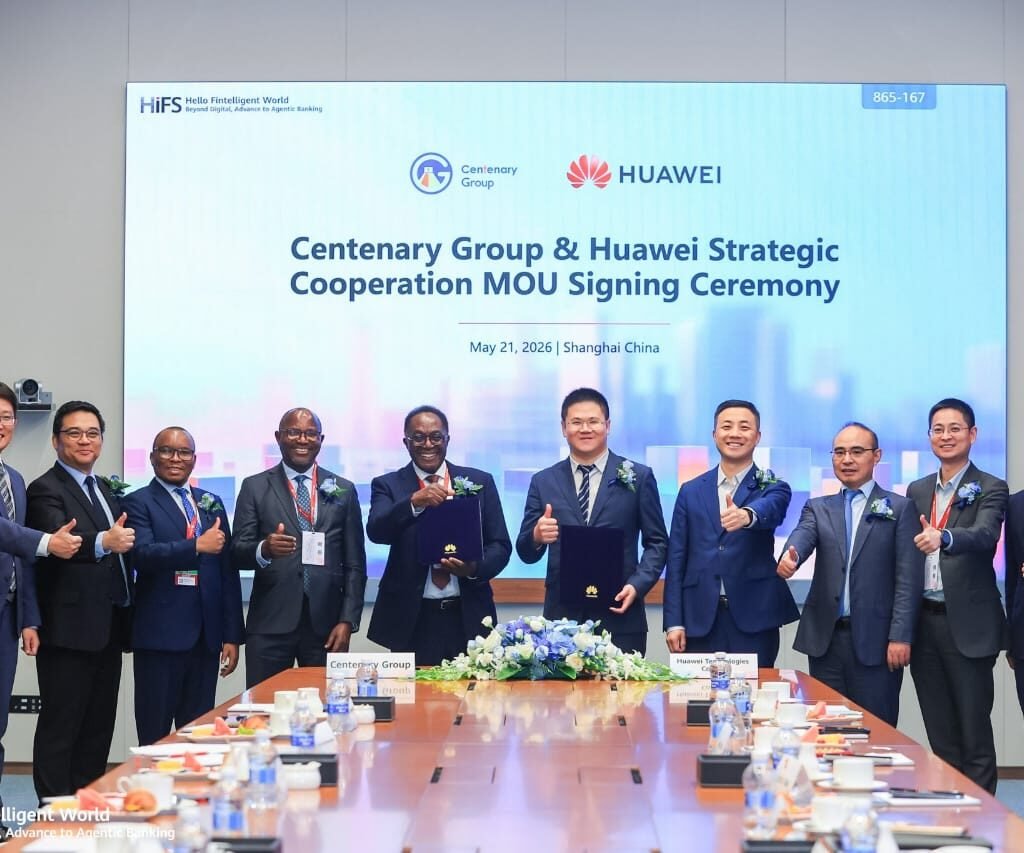
The agreement, signed in Shanghai on May 21, brings together one of Uganda’s largest financial institutions, serving more than four million customers, with one of the world’s biggest technology companies to deploy artificial intelligence, cloud computing, cybersecurity systems, and advanced digital infrastructure.
Centenary Group Chairman Prof. John Ddumba-Ssentamu described the partnership as a defining moment in the institution’s history, saying:
“Partnerships have always been at the heart of how Centenary Group has grown and this is the most significant we have signed in a generation.”
This is more than a routine technology upgrade. For a bank that has built its reputation around serving the unbanked and underbanked, particularly in rural communities, the partnership signals a deeper shift toward intelligent banking powered by data and automation.
The collaboration covers key areas including AI-driven banking systems, cybersecurity, cloud services, data centre modernisation, staff training, and digital innovation.
At the heart of the strategy is a simple business objective: lower costs while reaching more customers faster.
Artificial intelligence can automate repetitive banking processes, improve fraud detection, strengthen risk management, and accelerate loan approvals using alternative customer data. That matters in Uganda, where many rural customers and small businesses still lack formal financial records required by traditional banking systems.
The same leadership also emphasized the strategic alignment between the two institutions, noting:
“Huawei brings global depth; Centenary brings local mission and deep community trust. Together, we are building something that will matter to millions of Africans who deserve the kind of digital and financial inclusion this partnership will make possible.”
For SMEs, which remain the backbone of Uganda’s economy, the implications could be significant. Faster credit processing, more tailored financial products, and improved access to working capital could ease one of the biggest constraints facing small businesses: cash flow.
The timing is also strategic.
Uganda’s financial services industry is becoming increasingly competitive as fintech companies, telecom-led mobile money platforms, and digital lenders continue to reshape customer expectations. Banks are now under pressure to become faster, smarter, and more accessible while keeping operational costs under control.
By partnering with Huawei instead of building systems independently, Centenary gains access to advanced technology infrastructure while reducing development costs and implementation timelines.
Cybersecurity is another major factor behind the deal.
As digital banking grows, so do risks around fraud, cyberattacks, and data breaches. Strengthening digital security has become critical not only for customer protection but also for maintaining regulatory confidence and operational stability.
Reflecting on the deeper transformation required, the same leadership noted:
“AI cannot be treated as software you install and walk away from. It has to become the way an institution thinks and operates. That is the transformation Centenary Group is now committed to building.”
Beyond banking efficiency, the broader economic implications are substantial.
Expanding access to financial services in rural communities could support entrepreneurship, improve household resilience, and stimulate local economic activity. Greater financial inclusion often translates into more women-led businesses, stronger SME growth, and improved access to savings and credit products.
The partnership could also strengthen Centenary’s long-term regional ambitions. If the technology rollout succeeds in Uganda, the model could potentially be replicated in other African markets facing similar financial inclusion challenges.
However, the transition will not be without risks.
Questions around data privacy, regulatory compliance, digital literacy, and integration with legacy banking systems will need careful management. The Bank of Uganda is also expected to maintain close oversight as AI becomes more embedded in core financial operations.
Still, analysts say the direction is increasingly unavoidable.
Banks across Africa are rapidly shifting toward AI-powered systems as competition intensifies and customers demand faster digital services. Institutions that successfully combine technology with trust and accessibility are expected to dominate the next phase of financial growth.
The Centenary-Huawei partnership is ultimately not just about software, cloud systems, or automation. It is a broader bet that technology can help close Uganda’s financial inclusion gap while creating a more efficient and competitive banking sector.
The real challenge now is execution.
If the partnership translates into affordable, accessible, and practical banking solutions for ordinary Ugandans, it could help redefine what rural banking looks like in the digital age and position Centenary at the centre of Uganda’s next financial transformation.
