
Fifteen years is a long time in public service. It is even longer when spent at the center of a country’s economic decision-making.
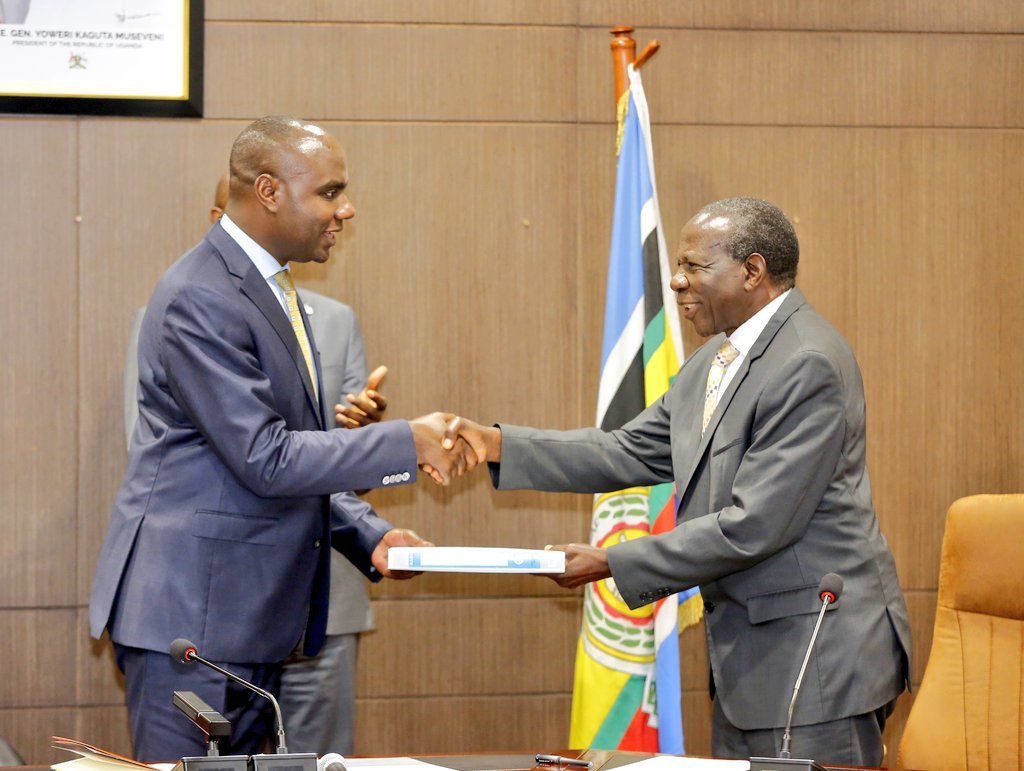
When Matia Kasaija first entered the Ministry of Finance, Planning and Economic Development as State Minister for Planning in 2011, Uganda’s economy was significantly smaller, infrastructure gaps were wider, and many of the economic transformation projects that dominate today’s conversations were still on the drawing board. By June 2026, after four years as State Minister and 11 years as full Cabinet Minister for Finance, Kasaija officially handed over the country’s economic command center to Hon. Henry Musasizi.
At 82, Kasaija leaves office as one of Uganda’s longest-serving and most recognizable finance ministers. Beyond the headlines and budget speeches, his tenure helped shape a period of economic expansion, structural transformation, and resilience through some of the most challenging global economic disruptions in recent history.
The formal handover at the ministry headquarters in Kampala marked the end of an era and the beginning of a new chapter under Musasizi, who steps into office at a critical moment as Uganda prepares for commercial oil production and pursues its ambitious Tenfold Growth Strategy.
Kasaija’s legacy is often remembered through his humor, wit, and uniquely relatable communication style. While finance ministries are typically associated with technical jargon, deficits, and fiscal discipline, Kasaija became known for making economics accessible to ordinary Ugandans.
His colorful remarks earned him the popular nickname “Minister of Enjoyment.” Journalists, parliamentarians, and the public eagerly anticipated his candid observations and memorable one-liners.
Perhaps his most famous moment came in 2018 when, while explaining Uganda’s economic progress, he stretched out his hands as if guiding an aircraft into the sky and declared that “the economy is now swiiiii.” The phrase instantly entered Uganda’s political vocabulary.
When the COVID-19 pandemic, global inflation, and the Russia-Ukraine conflict later disrupted economies worldwide, critics questioned what had happened to the economy that was supposedly flying. Kasaija responded with another memorable analogy.
“In movement, you expect accidents; we had an accident. But that does not mean the train stopped; the train is still moving.”
Then came another phrase that would become part of Uganda’s popular culture.
“Colleagues, money will come.”
What started as a reassurance during difficult fiscal discussions quickly became a national catchphrase, appearing in conversations, memes, and social media posts across the country. Years later, during a budget presentation, Kasaija returned with a smile and announced:
“Colleagues, money has come.”
Behind the humor, however, was a finance minister overseeing one of the most consequential periods in Uganda’s economic history.
When Kasaija became full Finance Minister in March 2015, Uganda’s nominal GDP stood at roughly $32 billion. By the end of the 2025/26 financial year, the economy had expanded to an estimated $69.3 billion, equivalent to about $197.1 billion in purchasing power parity terms. Gross National Income per capita rose to approximately $1,420, helping Uganda move beyond the lower-middle-income threshold.
The expansion was driven by deliberate efforts to formalize the economy, increase productivity, and implement successive National Development Plans aimed at accelerating industrialization, infrastructure development, and private-sector growth.
His tenure also coincided with one of the most turbulent periods in modern economic history. Global economies were battered by the COVID-19 pandemic, supply chain disruptions, geopolitical tensions, and inflationary pressures. Yet Uganda maintained relative macroeconomic stability and returned to strong growth.
Economic growth reached 6.4 percent in the financial year ending June 2026, up from 6.3 percent the previous year. Export earnings surged dramatically, reaching $18.04 billion in the twelve months to March 2026, representing a remarkable increase over five years. Coffee exports alone climbed to $2.46 billion, underscoring the growing importance of value addition and export-led growth.
Under Kasaija’s stewardship, Uganda also maintained one of the region’s most stable inflation environments. Average inflation remained at approximately 3.8 percent during his final fiscal year, comfortably below the government’s medium-term target of 5 percent.
Strong foreign direct investment inflows of about $3.2 billion and a balance of payments surplus of $2.47 billion helped strengthen Uganda’s external position. Foreign exchange reserves grew to approximately $6 billion, providing an important buffer against future shocks.
Perhaps most significantly, Kasaija’s budgets consistently prioritized long-term investments designed to transform the economy rather than simply manage short-term challenges.
His tenure saw major investments in electricity generation and transmission, industrial parks, transport infrastructure, and strategic projects such as the Standard Gauge Railway. Domestic revenue mobilization steadily improved, with collections projected to reach Shs35.7 trillion and finance more than 80 percent of discretionary government spending.
He also oversaw much of the fiscal planning and infrastructure preparation for Uganda’s oil and gas sector, including key developments linked to the East African Crude Oil Pipeline and associated investments in Hoima. These preparations have laid the groundwork for commercial oil production expected to begin during the 2026/27 financial year.
At a broader level, Kasaija helped shape the foundations of Uganda’s Tenfold Growth Strategy and the Fourth National Development Plan (NDP IV), which aim to expand the economy toward the $500 billion mark through industrialization, value addition, science and technology, tourism, and resource monetization.
His successor, Henry Musasizi, inherits both opportunity and responsibility. A certified public accountant with extensive parliamentary and government experience, Musasizi assumes office just after presenting his maiden national budget of Shs84.4 trillion, a framework built around accelerating growth, supporting wealth creation, and preparing Uganda for an oil-driven economic takeoff.
During the handover ceremony, Kasaija pledged continued support from Parliament, where he remains MP for Buyanja County, and encouraged ministry officials to maintain fiscal discipline and protect the gains achieved over the years.
Musasizi, in turn, paid tribute to his predecessor, describing him as a humble leader whose open-door approach fostered collaboration and mentorship throughout the ministry.
As Uganda embarks on a new phase of economic transformation, Matia Kasaija leaves office having achieved something few finance ministers manage: combining fiscal stewardship with public affection. He proved that economics does not always have to be communicated through technical language and spreadsheets. Sometimes, it can be explained through trains, airplanes, humor, and simple reassurance.
For many Ugandans, he will be remembered not only for the budgets he presented or the economic milestones achieved during his tenure, but also for the optimism he brought to one of government’s most demanding offices.
And perhaps that is why the title of “Minister of Enjoyment” endured for so long. Behind the jokes was a finance minister who spent fifteen years helping steer Uganda’s economy through uncertainty while convincing the country that progress was still possible.
As he exits the Treasury, one phrase remains inseparable from his legacy:
“Colleagues, money will come.”
