
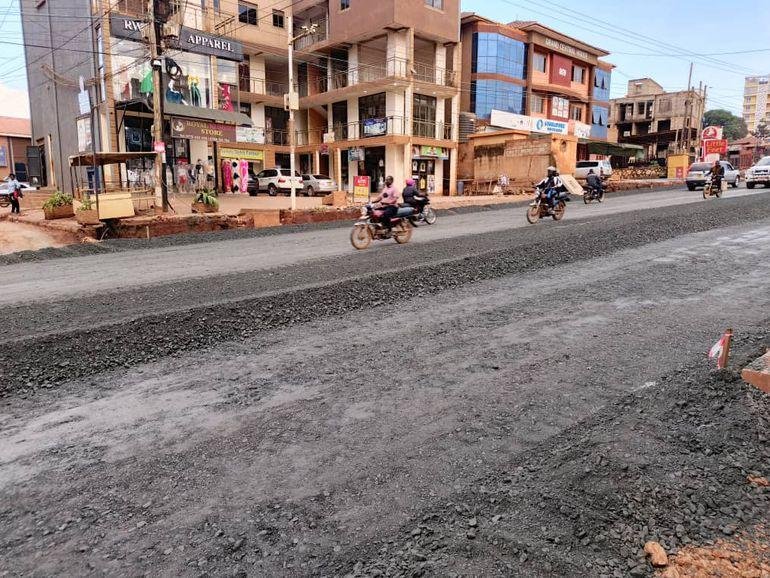
Road construction is supposed to be good news. A newly paved or widened road promises better access, more customers, and easier movement of goods. But for businesses sitting right next to a construction site, the months or even years before that promise is delivered can be brutal.
Across Uganda, from major roads around Kampala to projects such as the Kampala-Mpigi Expressway, traders, shopkeepers, restaurant owners, and other businesses can find themselves paying an unexpected price for infrastructure development. Their businesses remain open, their bills continue to arrive, but the customers who once sustained them suddenly struggle to reach them.
A Restaurant Caught in the Middle
Picture a mid-sized restaurant along a busy Kampala road. Before construction begins, the business depends on a steady stream of customers. Some are people walking in from nearby offices. Others are motorists stopping for lunch or picking up takeaway. Some simply see the restaurant from the road and decide to stop.
Then construction begins.
The road is narrowed, diverted, or reduced to a single lane. Customers who once pulled over easily can no longer do so. The parking area outside the restaurant is dug up, fenced off, or occupied by construction equipment and materials. Traffic builds up, and regular customers who used to stop on their way home begin avoiding the area altogether.
Pedestrians face their own problems. Footpaths are dug up, blocked by barriers, or replaced with temporary routes that are difficult to navigate. A restaurant that remains physically open can suddenly become practically inaccessible.
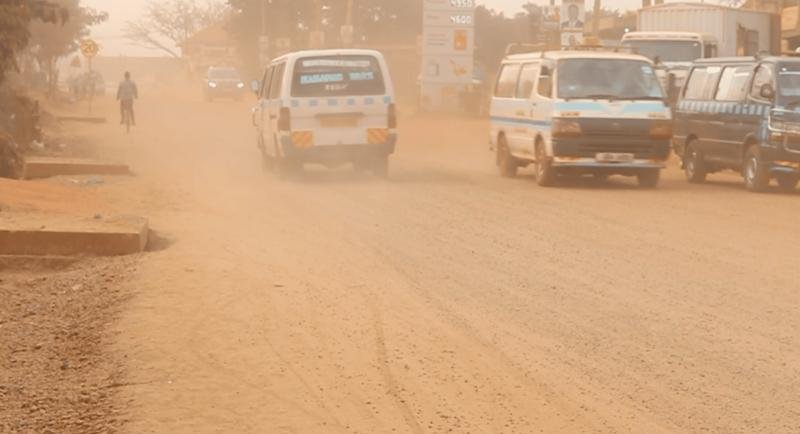
Then comes the dust.
Construction dust settles on outdoor seating, signage, parked vehicles, and surrounding buildings. It can drift into the restaurant through open doors and windows, making the environment uncomfortable for both staff and customers. Nobody wants to sit down for lunch while dust is blowing around them or settling near their food.
For some businesses, this disruption lasts weeks. For others, it can continue for months or years.
The result is a particularly painful situation: the business is still operating, still paying rent, still paying employees, still buying stock, and still meeting its other obligations, but the customers who once paid those bills have disappeared.
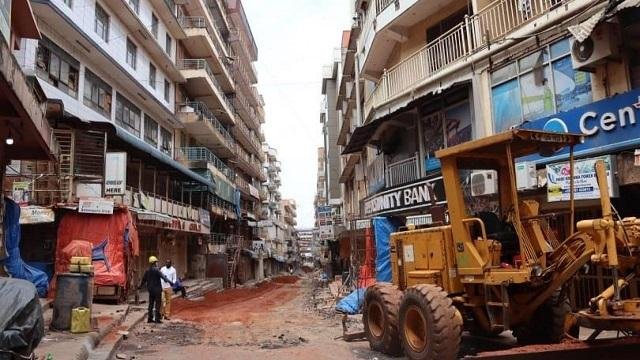
The restaurant has not closed. The road has effectively closed it off.
What Ugandan Law Actually Says About Compensation
This is where the situation becomes complicated.
Many business owners reasonably assume that if a government road project causes their income to collapse, they should be entitled to compensation. But Uganda’s legal framework does not provide a simple, general right to compensation for every form of business disruption caused by road construction.
Compensation for Land Taken, Not Simply Lost Trade
Article 26 of Uganda’s 1995 Constitution protects the right to property. It provides that a person’s property cannot be compulsorily taken unless the applicable legal requirements are met, including prompt payment of fair and adequate compensation.
Ugandan courts have reinforced this principle in cases involving compulsory acquisition of land for public infrastructure. In the well-known case involving the Uganda National Roads Authority and the Hoima-Kaiso-Tonya road, the Constitutional Court found aspects of the old land acquisition framework unconstitutional because they allowed government to take possession of property before compensation had been paid.
The Land Acquisition Act also provides for compensation where land and property are acquired or where crops, trees, and other property are affected.
But there is an important distinction for the restaurant owner.
If the road project requires the government to acquire part of your land, your building, or other property, there may be a clear basis for compensation.
If, however, your restaurant remains on its original property but is simply located next to a road that is under construction, the situation is different.
The law does not clearly guarantee compensation simply because your customer numbers have fallen, your parking has become inaccessible, or your revenues have collapsed because of construction.
In other words, there is a significant difference between losing property and losing business because of the temporary disruption surrounding that property.
That distinction can leave businesses absorbing significant losses without a straightforward statutory compensation mechanism.
What About Dust, Noise and Environmental Damage?
Environmental law provides another potential avenue.
Infrastructure projects are generally required to undergo environmental and social assessment, with measures designed to identify and mitigate potential impacts on surrounding communities, properties, and businesses. The National Environment Management Authority plays a central role in Uganda’s environmental regulatory framework.
For road construction, mitigation measures can include dust suppression, traffic management, drainage management, noise control, and maintaining reasonable access to surrounding properties.
In practical terms, contractors may be expected to water dusty roads, manage construction materials, provide appropriate diversions, and ensure that construction activities do not create unnecessary harm to neighbouring communities and businesses.
This matters because not every disruption caused by road construction is necessarily unavoidable.
There is a difference between a business experiencing some temporary inconvenience because a road is being upgraded and a contractor failing to take reasonable measures to control dust, blocking access without justification, or causing direct physical damage to a business’s property.
Where a business owner can demonstrate that a contractor’s negligence, unlawful conduct, or failure to comply with applicable environmental requirements caused a specific and provable loss, there may be grounds for pursuing a civil claim or regulatory action.
The difficulty is that proving such a claim can be expensive and complicated.
A business owner would potentially need evidence showing what the contractor did, what obligations applied, what damage occurred, and how the conduct directly caused the loss.
For a large company, that may be manageable.
For a small restaurant, salon, shop, or roadside business already struggling with declining revenue, hiring lawyers and commissioning evidence can be another financial burden.
Delays Make Everything Worse
Then there is the problem of time.
A road project that was supposed to take 18 months can sometimes stretch much longer because of funding challenges, land acquisition disputes, contractor issues, changes in scope, or delays in accessing construction sites.
For businesses located along the affected corridor, every additional month matters.
One month of reduced sales can be difficult. Six months can threaten the survival of a small business. Two or three years can fundamentally change whether that business survives at all.
The longer construction continues, the more the initial disruption becomes a structural financial problem. Customers develop new routines. They find restaurants in other areas. They move their shopping elsewhere. Employees may leave. Suppliers may become less willing to offer credit. Rent arrears can accumulate.
By the time the road is finally completed, the business may no longer have the customer base it had before construction began.
The irony is that the completed road may eventually bring more economic activity to the area while some of the businesses that were there before the project began are no longer around to benefit from it.
The Practical Reality for Business Owners
So what can a business owner do? The first step is documentation.
Business owners affected by major road construction should keep records of their situation before, during, and after the project. This can include sales records, photographs, videos, rent payments, staff costs, evidence of blocked access, correspondence with contractors or authorities, and records of complaints.
If access to the business is blocked, document when it happened and how long it lasted. If dust or construction activity causes physical damage, document it.
If promised access routes are not provided, document that too.The second step is engagement.
Business owners can approach local leaders, area Members of Parliament, the Uganda National Roads Authority, local authorities, and the relevant contractor or project management team. Sometimes relatively simple interventions can make a difference: better signage, temporary parking areas, pedestrian access, alternative entrances, controlled traffic diversions, or clearly marked routes to businesses.
Businesses can also adapt where possible.
Some may introduce delivery services. Others may increase takeaway operations, strengthen their digital marketing, negotiate temporary arrangements with landlords, reduce operating hours, or move some operations online.
These measures may help a business survive, but they should not obscure the bigger issue.
A business should not have to carry the entire economic cost of a public infrastructure project simply because its premises happen to sit next to the construction zone.
The Policy Question Uganda Needs to Ask
Road infrastructure is essential to Uganda’s economic development. Better roads can reduce travel times, improve trade, connect communities, and create new commercial opportunities.
But infrastructure development also creates costs, and those costs are not always captured in the official project budget.
When a road project destroys access to a business for months, creates severe dust, eliminates parking, disrupts pedestrian movement, and causes customers to stay away, someone is paying for that disruption.
Often, it is the business owner.
That raises an important policy question: should Uganda’s road development framework do more to protect businesses that are temporarily disrupted by major public infrastructure projects?
The answer does not necessarily have to be a blanket compensation scheme for every decline in sales. Measuring lost business can be complicated, and not every reduction in trade can fairly be attributed to a construction project.
But there is room for stronger protections.
Projects could have enforceable requirements for maintaining reasonable business access. Contractors could face clearer obligations around dust and traffic management. Businesses could have more accessible mechanisms for reporting violations and seeking remedies. Major projects could also consider the economic impact on businesses along affected corridors when planning construction phases.
Article 26 protects Ugandans from losing their property without lawful acquisition and appropriate compensation.
But there is another, less visible cost of development: the business that keeps its property but loses its customers. The road may eventually bring prosperity.
The question is whether the businesses that paid the price during construction will still be there to enjoy it.
