

Uganda’s young agricultural innovators are being challenged to move beyond prototypes and turn their solutions into viable businesses as the AYuTe Africa Challenge Uganda awarded UGX205 million in catalytic financing to winners of its fifth season.
The awards were presented on Thursday at Sheraton Hotel Kampala during the Season 5 Awards Gala held under the theme “Go Big. Go Bold.” The competition attracted 836 applications from young Ugandans developing solutions across agriculture and agricultural value chains, up from 307 applications recorded in 2025.
The growth in applications was presented at the event as evidence of increasing interest among young people in using technology, entrepreneurship and innovation to address challenges facing farmers and agricultural businesses. The bigger question raised during the event was what happens after an innovation receives funding.
Hon. Eng. Jonard Asiimwe Akiiki, Minister for Science, Technology and Innovation in the Office of the President, told innovators that Uganda needs stronger systems to move promising ideas from prototypes into products, businesses and wider markets.
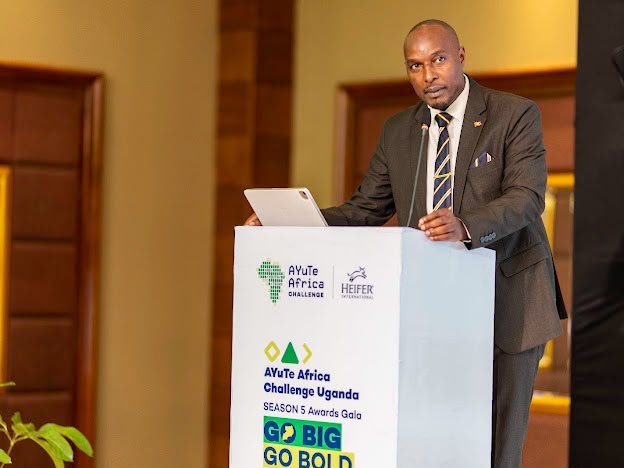
He pointed to challenges including limited testing and fabrication facilities, patient financing, standards and certification, market information, distribution networks and access to customers willing to adopt locally developed products.
“The innovation journey” therefore needs to extend beyond research and development, with greater attention given to product development, validation, commercialisation, industrial scale and access to regional and global markets, he said.
The minister’s message comes as the government continues to push research institutions and innovators towards commercialisation. During a recent engagement with Makerere University, Akiiki similarly called for research to move beyond prototypes and publications into products, services and enterprises that create value and jobs.
The challenge was also central to the panel discussion at the AYuTe gala, which focused on “Idea to Market”. Speakers discussed the practical hurdles young entrepreneurs face after developing an innovation, including product development, business modelling, certification, financing, packaging, market access and establishing a customer base.
The Consortium for Enhancing University Responsiveness to Agricultural Development, CURAD, explained how its incubation model supports entrepreneurs from early-stage ideas through business development and product commercialisation.
The incubator works with entrepreneurs to assess their ideas, develop business cases, improve products and packaging, and establish viable business models. One challenge raised during the discussion was the difficulty young businesses face when seeking certification from the Uganda National Bureau of Standards.
Entrepreneurs often need a finished product before seeking certification, while limited capital makes producing sufficient samples difficult. Incubation support therefore helps some founders develop test products and begin building a market while working through the requirements for formal approval.
For previous AYuTe winners, the transition from an idea to a commercial product has involved repeated testing and refinement. Nakalema Ann Asumpta, a Season 3 winner who developed a solar-powered egg incubator, told the audience that her interest in poultry technology grew from observing farmers struggle to access day-old chicks.
Her university research led to a prototype, which she later entered into an innovation competition. After receiving funding, she said the incubator went through three versions as she learnt more about product development and entrepreneurship. Her experience demonstrated that financing alone does not complete an innovation journey. The product also needs testing, refinement, business knowledge and a route to customers.
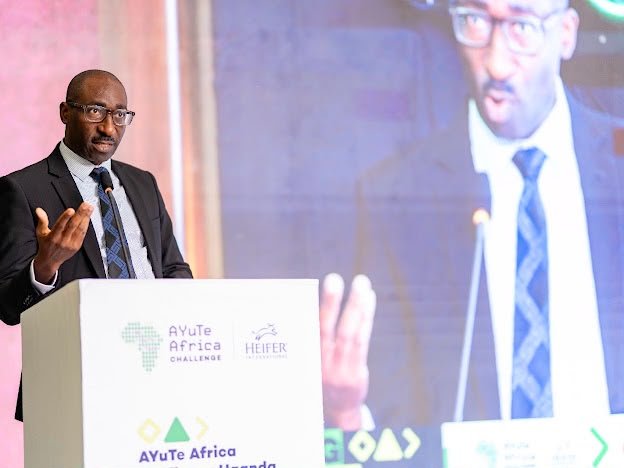
William Matovu, Country Director of Heifer International Uganda, said many of the Season 5 applicants had identified specific problems within agricultural value chains and built businesses around solving them. He cited examples involving spoiled tomatoes, poultry losses caused by inadequate temperature monitoring, agricultural waste, logistics, farmer-market connections and access to information.
AYuTe, which stands for Agriculture, Youth and Technology, is a Heifer International Uganda initiative supported by the Mastercard Foundation and implemented in partnership with CURAD. The programme was launched in Uganda in 2022 and has engaged more than 900 young innovators and entrepreneurs, according to AYuTe.
This year’s winners included Piipu General Enterprises LLP, which received UGX50 million after being named Best Agribusiness Enterprise Overall, and Revmake Tech Company Ltd, which received UGX50 million as Best Agritech Enterprise Overall.
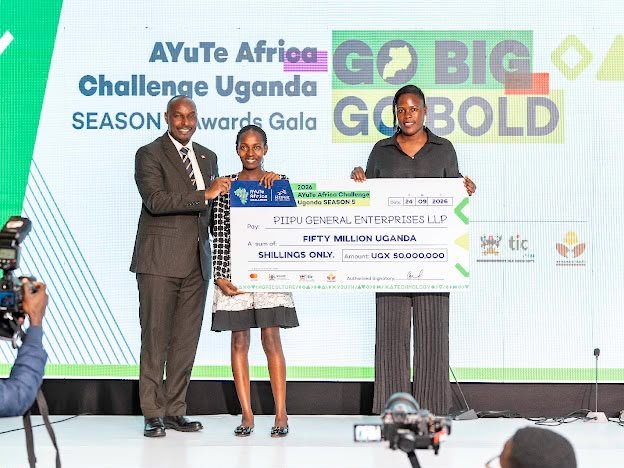
Lufafa Joel Enterprises received UGX30 million as Agribusiness first runner-up, while Ama Bulungi Enterprises received UGX15 million as second runner-up. In the Agritech category, Afripolli Farm-Tech Solutions Ltd received UGX20 million as first runner-up and Humi 99 Company Ltd received UGX15 million as second runner-up. Natura’s Nook Nutrition Ltd and Winnie Park Agro-Supply each received UGX10 million under the female entrepreneur category.
The awards also continued a programme history that includes earlier innovators who developed solutions for irrigation, poultry production, post-harvest management and agricultural value addition. For Season 5’s winners, the financing marks the next stage of their businesses. The focus now shifts from proving an idea works to demonstrating who will buy the product, how many farmers it serves, how many jobs it creates and whether the enterprise has a sustainable path to growth.
