
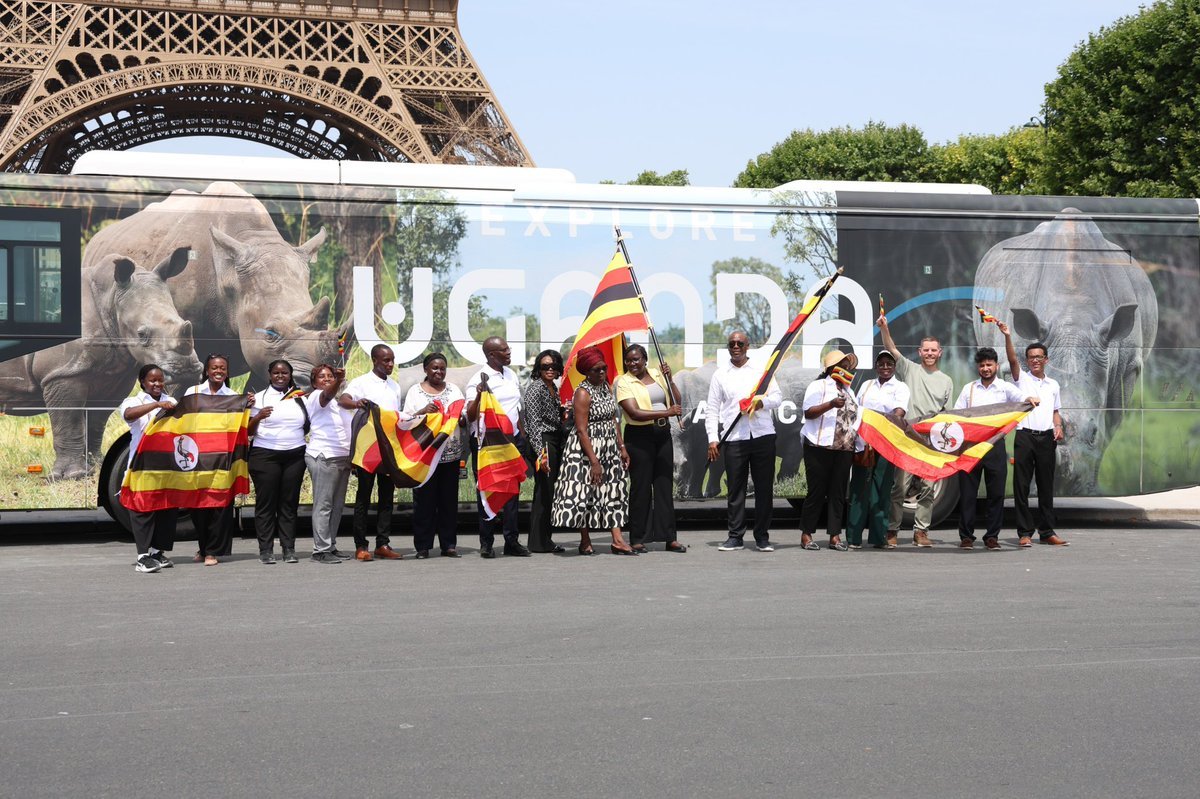
On the busy streets of Paris, brightly branded buses carrying images of Uganda’s mountain gorillas, wildlife, and breathtaking landscapes are weaving through some of Europe’s most iconic tourist corridors. Hundreds of kilometres away in Copenhagen, commuters are encountering similar visuals across the Danish capital’s public transport network.
Together, these campaigns represent one of Uganda’s most visible tourism marketing initiatives in Europe in recent years.
But behind the striking imagery lies a much larger economic objective: turning European attention into tourism arrivals, foreign exchange earnings, and long-term investment in one of Uganda’s most important service sectors.
Uganda’s embassies in France and Denmark have launched the “Explore Uganda – The Pearl of Africa” campaign, targeting affluent European travellers through high-visibility transit advertising designed to showcase the country’s wildlife, culture, landscapes, and adventure tourism offerings.
The initiative comes at a time when Uganda is seeking to strengthen tourism’s contribution to economic growth while positioning itself ahead of major milestones including commercial oil production and the 2027 Africa Cup of Nations (AFCON), which the country will co-host alongside Kenya and Tanzania.
On June 23, Uganda’s Embassy in Paris rolled out three fully branded buses across major routes in the French capital.
The two-week campaign, running until July 8, features large-format images of mountain gorillas, scenic landscapes, and cultural attractions. Each vehicle is fitted with QR codes that allow passers-by to instantly access tourism information, travel itineraries, and destination resources.
At the same time, Uganda’s Embassy in Copenhagen launched a complementary campaign across the Danish capital’s public transport network.
The Danish initiative focuses on attracting high-value Nordic travellers by highlighting attractions such as the Rwenzori Mountains, Uganda’s national parks, and the famous tree-climbing lions of Ishasha.
The campaigns are designed to reach not only local residents but also international visitors, travel professionals, and potential investors moving through two of Europe’s most affluent urban centres.
For Uganda, the economic rationale behind the campaign is straightforward.
Tourism remains one of the country’s most important sources of foreign exchange and employment. The sector generated approximately $1.7 billion in revenue and attracted around 1.6 million visitors in 2025.
Despite these gains, Uganda continues to compete with more established regional tourism destinations such as Kenya and Tanzania, which generally enjoy stronger brand recognition in international markets.
The Paris and Copenhagen campaigns aim to address that visibility gap.
European travellers, particularly those from Western Europe and the Nordic region, are among the world’s highest-spending tourists. Many seek premium travel experiences centred on nature, conservation, culture, and adventure areas where Uganda possesses significant competitive advantages.
A single international traveller can generate substantial economic value through gorilla trekking permits, accommodation bookings, domestic transportation, guided tours, and local purchases.
The economic impact extends beyond tourism operators.
Revenue generated by international visitors supports conservation programmes, creates jobs across the hospitality industry, benefits transport providers, and provides income opportunities for local communities and artisans.
The timing of the campaign reflects a broader strategic shift in Uganda’s economic positioning.
As the country prepares for commercial oil production, policymakers continue to emphasise the importance of diversifying economic growth beyond extractive industries.
Tourism is increasingly viewed as a sector capable of generating sustainable foreign exchange earnings while creating employment opportunities across multiple regions of the country.
Unlike resource extraction, tourism has a powerful multiplier effect that spreads economic benefits across hotels, restaurants, transport services, cultural enterprises, conservation programmes, and small businesses.
The sector also provides an opportunity to strengthen Uganda’s international image at a time when the country is seeking to attract greater investment and expand its global economic footprint.
The marketing push also aligns with preparations for the 2027 Africa Cup of Nations, which Uganda will co-host with Kenya and Tanzania.
The tournament is expected to attract thousands of visitors, media organisations, sponsors, and investors from across Africa and beyond.
Building destination awareness before the event could help Uganda convert sports tourism into broader travel demand, encouraging visitors to extend their stays and explore the country’s attractions beyond match venues.
The European campaign therefore serves both immediate tourism objectives and longer-term branding goals.
While the campaigns have generated significant visibility, their ultimate success will depend on measurable outcomes.
Tourism officials and industry stakeholders will be watching key indicators including website traffic, QR code engagement, travel inquiries, tour bookings, and visitor arrivals from targeted European markets.
Marketing alone cannot guarantee results.
Industry experts note that sustained success will require strong follow-through from airlines, tour operators, hotels, transport providers, and government agencies responsible for visitor experience.
Infrastructure quality, service standards, ease of travel, and destination safety will all play critical roles in converting interest into actual tourism spending.
The Paris and Copenhagen initiatives signal a more ambitious approach to tourism diplomacy and destination marketing.
Rather than relying solely on traditional promotional channels, Uganda is increasingly using creative, high-visibility campaigns to compete for attention in crowded international markets.
Whether the buses ultimately translate into a significant increase in visitor numbers remains to be seen.
What is clear, however, is that Uganda is making a deliberate effort to place itself directly in front of high-spending international travellers and reposition the Pearl of Africa as a premium global destination.
For a country seeking to expand tourism revenues, strengthen its international profile, and diversify economic growth, the campaign is about more than branding. It is an investment in visibility, competitiveness, and the long-term future of one of Uganda’s most promising industries.
