
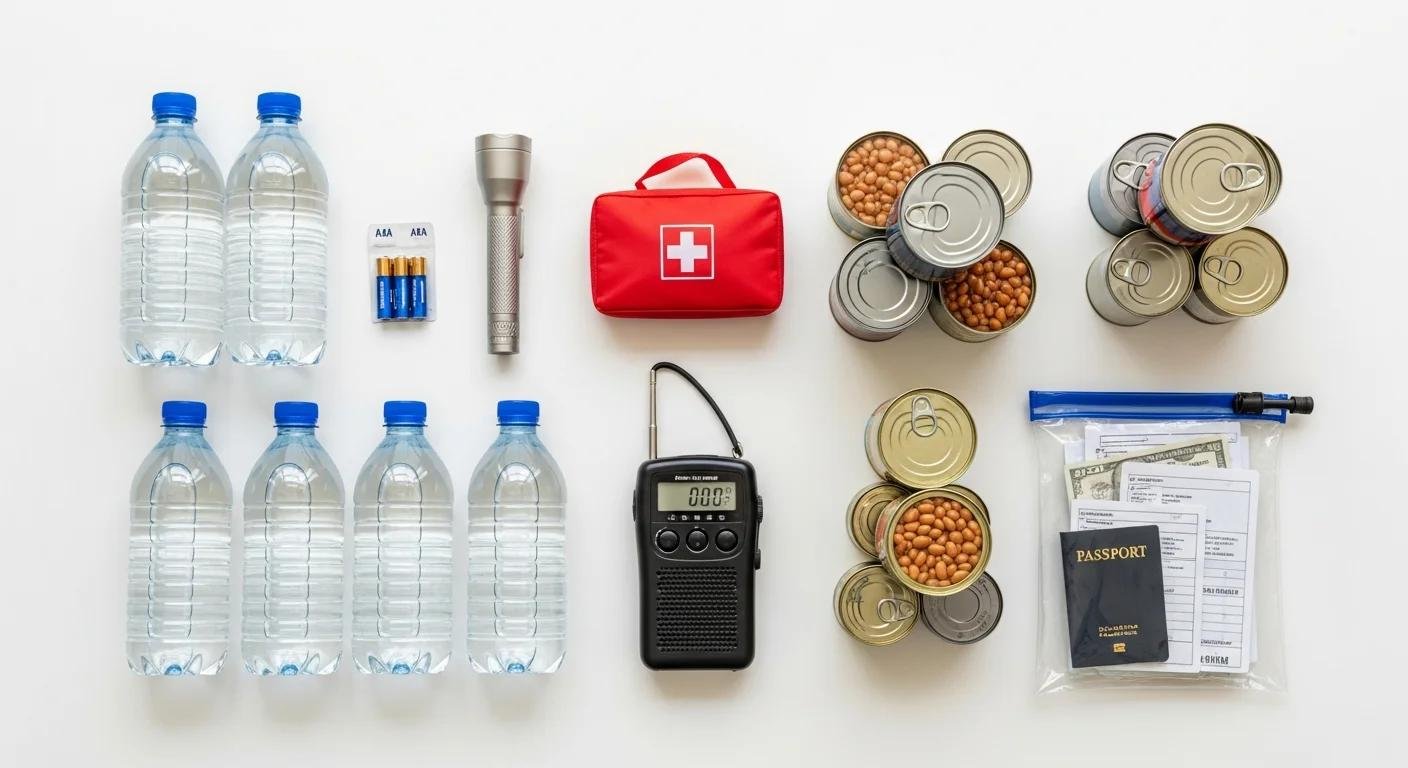
Governments across Europe, Asia and North America are telling citizens to prepare for emergencies, testing their ability to withstand major disruptions and strengthening reserves of essential supplies. Officially, these measures are about preparedness: ensuring households can survive temporary interruptions to electricity, water, transport and food distribution. But against the backdrop of the war in Ukraine, escalating tensions involving Iran, growing rivalry between major powers and mounting pressure on global supply chains, it is difficult not to ask whether governments are preparing for more than the routine emergencies they publicly describe.
There is no confirmed evidence of a single impending global catastrophe behind these preparations. Governments have legitimate reasons to test emergency systems, and many of their stockpiling policies address risks that have existed for decades. Yet the timing, breadth and increasingly strategic character of these measures invite a bigger question: what are the world’s most powerful economies anticipating about the future of global security, and what should the rest of the world make of it?
A World Preparing for Disruption
Across Europe, emergency preparedness has become a more prominent part of public policy. Governments have encouraged households to maintain essential supplies, with some recommending that families be able to manage independently for at least 72 hours and others advocating longer periods.
Sweden, Germany and Finland have promoted household preparedness guidance covering food, water, medicines and other necessities. The European Union has also emphasised the need to strengthen civilian preparedness and improve the ability of societies to withstand crises.
The official reasoning is straightforward. A major power outage, cyberattack, extreme weather event or disruption to transport networks could leave communities temporarily without essential services. Encouraging households to prepare reduces immediate pressure on emergency responders and gives authorities more time to restore normal operations.
But preparedness is not limited to household emergency kits. Governments are also concerned about energy security, critical minerals, food supplies, medical commodities and the resilience of infrastructure that supports their economies.
These are not isolated concerns. They sit within a global security environment that has become considerably more uncertain.
Ukraine, Iran and the Geopolitics of Preparedness
Russia’s full-scale invasion of Ukraine in 2022 fundamentally altered Europe’s security calculations. The war exposed vulnerabilities in energy dependence, demonstrated how conflict can disrupt agricultural exports and fertiliser supplies, and prompted European governments to reconsider defence spending and civil protection.
The implications have extended far beyond Ukraine. Disruptions to energy markets and Black Sea grain exports have shown how a regional conflict can affect food prices, industrial production and household budgets in distant countries.
Tensions involving Iran add another layer of uncertainty. The security of the Strait of Hormuz, through which a substantial share of global petroleum liquids consumption passes, has long been a concern for energy-importing economies. A serious escalation affecting shipping through the strait could push up oil prices, raise transport costs and place additional pressure on countries dependent on imported fuel.
Meanwhile, strategic competition between the United States and China has increased the importance of critical minerals, semiconductor production, advanced technology and secure supply chains. Governments are increasingly concerned that economic dependencies can become strategic vulnerabilities during periods of confrontation.
These developments do not prove that a wider conflict is imminent. They do, however, help explain why governments are reassessing how they would cope if several disruptions occurred simultaneously.
The question is whether emergency preparedness is simply a prudent response to an unstable world or whether officials are also accounting for scenarios they consider too uncertain or sensitive to present as imminent threats.
There is no verified evidence that governments are concealing a specific impending emergency. Nevertheless, their preparations deserve scrutiny because the risks they address are increasingly interconnected.
Are Governments Testing Their Systems or Preparing for Something Bigger?
Governments frequently describe emergency exercises as tests of readiness. Such exercises allow authorities to identify weaknesses in communication, transport, healthcare, energy distribution and crisis coordination before a real emergency occurs.
That explanation is credible. Preparedness exercises are a standard part of disaster management, and their existence should not automatically be interpreted as evidence of secret intelligence about an approaching crisis.
However, the geopolitical context matters.
When governments test emergency arrangements while simultaneously strengthening defence capabilities, reassessing energy dependence, securing critical materials and urging citizens to maintain essential supplies, the combined picture suggests that resilience has become a strategic priority.
The important distinction is between preparing for a specific event and preparing for a range of plausible scenarios. A government does not need to know that a war will spread, a shipping route will close or a cyberattack will occur to conclude that it must be better equipped to withstand those possibilities.
In an increasingly volatile international environment, the cost of being unprepared may be greater than the cost of maintaining reserves and conducting exercises that never need to be activated.
Still, public communication matters. Citizens deserve clear explanations of what governments are preparing for, which risks authorities consider most serious and what practical steps households should take. Without that context, even legitimate preparedness programmes can fuel speculation about threats that officials have not established.
What Does This Mean for Africa?
For Africa, the issue extends beyond whether governments should encourage households to store food and water. It concerns the continent’s exposure to disruptions originating far beyond its borders.
Many African economies depend on imported fuel, fertilisers, medicines, machinery and other essential goods. A major disruption to global shipping or energy markets could increase import costs, weaken currencies, raise food prices and place additional pressure on public finances.
The consequences of a prolonged crisis could be particularly severe for countries with limited foreign-exchange reserves, inadequate storage infrastructure or heavy dependence on international assistance.
Africa has established some important safeguards. Several countries maintain grain reserves, while regional mechanisms such as the ECOWAS food security reserve provide a framework for responding to shortages. Africa CDC has also worked to strengthen medical supply preparedness.
But these arrangements vary in scale and effectiveness. The ability to respond to a local drought is different from the ability to withstand a simultaneous shock involving fuel, fertilisers, shipping, medicines and food imports.
African governments and businesses therefore have reason to examine the assumptions underlying their supply chains. Which essential goods depend on a small number of foreign suppliers? How long could critical services continue if imports were interrupted? What reserves are available, and how quickly could they reach the people who need them?
These questions become more urgent when major economies are themselves investing in resilience rather than assuming that international markets will always provide uninterrupted access to essential supplies.
The Warning May Be in the Preparation Itself
It would be premature to conclude that the world’s emergency preparations signal an imminent global war or a specific disaster that governments are unwilling to disclose. The available evidence does not establish that.
But it would also be a mistake to dismiss the broader trend as routine administrative planning unrelated to geopolitical developments.
The war in Ukraine has demonstrated the economic consequences of conflict. Tensions involving Iran underline the strategic importance of energy routes. Competition between major powers has exposed the risks of dependence on concentrated supply chains, while cyberattacks and climate-related disasters continue to test essential infrastructure.
Together, these pressures have made one lesson increasingly difficult for governments to ignore: a crisis in one part of the world can rapidly become an economic and social problem elsewhere.
Perhaps governments are simply preparing for the uncertainty they can already see. Perhaps their exercises are designed to test systems against scenarios that may never materialise. What remains unclear is how they assess the likelihood of more severe disruptions and whether their public messaging fully conveys the range of risks they are considering.
For Africa, the objective should not be to assume the worst or imitate every measure adopted by wealthier countries. It should be to understand why preparedness is gaining prominence, identify the continent’s most consequential vulnerabilities and strengthen the capacity to withstand shocks before they arrive.
The world may not be preparing for one particular emergency. It may be preparing for a period in which several emergencies can overlap.
And that leaves a question worth asking: if the world’s most powerful economies are increasingly planning for disruption, what do they see in the global landscape that makes such preparation necessary and is Africa paying close enough attention?
