
In his June 2026 State of the Nation Address at Kololo Ceremonial Grounds, President Yoweri Kaguta Museveni announced that Uganda’s Gross Domestic Product (GDP) per capita had reached $1,278 using the foreign exchange method, moving the country beyond the World Bank’s lower-middle-income threshold of $1,136.
At the same time, the Uganda Bureau of Statistics (UBOS) reported that household poverty had declined to 16.1%, signaling steady expansion of the formal cash economy and broader improvements in national welfare indicators.
Despite these macroeconomic gains, a different reality emerges in Kampala’s corporate offices, financial institutions, and commercial hubs.
Many households continue to experience persistent financial pressure that appears disconnected from the country’s improving economic indicators.
This divergence raises a fundamental question: why does Kampala feel significantly more expensive than the national data suggests?
The explanation lies in what Nassim Nicholas Taleb refers to as the “illusion of the average,” where national statistics aggregate vastly different economic environments into a single figure.
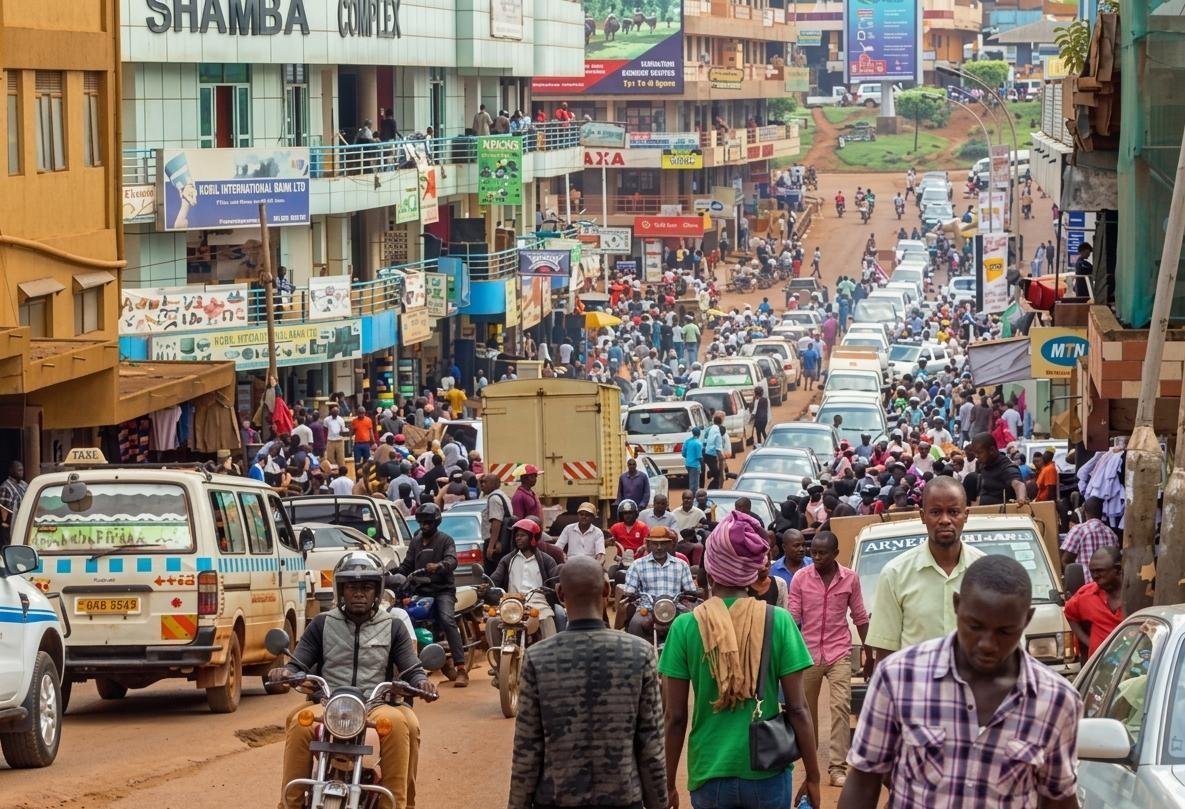
Uganda’s averages combine low-cost rural subsistence economies with a high-density urban capital that operates under entirely different economic pressures.
Kampala is not representative of the national average.
It is a concentrated urban system where demand for housing, education, healthcare, and infrastructure far exceeds supply, driving up the cost of living in ways that macroeconomic indicators fail to capture. Housing forms the most significant component of this urban cost structure.
In Kampala, securing a standard three-bedroom home in residential areas such as Kira, Naalya, Lubowa, or Namugongo typically costs between Shs 1.2 million and Shs 2.5 million per month, often requiring several months of rent paid upfront.
This alone establishes a high fixed-cost baseline for urban households. Beyond rent, recurring utility expenses further compound the burden.
Electricity costs range between Shs 150,000 and Shs 300,000 per month, water averages around Shs 50,000, and reliable internet connectivity, now essential for most professional and business activities, adds another Shs 150,000 to Shs 250,000 per month.
These are not discretionary expenditures but structural necessities of urban life and work. Education represents another major financial commitment for households seeking stability and upward mobility. Many families opt for private or international-curriculum schools due to perceived gaps in public education quality.
Fees in reputable schools across Kampala range between Shs 1.5 million and Shs 3.5 million per child, per term, translating to an annual cost of up to Shs 15 million for two children, or approximately Shs 1.25 million per month when averaged across the year.
This transforms education from a periodic expense into a continuous financial obligation that shapes household budgeting decisions.
Healthcare follows a similar pattern of privatization and cost concentration.
While Uganda maintains a public health system, many urban households rely on private healthcare providers and insurance schemes due to concerns around efficiency, quality, and accessibility.
Private health insurance for a family typically costs between Shs 2.5 million and Shs 5 million per year. Without such coverage, a single medical emergency at private facilities such as International Hospital Kampala (IHK), Nakasero Hospital, or Case Medical Centre can impose a significant and immediate financial shock, often disrupting long-term household savings and stability.
Transport costs further intensify the financial pressure associated with urban living. As Kampala expands outward into peri-urban settlements such as Bulindo, Matugga, Sonde, and Ssabagabo, commuting distances have increased significantly.
For many professionals, daily transport costs range between Shs 25,000 and Shs 40,000, resulting in monthly fuel expenditures of Shs 600,000 to Shs 900,000, excluding additional costs such as maintenance, insurance, and parking, which add approximately Shs 150,000 per month.
Even food expenditure, while relatively stable due to Uganda’s strong agricultural base and low agricultural inflation of around 1.0%, is increasingly shaped by urban consumption patterns that favor processed and convenience-based goods.
As a result, a typical monthly grocery basket for a family of four ranges between Shs 600,000 and Shs 1 million.
When these components are aggregated, a clear structural picture emerges.
A consolidated middle-class household in Kampala requires approximately Shs 5.5 million per month to maintain financial stability. This figure reflects the cumulative effect of fixed urban costs that operate independently of national averages.
For employers and corporate decision-makers, this cost structure presents a significant challenge. A gross salary of Shs 3 million may appear competitive in national terms, yet after statutory deductions such as PAYE and NSSF contributions, disposable income is quickly absorbed by housing, transport, and education costs.
This reality is driving a shift in compensation strategies, with organisations increasingly adopting non-cash benefits such as health insurance, education support, and structured mobility assistance to offset the high cost of urban living.
Uganda’s transition into lower-middle-income status remains an important macroeconomic achievement, reflecting sustained growth and expanded economic participation.
However, Kampala operates under a distinct economic reality where urban cost pressures shape lived experience more than national averages.
The city’s financial structure reveals a clear disconnect between statistical progress and household-level affordability.
Ultimately, sustaining a middle-class lifestyle in Kampala requires significantly more than meeting national income thresholds.
It requires navigating a high-cost urban system where fixed expenses define financial stability.
Understanding this gap is essential for policymakers, employers, and individuals seeking to interpret Uganda’s economic progress in a meaningful and grounded way.
