
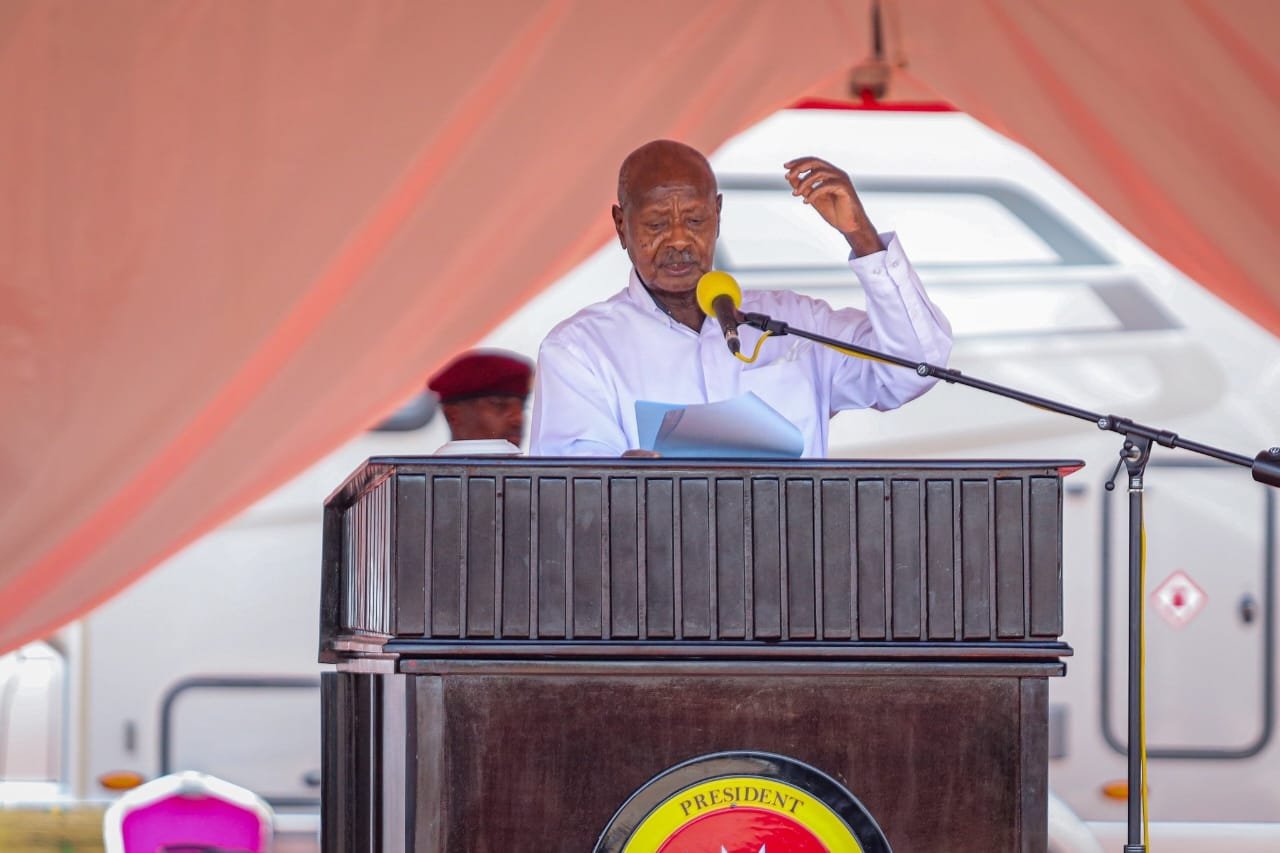
In his 2026 State of the Nation Address at Kololo Ceremonial Grounds, President Yoweri Kaguta Museveni outlined an ambitious economic trajectory: Uganda is targeting a rise in GDP growth from 6.4% to 10%, pushing the economy toward the $80 billion mark.
The timing is significant. This milestone is projected to be achieved before commercial oil production begins, raising a critical question for investors and policymakers: Can Uganda sustain double-digit growth without oil revenues?
The “No More Sleep” Doctrine as a Productivity Shift
At the center of the President’s economic message is what can be interpreted as a national productivity doctrine. His repeated references to kukongola (leaning on the hoe), okukolera ekidda kyoonka (subsistence production), and kutuhenda (overburdening the few productive actors) signal a structural shift away from subsistence behavior toward commercial labor output.
The policy implication is clear. The transition of the remaining 33% of households still in subsistence agriculture into commercial production is now positioned as the primary engine for achieving 10% growth.
In effect, Uganda’s growth strategy is no longer purely macroeconomic. It is increasingly behavioral, targeting how labor is deployed, measured, and monetized at household level.
The Economic Foundation: Four Decades of Expansion
Uganda’s current growth ambition builds on a long structural transformation.
GDP has expanded from $3.9 billion in 1986 to $69.3 billion today under the foreign exchange method. On a Purchasing Power Parity basis, the economy now stands at $197.1 billion. GDP per capita has reached $1,278, placing Uganda above the lower-middle-income threshold. Poverty levels have fallen from 56.4% in 1992 to 16.1%.
This reflects a steady expansion of the cash economy and deeper monetization of household activity.
Parish Development Model: The Grassroots Capital Engine
A central pillar of this transition is the Parish Development Model (PDM), which is emerging as the most significant decentralized capital program in Uganda’s recent economic history.
So far, Shs 557 million has already been disbursed to approximately 3.7 million households nationwide. The next phase of expansion introduces a structured fiscal injection at the lowest administrative level.
Under the framework, each parish in rural areas is set to receive Shs 100 million, plus Shs 15 million for leadership and coordination annually. Urban wards are allocated Shs 300 million, plus Shs 15 million for administration.
This represents a deliberate strategy to inject low-cost capital at scale, with lending structured at around 6% interest. The objective is to stimulate grassroots production, expand household purchasing power, and convert subsistence units into commercial micro-enterprises.
Export Growth and the Rise of a Diversified Economy
Uganda’s export base has expanded significantly, now generating approximately $18 billion annually.
Over the past 15 years, 31 new export products have been added to the national basket. These include pharmaceuticals, steel, ceramics, refined gold, and industrial dairy products, alongside processed agricultural goods.
This diversification reduces dependence on raw commodities and strengthens resilience against global price fluctuations.
Surplus-Driven Industrialization
A key argument supporting non-oil growth is the existence of large-scale production surpluses that can feed domestic industrialization.
Uganda now produces:
- Bananas: 11 million metric tonnes
- Cassava: 4.5 million metric tonnes
- Fish: 727,000 metric tonnes
- Cocoa: 76,173 metric tonnes
- Milk: 5.4 billion litres annually
- Coffee: 9.3 million 60kg bags
- Maize: 5 million metric tonnes
- Cement: 7 million metric tonnes
The industrial strategy, particularly through zones like Mbale Industrial Park, is to convert these raw volumes into processed exports and manufactured goods. This is the shift from raw output to value-added industrial grids.
The Rise of Competing Economic Classes
A growing tension in Uganda’s development narrative is the nature of its emerging middle class.
The President’s framing highlights a key structural question; is Uganda developing a comprador bourgeoisie, dependent on imports, real estate speculation, and commission-based trade, or a national bourgeoisie anchored in manufacturing, ICT, and productive agriculture?
Recent real estate trends show strong domestic absorption of high-end properties, including units priced at $1.2 million, largely purchased by local Ugandans rather than diaspora investors.
The long-term growth question is whether this rising capital base will be redirected into productive sectors or remain concentrated in consumption-driven assets.
Energy as the Binding Constraint and Enabler
No 10% growth trajectory is possible without energy expansion.
Uganda’s generation capacity has increased from 60 MW in 1986 to 2,098 MW in 2026. The government’s long-term target is 50,000 MW, supported by a diversified energy mix including hydro, solar, gas, wind, geothermal, and nuclear power.
This energy roadmap is designed to support heavy industrialization, regional exports, and long-term manufacturing competitiveness.
Infrastructure and Logistical Rebalancing
Logistics remains a critical constraint. Government investment in railway rehabilitation, the Standard Gauge Railway, and regional corridors is intended to reduce freight costs and improve competitiveness across East African and AfCFTA markets.
Without these systems, production surpluses cannot efficiently translate into export growth.
Climate Resilience and the Micro-Irrigation Shift
Agricultural stability is being reinforced through climate adaptation strategies.
In partnership with Nexus Green, the government is rolling out solar-powered micro-irrigation systems across districts including Ngora, Serere, Bukedea, Amolatar, Kwania, Apac, Kasanda, Masaka, and Mukono.
This intervention is designed to insulate agricultural output from rainfall variability, ensuring stable supply chains for agro-processing and export industries.
Structural Bottleneck: Fragmented Land and Family Holdings
A less discussed but critical constraint is the fragmentation of agricultural land through traditional inheritance systems.
The division of productive land into increasingly smaller plots reduces commercial efficiency and limits mechanization. Government policy is now encouraging a transition toward family-based corporate structures, where land is managed as shared equity rather than physically subdivided assets.
This shift is essential if agriculture is to remain viable at scale.
The Growth Pathway: A Coordinated Economic Model
Uganda’s non-oil growth strategy is anchored on five interconnected pillars:
- Labor mobilization through productivity reform
- Decentralized capital via the Parish Development Model
- Industrialization through value addition
- Energy expansion for manufacturing scale
- Climate-resilient agriculture and irrigation systems
Together, these elements form a coordinated attempt to sustain high growth without dependence on oil revenues.
The Economic Horizon: Ambition Meets Execution
The projection of an $80 billion economy driven by 10% growth without oil is ambitious, but increasingly structured.
Uganda now possesses the core ingredients of a diversified economy: rising exports, expanding energy capacity, surplus-driven agriculture, and a large untapped labor force transitioning out of subsistence production.
The determining factor is execution. If capital deployment, productivity transformation, and infrastructure delivery align, Uganda’s non-oil growth model could become one of the most significant structural economic transitions in the region.
The challenge is no longer vision. It is conversion.
