
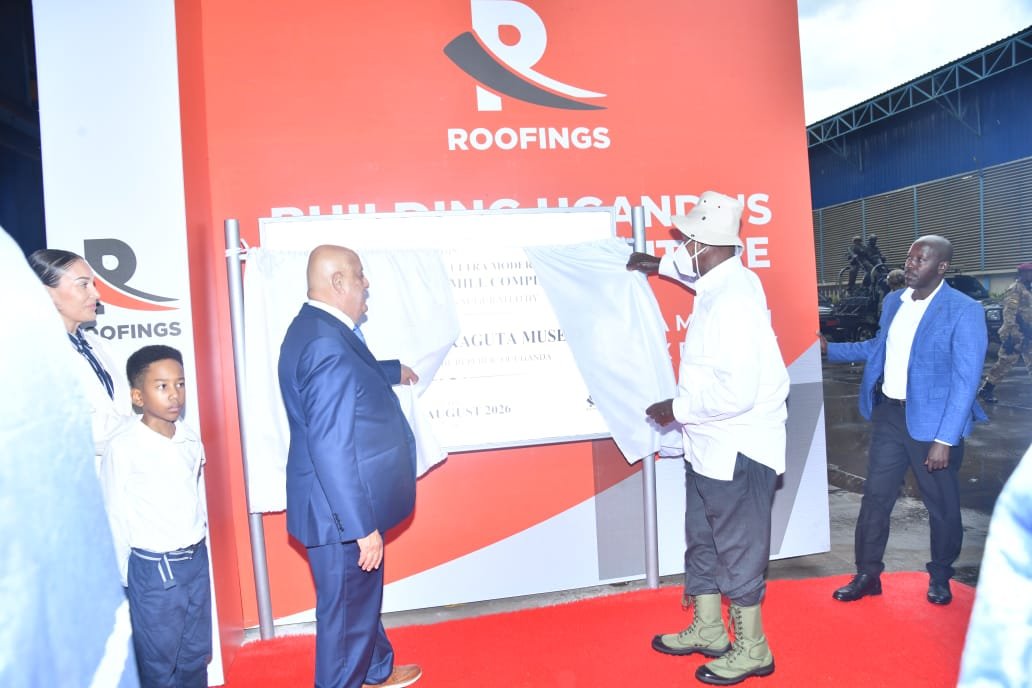
President Museveni on Tuesday commissioned Roofings Group’s US$125 million (about Shs460 billion) Phase IV Cold Rolling Mill Complex at the Kampala Industrial and Business Park, a facility that doubles the company’s cold rolled steel capacity to 300,000 metric tonnes a year and pushes its total installed production capacity to 625,000 tonnes annually.
The ceremony, held at the company’s Namanve plant, drew senior government officials, diplomats, business leaders, financiers and Roofings employees, underscoring the scale of what is now one of the largest private sector investments in Uganda’s manufacturing sector.
Speaking at the event, President Museveni praised Dr Sikander Lalani, the Chairman and Managing Director of Roofings Group, for what he described as a textbook case of local value addition, the process of processing raw or semi finished materials into higher value goods within the country rather than exporting them unprocessed.
The President said Roofings had steadily shifted from importing intermediate steel products for local processing to manufacturing more of those intermediate products in Uganda itself, a move that keeps more value inside the domestic economy. According to figures shared at the event, Roofings now achieves about 54 percent local value addition on every hot rolled coil it processes, worth more than Shs400 billion.
Mr Museveni also turned attention to Uganda’s iron ore deposits, some of which have purity levels of around 65 percent, and urged that they be developed to anchor a fully competitive domestic steel industry.
“Uganda has abundant iron ore resources, including high grade iron ore, and we must use these resources to build a competitive steel industry,” he said.
He added that building strong regional markets was essential for turning that potential into jobs and wealth. “A strong market makes it easy for wealth creators to succeed. All they want is a market, and by having a big and sure market, we will create jobs and wealth,” he said.
The President noted that Roofings’ annual turnover now stands at about Shs1.2 trillion, with exports worth roughly US$70 million, and pointed to the project’s mix of Italian and Japanese technology alongside Chinese construction partnerships as evidence of the kind of international cooperation Uganda’s industrial strategy depends on.
In his remarks, Dr Lalani traced the company’s journey from a small sheet forming operation he started in Lubowa 32 years ago to what is today one of East and Central Africa’s largest steel manufacturers. He said the new complex, which comprises a 4 Hi Cold Rolling Mill, an edge trimming line, a hot dip galvanising line and a colour coating line, was built with automation technology from Danieli, Siemens and ABB, while its galvanising line runs on hydrogen produced on site through electrolysis.
“Our vision is to be an accelerator for a sustainable Africa,” Dr Lalani said. “To us, sustainability means employment that endures, doing business ethically, treating people fairly, and manufacturing products of genuine quality that withstand time and use. It means capturing value here, at home, rather than exporting opportunity elsewhere.”
He said the company’s growth was closely tied to Uganda’s Vision 2040 goal of becoming a modern, industrialised economy. “Every coil we roll, every ton we melt, every job we create, every young engineer we train, is a deliberate contribution to that national vision,” he said.
Dr Lalani thanked government for the peace, security and infrastructure support that allowed the company to expand at Namanve over nearly two decades, recalling that President Museveni had personally encouraged Roofings to invest in the industrial park when the project began.
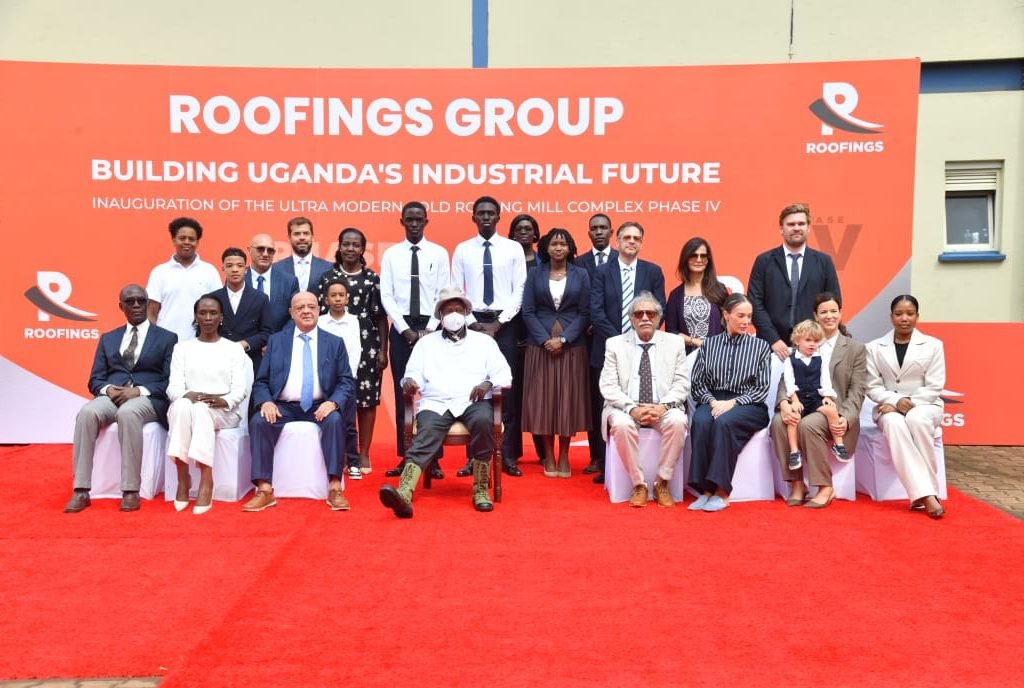
Phase IV is expected to create about 400 direct jobs, with additional employment expected across suppliers, transporters, hardware dealers and other businesses linked to the construction value chain. Dr Lalani said the company also plans further backward integration, revealing that Roofings has already set up a dedicated entity to begin exploration work in Uganda as part of a longer term plan to combine local iron ore and renewable energy resources with regional markets.
Company officials said Roofings can now produce about 4.2 million iron sheets a month, more than 50 million a year, enough roofing material for over 1.6 million homes annually. In 2024 and 2025, the company exported goods worth about Shs264 billion and Shs229.6 billion respectively, while remitting about Shs9.3 billion and Shs10 billion to the National Social Security Fund in those same years.
Beyond manufacturing, Dr Lalani highlighted the company’s ongoing reconstruction of Kasubi Family Primary School, a Shs3.7 billion project undertaken with Kampala Capital City Authority, as part of Roofings’ wider social investment in education, health and environmental programmes.
Closing his remarks with a message to Uganda’s young people, Dr Lalani said, “The future of Uganda, and this continent, will be shaped by your hands, your ideas, and your resolve.”
