
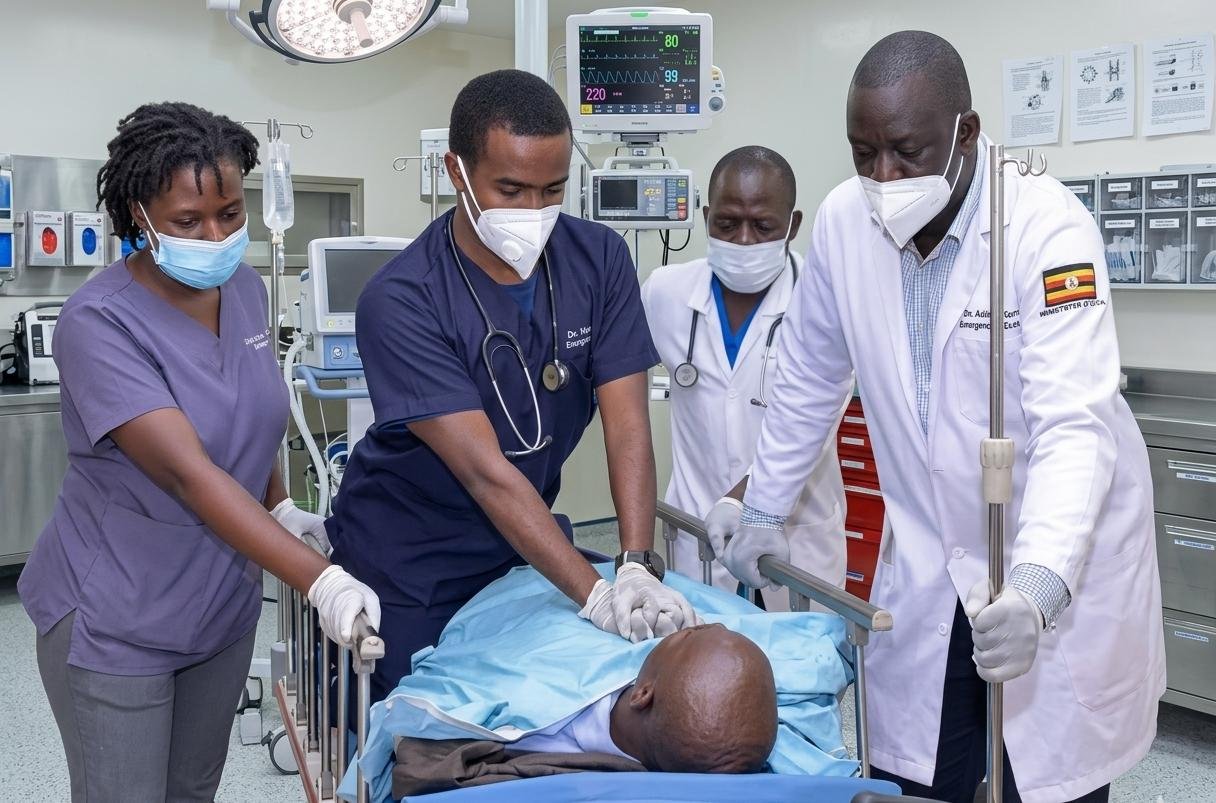
A sweeping regulatory overhaul approved by Cabinet has triggered intense national debate across Uganda’s healthcare and education sectors, with critics warning it could fundamentally reshape and strain the country’s already fragile medical workforce.
At the center of the controversy is the National Education and Training for Health Policy, a joint reform by the Ministry of Health and the Ministry of Education and Sports that seeks to redesign how medical doctors, dentists, and pharmacists are trained and certified.
Under the new framework, medical students will no longer graduate after five years and then proceed to a paid internship. Instead, the mandatory 12-month clinical internship will be absorbed into the academic curriculum, extending medical training to six years. Crucially, graduation will only be awarded after successful completion of internship, effectively reclassifying interns as students rather than working professionals.
This single shift has become the most contentious element of the reform, with medical associations arguing it could weaken or eliminate long-standing internship allowances and deepen financial pressure on young doctors already under strain.
The Government’s Case: Raising Standards and Tightening Control
Defending the policy before Parliament’s Health Committee, Minister of Health Dr. Jane Ruth Aceng said the reform responds to declining training quality caused by the rapid expansion of medical institutions across the country.
Uganda now manages between 1,500 and 2,000 interns annually across more than 33 training centers, far higher than previous years, raising concerns over supervision and competency.
“The challenge we have is interns graduating and being called medical doctors while still undergoing internship,” Dr. Aceng told lawmakers. “Some have failed internship three or four times, yet they already hold certificates. We must safeguard our population.”
State Minister for Primary Education Dr. Joyce Moriku Kaducu added that a new National Internship Management Framework will introduce strict pre-internship examinations to ensure only competent candidates enter clinical environments.
The Backbone of the Wards: Interns Carry the System
While policymakers frame the reform as quality control, frontline medical professionals argue it overlooks a critical reality. Uganda’s public health system heavily depends on interns to function.
Studies and hospital-level assessments suggest that as much as 70 percent of frontline care in regional referral and national hospitals is handled by medical interns.
From emergency admissions and trauma response to obstetric emergencies and overnight ward coverage, interns are often the backbone of overstretched facilities.
“While interns are trainees, they are also essential contributors to healthcare delivery,” noted Dr. Robert Kalyesubula (MD, FISN, PhD-FRCP). “They work nights, weekends, emergency shifts, labor wards, theaters, and medical wards, sometimes straight 72-hour shifts. Hospitals across Uganda rely heavily on their service.”
This dependency raises a critical concern. Any disruption in intern welfare or motivation could have immediate consequences for patient care delivery.
Medical Backlash: A System Under Pressure
The reforms have been met with strong resistance from medical student bodies and professional associations, who argue the policy risks undermining both livelihoods and workforce stability.
Redefining Interns as Students
Medical Interns’ leader Dr. Jacob Mwandha questioned the assumption that all medical graduates require a compulsory internship before graduation.
He warned that delaying graduation could be a legal and administrative mechanism to reclassify interns as students, potentially weakening their entitlement to stipends and allowances.
The Financial Burden on Families
Lawmakers have also raised concerns about the economic impact. Many medical students rely on structured funding arrangements that assume a five-year academic cycle.
Extending training to six years without guaranteed income support could place families under severe financial strain, particularly for students from low and middle-income backgrounds.
“Denying or weakening internship pay sends the wrong message,” Dr. Kalyesubula warned. “It risks increasing brain drain, discouraging students from poor backgrounds, and worsening migration of health workers to countries that value their contribution.”
Rising Risk: Brain Drain and Workforce Shortages
Uganda already faces a critical shortage of doctors, with many rural districts struggling to retain medical staff. Experts warn that extending training duration while reducing financial incentives could accelerate migration of young doctors abroad.
Key concerns include longer training cycles, higher education costs, reduced financial support during internship, and declining morale among medical trainees.
Collectively, these pressures risk worsening an already strained healthcare workforce and deepening staffing gaps in public hospitals.
The Way Forward: Reform Without Collapse
Despite the backlash, medical stakeholders are not rejecting reform entirely. Instead, they are calling for a balanced approach that strengthens standards without undermining workforce sustainability.
Proposed solutions include maintaining fair intern remuneration to support basic living costs during training, improving entry standards at the point of medical school admission rather than extending training duration, and expanding internship centers alongside consultant supervision capacity to improve quality outcomes.
“Uganda needs more doctors, not more obstacles for those willing to become them,” Dr. Kalyesubula emphasized. “A stronger health system will be built by supporting future health workers, not by making their journey longer and harder than necessary.”
Conclusion: A High-Stakes Policy Moment
As Uganda moves closer to implementing the policy, the government faces a delicate balancing act between improving training standards and preserving the stability of its healthcare workforce.
Supporters see a necessary correction to rising training inconsistencies. Critics see a structural risk that could destabilize hospital operations and discourage future doctors.
What remains clear is that Uganda’s healthcare system, already heavily reliant on interns, cannot afford a disruption at its foundation. The outcome of this policy debate may define not only the future of medical education, but the future capacity of Uganda’s public health system itself.
