
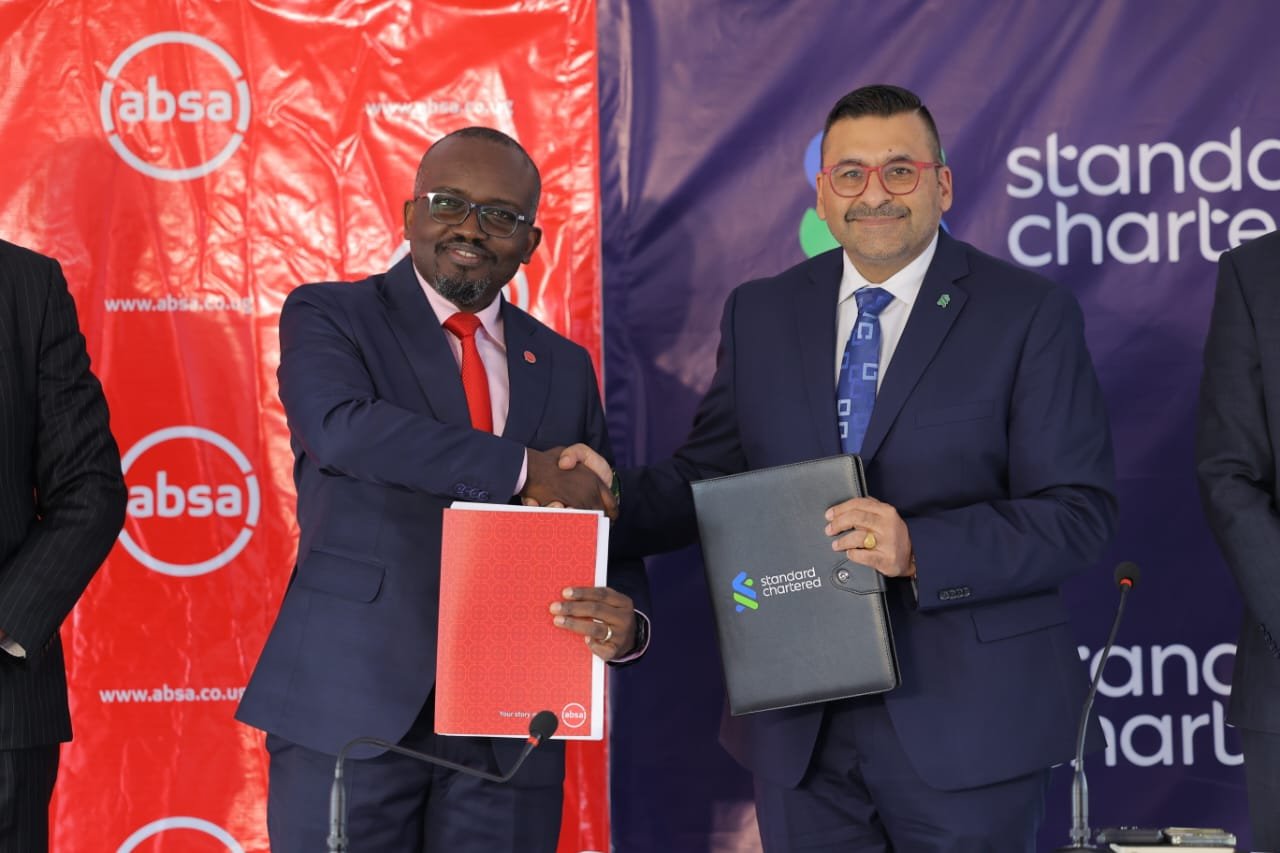
In a move signaling a major structural shift in Uganda’s financial services landscape, Standard Chartered Bank Uganda and Absa Bank Uganda Limited have received regulatory approval from the Bank of Uganda (BoU) for the transfer of Standard Chartered’s Wealth and Retail Banking (WRB) portfolio to Absa.
Far from a simple transaction, the deal represents a strategic realignment of two major banking players. Standard Chartered is doubling down on its global strength in corporate and investment banking, while Absa is making a decisive expansion move to strengthen its retail banking dominance in Uganda.
At its core, this is a structured portfolio transfer rather than a merger. Standard Chartered Uganda will move its entire consumer banking business, including retail deposits, personal lending, credit cards, and wealth management services, to Absa Bank Uganda.
Until completion, both institutions will continue normal operations under regulatory supervision.
Standard Chartered’s decision is part of a broader global strategy to streamline operations and concentrate on high-value corporate and institutional banking. By exiting retail banking, the bank frees up capital, operational resources, and management focus to strengthen its core strengths in trade finance, investment banking, and large-scale corporate advisory services.
“This decision reflects our continued commitment to align our operations with Standard Chartered’s global strategy, focusing on our core strengths in Corporate & Investment Banking. We are confident Absa is well positioned to take this business forward, ensuring continuity, innovation and reliable client experiences,” said CEO Sanjay Rughani.
The bank remains committed to Uganda through corporate banking, trade facilitation, and capital market services.
For Absa, this acquisition is a major growth accelerator. By absorbing Standard Chartered’s established retail and wealth portfolio, Absa immediately expands its customer base, increases deposits, and strengthens its position in Uganda’s competitive banking market. The deal also gives Absa access to a high-value client segment made up of salaried professionals, corporate executives, and wealth customers. This strengthens its ability to scale digital banking, expand lending, and compete more aggressively with top-tier banks in Uganda.
For customers, the transition is expected to be smooth, with no immediate disruption to existing banking services. Accounts, cards, and digital banking platforms will continue to function as normal while the integration process is gradually rolled out. Absa has also indicated that it will communicate any future system updates or changes well in advance, ensuring customers remain fully informed throughout the transition. The bank says it will draw on its experience from previous large-scale integrations to ensure stability and continuity.
“Drawing on our experience from the Barclays to Absa transition in 2019, we bring proven capability in managing complex banking transitions under regulatory oversight, with a strong focus on customer continuity and operational stability,” said Managing Director David Wandera.
Over time, customers are expected to benefit from access to Absa’s wider branch network, expanded ATM coverage, and upgraded digital banking systems.
A more consolidated market is emerging as a key outcome of this deal. The transaction reflects a broader trend toward consolidation in Uganda’s banking industry, where scale and efficiency are becoming more important than fragmentation. As banks realign and optimise their operations, the sector is gradually shifting toward fewer but stronger institutions capable of competing more effectively and serving customers at scale.
Strong regulatory confidence is also evident in the approval process. The Bank of Uganda’s decision highlights the strength and credibility of Uganda’s financial regulatory framework, particularly in handling complex cross-bank portfolio transfers. The smooth clearance of such a significant transaction reinforces trust in the stability, oversight, and professionalism of the country’s financial governance system.
Increased lending capacity is another important outcome of the deal. With a larger deposit base and an expanded customer portfolio, Absa is expected to strengthen its ability to extend credit, particularly in areas such as mortgages, small and medium-sized enterprises, and personal finance. This improved capacity could help stimulate credit growth and support wider economic activity across the country.
The Standard Chartered–Absa transaction is a clear example of strategic corporate alignment working in two directions. Standard Chartered exits retail banking to sharpen its global corporate focus, while Absa strengthens its domestic retail dominance through expansion. For customers, the transition is seamless. For the sector, it strengthens competition and efficiency. For Uganda’s financial system, it reinforces stability and long-term investor confidence. In the end, the deal reshapes not just two banks, but the structure of Uganda’s banking landscape itself towards specialization, scale, and stronger financial resilience
