
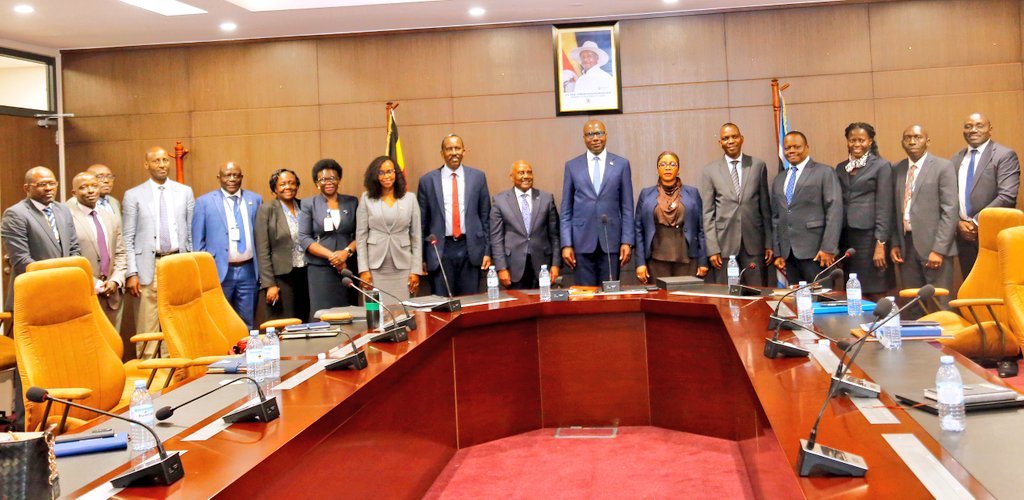
Uganda has set itself one of its most ambitious fiscal targets in decades. The Ministry of Finance, Planning and Economic Development (MOFPED) and the Uganda Revenue Authority (URA) have committed to increasing the country’s tax-to-GDP ratio from 14.2 percent to 20 percent by the Financial Year 2029/30, a move designed to fundamentally reshape how the government finances economic development.
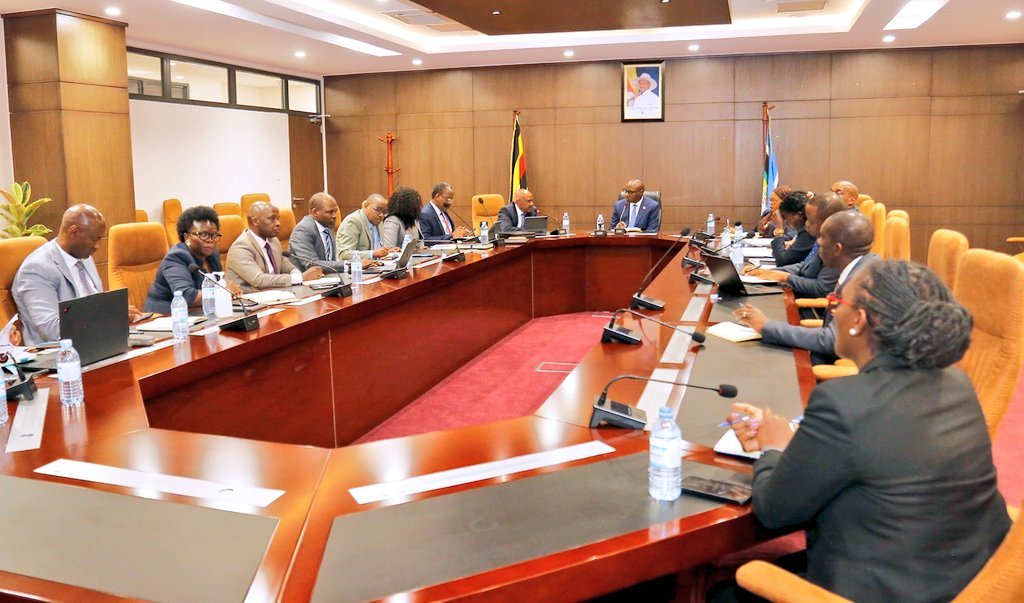
The commitment, reaffirmed during a high-level strategy meeting between Finance Minister Henry Musasizi, Minister of State for Privatisation and Investment Hajjat Aminah Mukalazi, URA Board Chairman Emmanuel Katongole and Commissioner General John Musinguzi, represents more than another revenue target. It is an acknowledgement that Uganda’s current tax system has reached its limits and that structural reforms, rather than simply collecting more from existing taxpayers, will determine whether government can finance its long-term economic ambitions.
The challenge is considerable.
Despite recording a historic UGX 31.63 trillion in domestic revenue during the 2024/25 financial year, Uganda’s tax-to-GDP ratio has remained largely unchanged for years, fluctuating between 13 and 14.2 percent. The figure remains below the sub-Saharan African average of between 16 and 18 percent, leaving government increasingly dependent on borrowing to finance infrastructure, social services and industrial development.
At the heart of the problem is a narrow tax base.
Although approximately 3.5 million taxpayers are registered with URA, more than 70 percent of all tax revenue comes from just 1,000 individuals and large corporate entities. That concentration exposes a structural weakness: government revenue depends heavily on a relatively small group of compliant taxpayers while a significant portion of economic activity remains outside the formal tax system.
Finance Minister Henry Musasizi acknowledged that this imbalance cannot continue.
“URA must put in place strategies to ensure that all Ugandans with taxable income pay their fair share of taxes.”
His remarks signal a shift in government thinking. Rather than increasing tax rates, the strategy focuses on expanding compliance by identifying previously untaxed individuals and businesses.
That explains why technology sits at the centre of URA’s new roadmap.
The Authority plans to integrate its systems with databases across Ministries, Departments and Agencies, financial institutions and utility providers to improve taxpayer visibility. Government also intends to link National Identification Numbers (NINs) with Tax Identification Numbers (TINs), giving tax administrators a more complete picture of economic activity across the country.
The objective is straightforward: use data to identify economic activity that currently escapes taxation instead of imposing heavier obligations on those already complying with the law.
The reforms extend beyond technology.
URA Board Chairman Emmanuel Katongole proposed establishing a centralized Internal Container Depot at the Namanve Industrial Park to simplify customs operations, reduce logistics costs, minimize delays and curb revenue leakages associated with cross-border trade. He also called for a review of Uganda’s Double Taxation Agreements, arguing that some existing treaties restrict the country’s ability to tax multinational corporations and may allow profits to be shifted beyond Uganda’s tax jurisdiction.
Together, these measures target both domestic compliance gaps and international tax leakages.
URA Commissioner General John Musinguzi framed the challenge as one that extends beyond the tax authority itself.
He argued that revenue mobilization requires coordinated action across government institutions, improved visibility of economic sectors and sustained political support if Uganda is to close its financing gap and fund its development agenda.
Equally important is public confidence.
Minister of State for Privatisation and Investment Hajjat Aminah Mukalazi emphasized that expanding the tax base depends on convincing citizens that taxation delivers tangible public value. She called for stronger nationwide tax education campaigns, accelerated business formalization and tougher action against corruption within URA itself.
“We cannot expand the tax base if our own staff act as agents of corruption or trade facilitators for tax evaders.”
The Authority plans to strengthen institutional integrity by recruiting approximately 1,500 additional staff by 2030 while deploying artificial intelligence and machine learning tools to detect internal misconduct and external tax fraud.
Whether these reforms succeed will have consequences far beyond URA’s annual revenue performance.
A tax-to-GDP ratio of 20 percent would substantially increase Uganda’s fiscal capacity, allowing government to finance a larger share of infrastructure, healthcare, education, agro-industrialization, tourism, mineral development and science and technology using domestic resources. It would also reduce reliance on expensive commercial borrowing and unpredictable external donor financing, strengthening macroeconomic resilience.
However, achieving the target will require more than improved tax administration. It will depend on sustained economic growth, continued formalization of businesses, stronger institutional coordination and public trust in the fairness and effectiveness of the tax system.
The agreement between MOFPED and URA therefore marks the beginning, not the culmination, of Uganda’s revenue reform agenda. The 20 percent target provides a clear destination. The challenge now is converting policy commitments into measurable improvements in compliance, broader taxpayer participation and stronger domestic resource mobilization over the next four financial years.
