
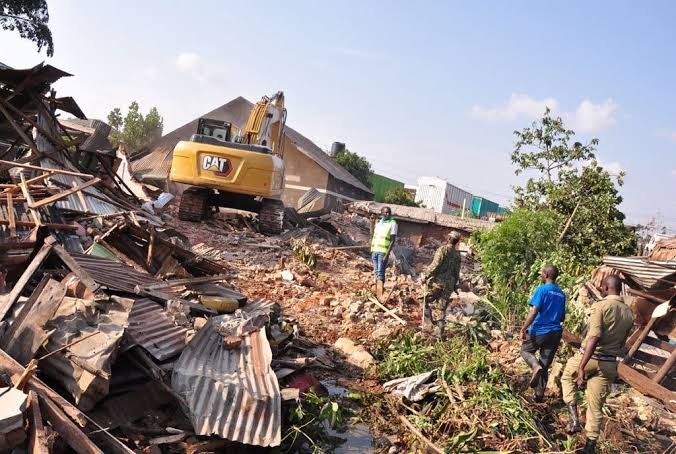
Across Kampala and its rapidly expanding metropolitan edge, a recurring and deeply unsettling contradiction is defining Uganda’s property and investment landscape. How do fully approved developments end up demolished by the National Environment Management Authority (NEMA)?
In recent enforcement operations across wetland zones such as Lubigi, Busabala, Kira, and Kajjansi, NEMA, backed by the Environmental Protection Police Unit, Uganda Police Force, and UPDF, has demolished hundreds of structures. Many of these properties reportedly held valid land titles, approved building plans, and utility connections issued by state institutions.
The result is a growing trust deficit in Uganda’s land governance system alongside significant financial losses for investors, developers, and lenders.
The Core Conflict: Two Systems, One Piece of Land
At the heart of the crisis is a structural mismatch between urban planning approvals and environmental enforcement law.
Local authorities such as Kampala Capital City Authority (KCCA) and district physical planning committees issue development permits under the Physical Planning Act, confirming that land is suitable for construction from a spatial and structural perspective.
However, NEMA operates independently under the National Environment Act, 2019 with constitutional authority to protect wetlands, riverbanks, and sensitive ecosystems.
This creates a situation where a property may be legally approved for construction at the planning level but still be deemed illegal under environmental law.
NEMA has further clarified that it stopped issuing permits for developments in wetlands following a government directive in 2021, reinforcing its strict enforcement stance.
The Statutory Collision: When One Law Overrides Another
The legal foundation of this conflict lies in three key statutory provisions.
Under Section 129 of the National Environment Act, 2019, NEMA environmental inspectors are empowered to issue Environmental Restoration Orders, including demolition of structures, notwithstanding any license or permit issued under any other law. This is the legal mechanism that allows NEMA to override KCCA or local government approvals.
Under Section 55 of the same Act, it is a criminal offense to reclaim, drain, or construct on wetlands without explicit authorization from NEMA, punishable by fines of up to Shs 600 million or imprisonment of up to 12 years.
At the same time, Section 44 of the Land Act (Cap 227) provides that wetlands are held in trust by the government and cannot be alienated for private ownership, meaning any land title issued over a protected wetland is legally void ab initio.
This creates a legal paradox where different arms of the state can simultaneously approve, license, and later destroy the same development.
The Institutional Breakdown: Fragmented Authority, Unified Loss
Experts increasingly argue that the crisis is not simply enforcement but institutional fragmentation.
Land administration, urban planning, environmental regulation, and utility provision operate on separate systems, databases, and approval chains.
In practice, the Ministry of Lands issues titles, KCCA and local governments approve building plans, utility providers extend electricity and water connections, and NEMA enforces environmental law at the final stage.
Each institution acts legally within its mandate but without coordination.
📊 The Institutional Blame Matrix: A Circle of Conflicting Approvals
| Institutional Actor | Action Taken | Systemic Failure | Legal Position |
|---|---|---|---|
| Ministry of Lands | Issues land titles | Uses outdated wetland mapping systems | Title may be void under Section 44 of Land Act |
| KCCA / Local Governments | Approve building plans | Focus on structure, not environmental zoning | Environmental authority lies with NEMA |
| Utilities (Umeme/NWSC) | Provide electricity and water | Extend services without ecological validation | Based on local approvals |
| NEMA | Demolishes structures | Acts at final stage of investment lifecycle | Section 129 overrides all prior approvals |
The Financial Impact: When Compliance Still Leads to Total Loss
For investors, the consequences are severe.
Developers invest millions in land acquisition, construction, and infrastructure based on official approvals only to later discover that the land falls within a protected ecosystem.
When demolition occurs, bank collateral is instantly wiped out, loans risk becoming non-performing assets, contractors and suppliers are left unpaid, and investors face 100 percent capital loss events.
According to Bank of Uganda financial stability assessments, environmental and land-use uncertainty is now a growing contributor to credit risk exposure in the banking sector.
At the same time, insurance providers typically exclude government enforcement actions, statutory demolition, or expropriation, leaving investors with no financial recovery mechanism.
The Cost of Compliance vs. The Cost of Destruction
The system creates a dangerous imbalance.
Environmental and Social Impact Assessment (ESIA) costs range between 5 percent and 15 percent of project cost. Full compliance adds additional permitting delays and technical costs.
Non-compliance or misclassification, however, results in 100 percent irreversible capital loss.
This makes Uganda’s regulatory environment one of the most asymmetric risk structures in the real estate sector.
The Data Behind the Crisis: Wetland Loss and Enforcement Pressure
Uganda’s wetlands have declined significantly over time.
Official data from NEMA and the Ministry of Water and Environment shows wetland coverage dropped from 15.6 percent in 1994 to about 8.9 percent in 2021. Loss rates are estimated at 2 to 2.5 percent annually.
The Eastern Region has lost up to 39 percent of wetlands, largely due to agriculture and settlement expansion.
In Greater Kampala, rapid urbanization remains the dominant driver of wetland encroachment.
In Lubigi Wetland alone, which spans 1,721 hectares, NEMA has conducted multiple restoration operations, including demolition of over 200 households in prior enforcement cycles.
These operations are part of a broader national strategy aligned with Uganda’s development and climate resilience goals under the National Development Plans (NDPIII and emerging NDPIV).
The Human and Economic Trade-Off
Beyond legal and financial systems, the human impact is significant.
Families lose homes, businesses collapse overnight, and investors absorb total capital destruction. Communities experience displacement and uncertainty.
At the macroeconomic level, continued wetland loss increases flooding risks, damages infrastructure, and undermines long-term urban resilience.
At the same time, unpredictable enforcement weakens investor confidence in peri-urban development zones where most of Uganda’s urban expansion is occurring.
The Governance Question: System Failure or Legal Necessity?
The central debate remains unresolved.
NEMA insists enforcement is constitutionally mandated and necessary to protect public environmental goods. Urban planners and investors argue that fragmented approvals create unavoidable good-faith losses.
Even NEMA officials acknowledge conditional permitting dynamics in sensitive zones, where approvals may be issued with strict environmental restrictions.
This confirms a deeper truth. The system is not absent. It is uncoordinated.
The Way Forward: From Fragmentation to Integration
Experts recommend structural reforms rather than isolated fixes.
A unified land-use approval system should integrate NEMA, KCCA, and the Ministry of Lands into a single geospatial platform.
Real-time digital mapping of wetlands and protected zones should be made accessible to all agencies.
Mandatory joint approvals should be required before any construction permit is issued.
Stronger accountability mechanisms are needed for officials issuing approvals in restricted areas.
Clear investor protection frameworks should also be introduced for good-faith approvals later invalidated by institutional misalignment.
Without these reforms, the cycle of approval, investment, and demolition will continue.
A System Built on Parallel Truths
So who is to blame when approved properties are bulldozed by NEMA?
The answer lies not in a single institution, but in a fragmented governance structure where multiple state systems operate independently but govern the same land. The Ministry of Lands issues titles. Local authorities issue permits. Utilities enable development. NEMA enforces environmental law.
Each is acting within its legal mandate but without institutional coordination.
Until Uganda bridges this gap between planning and environmental enforcement, investors will continue to face a harsh reality.
A property can be fully approved, fully built, and still fully demolished. And in that gap between legality and enforcement, millions in capital continue to be lost.
