
For months, East Africa watched as Kenya and Tanzania competed to host what could become the region’s most transformative industrial investment. Both countries lobbied aggressively, each hoping to secure a refinery that would redefine regional energy markets, attract billions of dollars in investment, and create thousands of jobs.
The contest has now been decided.
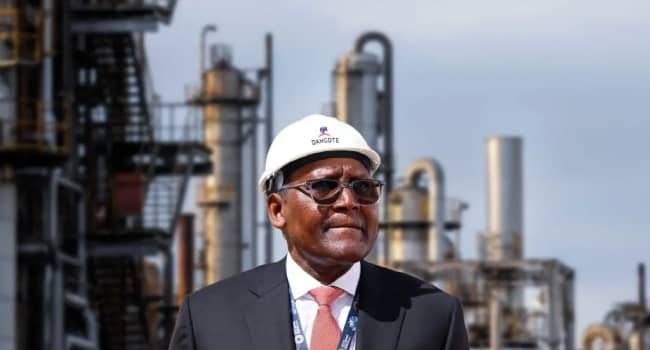
Africa’s richest man, Aliko Dangote, has confirmed plans to establish his proposed $17 billion oil refinery in Kenya, bringing an end to months of speculation over whether the project would be built in Kenya or Tanzania. The proposed refinery, expected to process up to 700,000 barrels of crude oil per day, will become one of Africa’s largest refining facilities and a major pillar in East Africa’s quest for energy security.
The decision is far more significant than the location of another industrial project. It signals a shift in the region’s economic landscape and demonstrates that when investments of this scale are at stake, infrastructure, market size, and commercial viability outweigh political goodwill.
Initially, Tanzania appeared to have the upper hand. Earlier discussions centred on developing the refinery at the Port of Tanga, with the project expected to process crude from Uganda, South Sudan, Kenya, and potentially the Democratic Republic of Congo. Regional leaders promoted the proposal as a strategic partnership that would reduce East Africa’s dependence on imported petroleum products from the Middle East, Europe, and Asia.
However, as technical assessments progressed, Kenya steadily emerged as the preferred destination.
One of the biggest factors behind the decision was port infrastructure.
A refinery capable of processing 700,000 barrels every day requires enormous logistical capacity. It must accommodate Very Large Crude Carriers carrying imported crude while simultaneously exporting refined products across regional and international markets. Such operations demand deep-water ports capable of handling some of the world’s largest vessels efficiently.
Kenya’s coastline, particularly the Lamu Port under the Lamu Port-South Sudan-Ethiopia-Transport (LAPSSET) Corridor, offers precisely that advantage. The port’s deep natural berths can accommodate larger ships, reduce congestion, lower shipping costs, and improve turnaround times.
Although Tanzania’s Port of Tanga remains an important regional gateway, technical evaluations reportedly ranked its scalability below Kenya’s alternatives for a project of this magnitude.
Market demand also played a decisive role.
Refineries are capital-intensive investments that require strong domestic consumption before relying on exports. Kenya possesses East Africa’s largest economy and consumes considerably more refined petroleum products than Tanzania.
That larger domestic market provides a reliable base for refinery operations while reducing commercial risk during the project’s early years. Dangote himself acknowledged that Kenya’s stronger consumption profile made the investment more attractive.
Government support further strengthened Kenya’s position.
The Kenyan government committed approximately KES 21.5 billion, equivalent to about $165 million, in seed capital to support the broader energy ecosystem surrounding the refinery. Such commitments significantly improve investor confidence by demonstrating long-term policy support and reducing development risks.
Distribution infrastructure also influenced the final decision.
Producing fuel is only one part of the equation. Getting it efficiently to consumers across East Africa is equally important.
Kenya already possesses one of the region’s most mature petroleum transportation systems through the Kenya Pipeline Company. Its extensive pipeline network stretches from the coast into western Kenya and provides efficient access to neighbouring countries including Uganda, South Sudan, and the Democratic Republic of Congo.
This existing infrastructure dramatically lowers transportation costs while expanding the refinery’s commercial reach across the region.
The project also represents a much broader strategic vision for Dangote Industries.
The new refinery is expected to complement the company’s flagship refinery in Lagos, Nigeria, which currently processes around 650,000 barrels per day and has ambitions for even greater capacity in the coming years.
Together, the Nigerian and Kenyan facilities would create refining hubs on both the Atlantic and Indian Ocean coastlines, giving Dangote a powerful position within Africa’s downstream petroleum industry. Such a network would enable the company to serve both West and East African markets while reducing dependence on imported refined fuels.
For decades, East African countries have exported crude or imported refined petroleum products at significant cost. This has drained foreign exchange reserves while exposing local economies to volatile global shipping costs and supply disruptions.
A regional refinery of this scale could fundamentally alter that equation by keeping more value addition within Africa, reducing import bills, and improving regional energy security.
The decision, however, creates interesting questions for Uganda.
Uganda’s commercial oil production is expected to rely on the East African Crude Oil Pipeline (EACOP), which transports crude through Tanzania to the Indian Ocean. With Dangote’s refinery now located in Kenya, analysts will be watching closely to see whether the company sources crude from international suppliers, negotiates access to regional crude supplies, or develops alternative logistical arrangements.
This could reshape future energy partnerships across East Africa.
For Kenya, the benefits are substantial.
The refinery is expected to generate thousands of direct and indirect jobs, attract billions of dollars in foreign direct investment, stimulate supporting industries, and reinforce the country’s ambition of becoming East Africa’s energy and logistics hub. It also provides renewed momentum for the long-envisioned industrialisation of the LAPSSET Corridor.
For Tanzania, missing out on hosting the refinery represents a significant setback. Nevertheless, Dangote has reportedly invited Tanzania to participate as an equity partner in the project, preserving opportunities for regional cooperation despite losing the primary investment.
Construction activities, including site assessments and preliminary engineering work, have already begun, with the project expected to be financed through a combination of internal capital, debt financing, and future public investment.
If completed within the projected three to five years, the refinery could transform East Africa’s energy landscape.
Ultimately, Dangote’s decision offers an important lesson for governments competing for large-scale investments. Political relationships may open doors, but investors ultimately follow infrastructure, logistics, market depth, and commercial fundamentals. In the race between Kenya and Tanzania, those fundamentals made the difference.
