
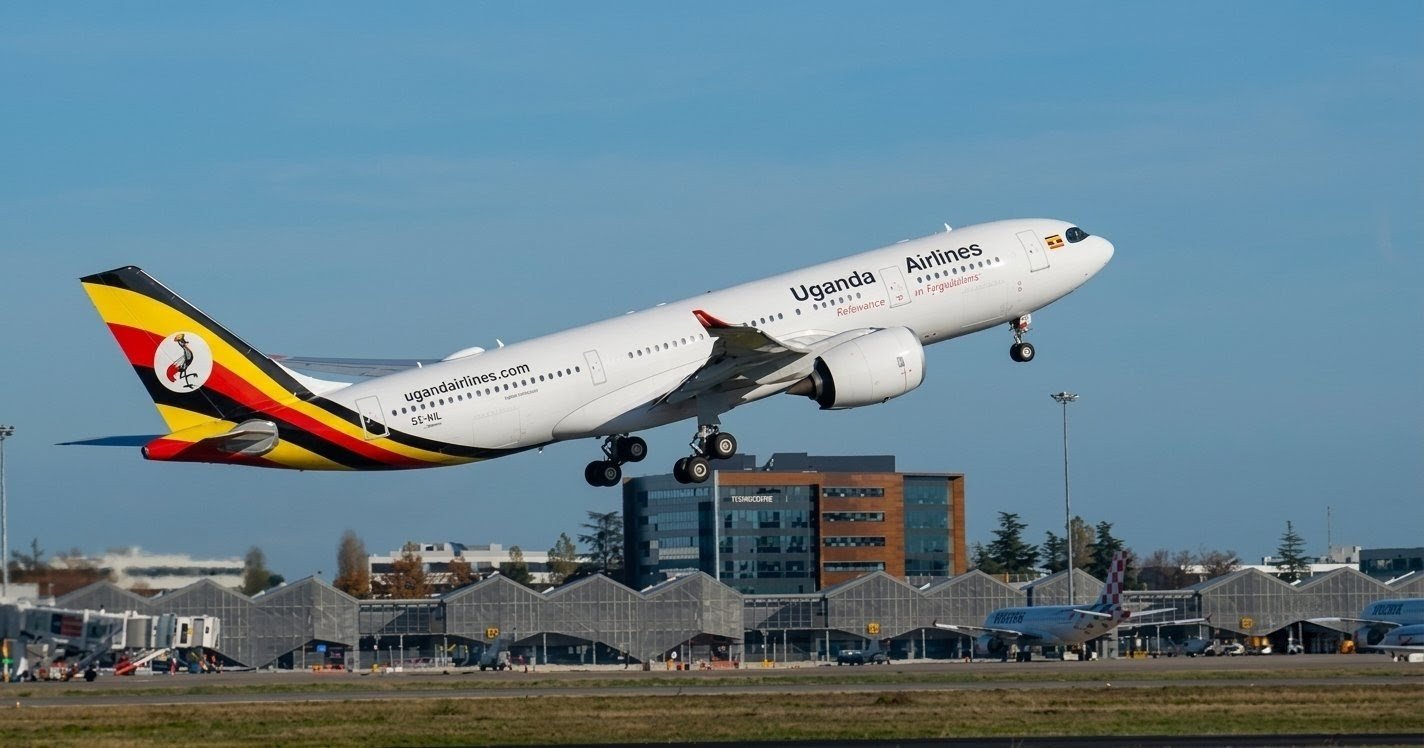
For much of the last two decades, Uganda Airlines existed more as a memory than a business.
When the government announced plans to revive the national carrier in 2019, optimism was tempered by skepticism. Across Africa, national airlines have often become cautionary tales, burdened by political interference, mounting debts and persistent losses. Critics questioned whether Uganda was resurrecting a symbol of national pride or creating another financial liability.
Six years later, that narrative is changing.
Uganda Airlines has increased its annual revenue from US$10.3 million in FY2019/20 to US$116.2 million in FY2024/25, achieving an exceptional 62.4 percent compound annual growth rate (CAGR). It has carried more than 1.7 million passengers, expanded its network to 16 destinations across Africa, the Middle East, Europe and Asia, and maintained the distinction of operating Africa’s youngest fleet for six consecutive years.
Those figures were presented during a recent meeting between officials from the Ministry of Works and Transport, led by Hon. Fred Byamukama alongside Hon. Ali and Hon. Mawanda, and Uganda Airlines’ Acting Chief Executive Officer, Mr. Gilma, and his management team. While the briefing reviewed operational performance and future expansion plans, it also revealed something far more significant: Uganda Airlines is steadily evolving from a government-backed startup into one of Uganda’s most strategic economic assets.

That transformation matters because aviation is no longer simply about transporting passengers. It has become a powerful driver of tourism, trade, investment and regional competitiveness. For a landlocked economy seeking deeper integration into African and global markets, the performance of its national airline has implications far beyond the runway.
A Difficult Journey to Growth
The journey, however, has been anything but smooth.
Uganda Airlines resumed operations in August 2019 after nearly twenty years of dormancy. Months later, the COVID-19 pandemic plunged global aviation into its deepest crisis in history. Passenger traffic collapsed almost overnight, airlines grounded fleets, and even some of the world’s largest carriers required government bailouts to survive.
Uganda Airlines entered that crisis while still building its route network, recruiting personnel and earning public confidence.
The airline also faced internal challenges. Its relatively small fleet meant that a single aircraft undergoing unscheduled maintenance could disrupt operations across multiple destinations. Parliamentary oversight committees questioned procurement processes and governance structures, leading to management changes intended to strengthen accountability and operational discipline.
Against that backdrop, today’s financial performance represents far more than rising ticket sales. It reflects years of institutional rebuilding, operational learning and strategic investment.
Winning Back Uganda’s Skies
Perhaps the clearest indicator of this transformation is the airline’s growing presence at Entebbe International Airport.
Industry estimates suggest Uganda Airlines now accounts for between 27 and 38 percent of passenger traffic passing through the country’s main international gateway, a dramatic increase from approximately 4 percent during its inaugural year. That growth indicates the airline is steadily reclaiming market share long dominated by foreign carriers.
Its route network has also expanded significantly. Uganda Airlines now connects Entebbe to key commercial and tourism destinations including Nairobi, Johannesburg, Lagos, Kinshasa, Juba, Dar es Salaam, Zanzibar, Mombasa, Dubai, Mumbai and Abuja.
The expansion is far from complete.
The airline is preparing to launch new services to Accra, strengthening links with West Africa, while increasing frequencies to Kigali as demand for regional travel continues to rise.
For Uganda, these routes are more than commercial opportunities.
Reliable international air connectivity reduces dependence on foreign airlines, lowers travel barriers for businesses, supports tourism, facilitates trade and strengthens Uganda’s participation in regional economic integration. Exporters of fresh flowers, fish, fruits and vegetables also benefit from faster access to international markets, where time-sensitive cargo commands premium prices.
More Than an Airline
The broader economic effects are equally significant.
Globally, aviation is recognised as a high-multiplier industry, generating activity across hospitality, logistics, manufacturing, retail, financial services and tourism. Every new route creates demand for hotels, conference facilities, freight operators, catering companies, airport services and ground transportation.
As Uganda Airlines expands, so too does demand for pilots, aircraft engineers, cabin crew, dispatchers, airport operations specialists and aviation technicians, creating opportunities for skilled employment within Uganda’s growing services economy.
Preparing for the Next Phase
The next phase of the airline’s strategy is considerably more ambitious.
Management plans to increase the fleet to 16 aircraft during the early 2030s, supported by new Boeing 787 Dreamliners already on order. These aircraft will allow Uganda Airlines to operate longer routes while improving fuel efficiency, passenger comfort and operational flexibility.
Beyond fleet expansion, the airline has outlined a reported US$985 million aircraft acquisition programme, including additional passenger aircraft and dedicated cargo freighters.
The objective extends beyond carrying more passengers.
Greater fleet capacity will enable Uganda Airlines to expand into new international markets, strengthen cargo operations, improve schedule reliability and reduce disruptions caused by limited aircraft availability.
One of the most strategically important investments, however, is unlikely to attract headlines.
The airline plans to establish its own Maintenance, Repair and Overhaul (MRO) facility at Entebbe International Airport.
Today, many African airlines spend millions of dollars flying aircraft overseas for heavy maintenance checks. A domestic MRO facility would significantly reduce maintenance costs, shorten aircraft downtime and potentially position Uganda as a regional maintenance hub serving neighbouring airlines.
Such investments signal a shift from simply operating aircraft to building an aviation ecosystem.
Competing in a Crowded Market
Competition, however, remains intense.
African aviation is increasingly dominated by ambitious regional players including Ethiopian Airlines, Kenya Airways and RwandAir, each investing heavily in fleet renewal and network expansion.
Uganda Airlines is unlikely to challenge Ethiopian Airlines’ continental dominance in the near future. Instead, it appears to be pursuing a more focused strategy built around selective route expansion, operational efficiency and strengthening Entebbe’s position as an emerging regional gateway.
Challenges Ahead
The airline must also navigate persistent industry challenges.
Commercial aviation remains among the world’s most capital-intensive businesses. Fuel prices remain volatile, aircraft financing requires enormous investment and profitability depends on consistently high passenger demand. Sustaining rapid growth will require disciplined financial management, continued government support and significant investment in people, technology and infrastructure.
Yet the airline’s trajectory suggests that the difficult years of market entry may be giving way to a period of consolidation and expansion.
A Strategic National Asset
From US$10.3 million in annual revenue to US$116.2 million in just six years, Uganda Airlines has become one of Africa’s fastest-growing national carriers. More importantly, it is increasingly serving as a platform for tourism, trade, exports and investment rather than simply a means of transportation.
Whether it ultimately becomes East Africa’s next aviation powerhouse remains to be seen. Achieving that ambition will require sustained profitability, disciplined expansion and the ability to compete against some of Africa’s strongest carriers.
But one conclusion is already difficult to ignore.
Uganda Airlines is no longer simply proving that a national carrier can fly again. It is beginning to demonstrate that, with strategic investment and long-term vision, aviation can become one of Uganda’s most powerful engines of economic transformation.
