
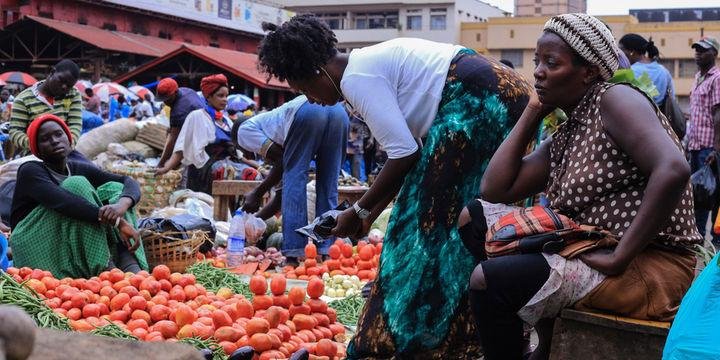
For many Ugandan households, the cost of living has become one of the country’s greatest economic puzzles.
A good harvest is expected to lower food prices. Falling global oil prices should make transport cheaper. Lower inflation should translate into relief at the supermarket checkout. Yet for shoppers in Kampala, Mbarara, Gulu and Mbale, that relief rarely arrives. Transport fares remain high, processed food prices barely move, and many everyday goods continue selling at prices set during previous economic shocks.
The numbers tell an interesting story. According to the Uganda Bureau of Statistics (UBOS), raw agricultural prices have fallen sharply in several categories, while inflation has moderated across parts of the economy. Yet consumers continue paying prices that seem disconnected from these improvements.
The explanation lies in what economists call downward nominal price rigidity, commonly known as the “rocket and feather” effect. Prices rise like rockets during periods of crisis but drift downward as slowly as feathers once conditions improve.
In Uganda, this phenomenon is increasingly being driven by structural business costs rather than short-term market forces.
According to the UBOS Consumer Price Index covering the twelve months to May 2026, petrol inflation rose to 16.6 percent, diesel inflation climbed to 21.5 percent, while kerosene inflation reached 25.4 percent. The impact spread rapidly across the economy, pushing annual passenger transport services inflation from 2.2 percent to 10.6 percent within a month.
The transmission mechanism is straightforward. Once fuel prices increase, transport operators immediately revise fares to cover higher operating costs. Businesses that rely on transportation also increase their prices to protect their profit margins.
The reverse, however, rarely happens.
Even when international oil prices soften or pump prices stabilise, transport fares often remain unchanged. The reason extends far beyond fuel.
Transport operators continue facing expensive commercial loans, rising maintenance costs, imported spare parts priced in foreign currency, insurance premiums and licensing fees. These costs remain largely fixed regardless of whether fuel prices decline slightly.
For many operators, reducing fares simply becomes financially impossible.
The same pattern can be seen in Uganda’s food value chain.
UBOS data shows bumper harvests have significantly lowered prices for several fresh agricultural commodities. Matooke prices fell by 3.4 percent, fresh beans recorded a dramatic 30.1 percent decline due to market oversupply, while sweet potatoes dropped by 10.5 percent.
Ordinarily, consumers would expect these reductions to translate into cheaper food on supermarket shelves.
Instead, processed food prices have remained relatively stable. Maize flour, for example, recorded inflation of 0.9 percent, indicating prices slowed their increase but did not actually fall.
The reason lies in the cost of processing rather than farming.
Millers continue paying industrial electricity tariffs to operate heavy machinery. Packaging materials remain expensive because many inputs are imported. Compliance costs, taxes, transport, warehousing and labour expenses all remain elevated even when raw grain becomes cheaper.
By the time maize leaves the farm, passes through processing, packaging, distribution and retail, much of the savings generated by lower farm gate prices have already disappeared.
The result is an economy where farmers earn less while consumers continue paying almost the same prices.
Currency movements further complicate the picture.
The Bank of Uganda has previously noted that fluctuations in the Uganda shilling directly affect the cost of imported fuel, machinery, industrial chemicals and manufacturing inputs.
When the shilling weakens, importers quickly adjust prices upward to reflect higher replacement costs.
When the currency later strengthens, those same businesses rarely reduce prices immediately.
Instead, many retain existing prices as a hedge against future exchange rate volatility. Having experienced repeated currency fluctuations over recent years, businesses increasingly build protective buffers into their pricing strategies.
Market structure also plays a significant role.
In industries dominated by only a handful of major producers, price competition is often limited. Rather than passing lower production costs directly to consumers, firms may choose to strengthen their balance sheets, repay expensive loans or invest in future expansion.
From a business perspective, maintaining prices improves resilience in an uncertain economic environment.
From a consumer perspective, however, it means the benefits of lower production costs are slow to materialise.
This explains why inflation can fall without households necessarily feeling better off.
Lower inflation simply means prices are increasing more slowly. It does not mean prices are returning to previous levels.
For policymakers, the findings highlight an important challenge.
Controlling inflation through monetary policy alone may not be sufficient to reduce the cost of living. Structural reforms that lower electricity costs, improve transport efficiency, strengthen competition, stabilise the exchange rate and reduce the cost of doing business are equally important if lower input costs are to reach consumers.
For businesses, maintaining higher prices often represents prudent financial management rather than opportunistic profiteering. High borrowing costs, volatile exchange rates and expensive operational overheads leave little room for frequent price reductions.
For ordinary Ugandans, however, the outcome is unmistakable.
Even when farms produce more, fuel prices ease or inflation slows, the price of everyday goods often remains stubbornly high. Until the structural costs embedded throughout Uganda’s supply chains begin to decline, consumers are likely to continue experiencing an economy where prices climb rapidly during crises but take far longer to come back down.
The mathematics behind Uganda’s economy makes one reality increasingly clear: prices are not determined solely by supply and demand. They are also shaped by the cost of surviving in an unpredictable business environment.
