

The global youth labour market is entering a difficult period as millions of young people struggle to find work while businesses restructure around slower economic growth, digital technology and artificial intelligence.
The International Labour Organization estimates that about 64.9 million young people aged 15 to 24 were unemployed globally in 2023, equivalent to a youth unemployment rate of 13 percent. The rate has since fallen from its pandemic-era peak, but the recovery has been uneven across regions and groups.
The challenge extends beyond unemployment. About one in five young people globally are not in employment, education or training, a group commonly referred to as NEET. Young women face a significantly higher risk of being excluded from work, education and training than young men.
For employers and policymakers, the numbers point to a deeper question: how do young people acquire their first years of experience when the jobs traditionally used to enter the labour market are changing?
AI is changing the entry point. Artificial intelligence is increasingly being integrated into administrative, customer service, software development, research and other knowledge-based tasks. For young workers, the concern is less about every job disappearing and more about the tasks within jobs changing.
Entry-level employees have traditionally performed routine assignments while developing the skills required for more senior positions. Businesses adopting AI tools are now able to automate some of those tasks or allow experienced employees to complete them faster.
This creates a potential experience gap. A graduate might find a vacancy requiring experience with software, data analysis or specialised industry tools, while employers simultaneously reduce the number of junior positions available for acquiring those skills.
The ILO has found that clerical occupations have the highest exposure to generative AI, although the organisation stresses that exposure does not automatically mean jobs will disappear. In many occupations, AI is more likely to transform tasks than eliminate entire jobs.
That distinction matters for young workers entering the market. The problem is bigger in developing economies Youth unemployment is only one measure of the challenge. In many developing economies, young people work without formal contracts, stable wages or social protection. Informal employment therefore reduces the usefulness of unemployment statistics as a measure of economic security.
The ILO has repeatedly highlighted the prevalence of informal employment among young workers, particularly in developing economies. Sub-Saharan Africa faces an especially difficult structural problem.
The region has one of the world’s fastest-growing youth populations, but formal employment is not expanding at the same pace. Millions of young people therefore enter informal trade, agriculture, transport, casual labour and digital gig work rather than formal salaried employment. For African economies, the challenge is therefore twofold: creating more jobs and creating jobs with sufficient productivity and income to support rising populations.

Young women face an additional barrier. The transition into employment is also unequal between young men and women. Globally, young women are substantially more likely than young men to be outside employment, education or training. The gap reflects factors including unpaid care responsibilities, social expectations and unequal access to education and economic opportunities.
The problem has economic consequences. When large numbers of young people remain outside productive employment, economies lose potential income, tax revenue, consumer spending and investment. For businesses, the exclusion of young women also reduces the available pool of workers and entrepreneurs.
The experience trap
One of the most persistent barriers for graduates is the demand for previous experience. Employers want workers who are productive from the beginning, while young workers need opportunities to acquire workplace experience.
AI may intensify this tension if companies use technology to reduce the amount of routine work assigned to junior employees. The result could be a labour market where the easiest tasks to automate are also the tasks through which young workers traditionally learned. This does not mean young people are becoming economically irrelevant. It means the skills required to enter the labour market are changing.
Training is moving closer to the workplace. Governments, universities and employers are increasingly focusing on technical and vocational education, apprenticeships and short professional credentials. The objective is to reduce the distance between classroom learning and workplace requirements.
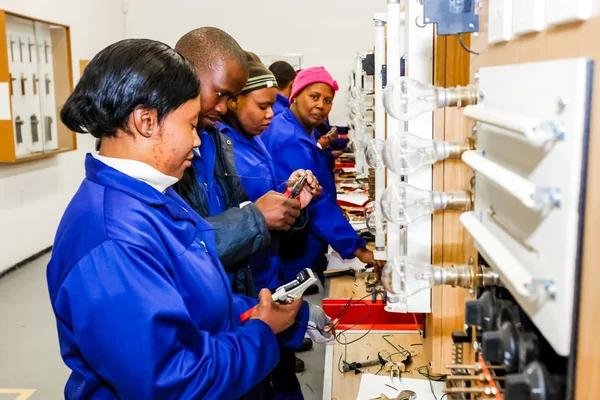
Skills linked to healthcare, renewable energy, advanced manufacturing, infrastructure maintenance and digital technology are receiving greater attention because many require physical, technical or interpersonal capabilities alongside digital knowledge.
For young workers, adaptability is becoming increasingly important. Learning how to use AI tools, analyse information, communicate effectively and apply technical skills within a specific industry could become more valuable than relying solely on a traditional academic qualification.
Governments face a difficult balancing act. Restricting new technologies would do little to solve youth unemployment over the long term because automation also creates productivity gains and new forms of work. The alternative is to prepare workers for the transition. That means improving vocational education, strengthening apprenticeships, supporting first-time jobseekers and making it easier for young people to gain practical experience.
Policy discussions are also increasingly considering how social protection should cover freelancers and workers earning income through digital platforms.
The global youth employment problem is therefore bigger than the unemployment rate. The central challenge is ensuring that young people have a realistic pathway from education to their first job, from their first job to experience, and from experience to sustainable careers.
As AI changes the tasks businesses need workers to perform, the countries that build those pathways most effectively will be better positioned to turn a rapidly growing young population into an economic advantage.
