
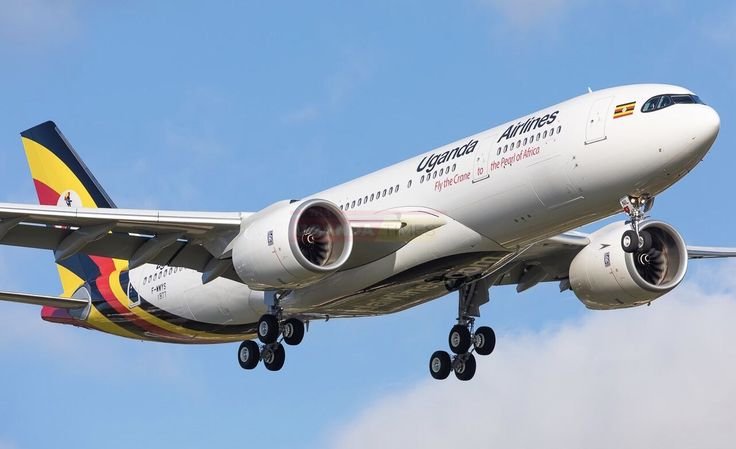
At State House Entebbe, Uganda Airlines signed a fleet expansion agreement with Boeing worth approximately Shs3.7 trillion (about $985 million). On paper it is a 10-aircraft procurement. In practice it is a broader attempt to reset a troubled national carrier, rebuild public confidence, and reposition Entebbe as a stronger East African aviation hub.
The deal comes after a period in which Uganda Airlines faced some of the sharpest scrutiny since its revival. Public frustration grew over flight disruptions, aircraft groundings, expensive wet-leasing arrangements, and persistent questions about whether the airline could become commercially sustainable. The Boeing package is being presented as the airline’s answer to these criticisms. It is a move away from fragmented operations and emergency fixes toward a more standardized and resilient fleet.
The 10-aircraft package at a glance
| Category | Aircraft | Role |
|---|---|---|
| Long-haul passenger | 4 × Boeing 787-9 Dreamliners | Intercontinental routes and network depth |
| Regional passenger | 4 × Boeing 737 MAX | East and Central African feeder network |
| Cargo | 1 × Boeing 767 Converted Freighter | Wide-body freight capacity |
| Cargo | 1 × Boeing 737-800 BCF | Regional freight and logistics support |
From crisis to procurement: why the deal happened now
The immediate backdrop matters. Uganda Airlines’ long-haul operation became exposed when technical issues affected both of its Airbus A330-800neo aircraft. The grounding of one aircraft abroad, followed by engine-related concerns on the second, disrupted flagship international services, forced schedule changes, and pushed the airline into costly short-term wet-leasing arrangements.
Those events reinforced a structural weakness. A small mixed fleet leaves little room for maintenance surprises. A single grounding can ripple across the entire network. The Boeing deal is therefore being framed less as a prestige purchase and more as a risk management response intended to add redundancy, simplify operations, and reduce dependence on emergency aircraft leasing.
Why standardization is central to the strategy
One of the biggest structural weaknesses in emerging national carriers is fleet fragmentation. Multiple aircraft types increase maintenance costs, complicate training systems, and inflate spare parts inventories.
Uganda Airlines is moving to correct that imbalance by anchoring future growth around Boeing families. The goal is operational simplification, reduced cost per aircraft, and improved scheduling efficiency.
The four Boeing 787-9 Dreamliners will serve as the long-haul backbone. The four Boeing 737 MAX aircraft will form the regional feeder system that feeds passengers into intercontinental routes through Entebbe.
Together, they are intended to function as a unified network rather than separate operational silos.
The cargo bet may matter more than the passenger story
Passenger expansion dominates headlines, but cargo could deliver the more immediate economic payoff.
Uganda’s export economy, particularly coffee, fish, flowers, fruits, and vegetables, depends on reliable air freight. Exporters have long faced constraints from limited cargo space and high reliance on foreign carriers.
By introducing dedicated freighters, Uganda Airlines is attempting to unlock predictable logistics capacity for exporters.
“Deploying dedicated freighters removes long-standing bottlenecks in Uganda’s export chain. It enables predictable cold-chain logistics, reduces spoilage, and strengthens direct access to premium international markets.”
This shift is particularly important for agribusiness and manufacturing firms that require consistent delivery schedules to maintain international contracts.
Technology transfer and local aviation capability
The agreement also includes a strong capacity-building component. Government officials say Boeing will support pilot training, technical instruction, and maintenance system development.
A key ambition is the establishment of a locally certified Approved Maintenance Organisation (AMO), which would reduce dependence on overseas maintenance facilities.
If achieved, this would represent a structural shift in Uganda’s aviation economy, keeping high-value technical work and training within the country.
The financial and governance reality check
Despite the strategic narrative, the financial implications remain significant.
A near-billion-dollar acquisition introduces long-term obligations that must be carefully managed before new routes reach full profitability. The airline will need disciplined financial structuring to avoid liquidity pressure.
Load factors will also determine success. Aviation history shows that state carriers often struggle when capacity expansion outpaces market demand.
Governance will be equally important. The appointment of veteran aviation executive Girma Wake signals an attempt to restore operational discipline after years of public skepticism and restructuring cycles.
The bigger picture: Transport policy as industrial policy
The most important shift revealed by this deal is conceptual. Aviation is now being treated as core economic infrastructure rather than a standalone business.
The argument is straightforward. Without reliable air connectivity, industrial growth, export competitiveness, and tourism expansion remain constrained by external dependencies.
Whether this strategy succeeds will depend not on procurement announcements but on execution outcomes.
The Boeing deal gives Uganda Airlines scale, modern aircraft, and cargo capacity. It does not guarantee profitability or hub dominance. Those outcomes will depend on execution discipline, network planning, and governance strength.
Ultimately, the significance of the deal lies in its intent. Uganda has chosen to use aviation as a deliberate tool of economic transformation, committing significant public capital to prove that a national carrier can be both commercially viable and strategically indispensable.
The next phase will be judged in operational reality: on-time performance, full cabins, reliable cargo movement, and financial results that justify one of the most ambitious aviation investments in the country’s recent history.
