
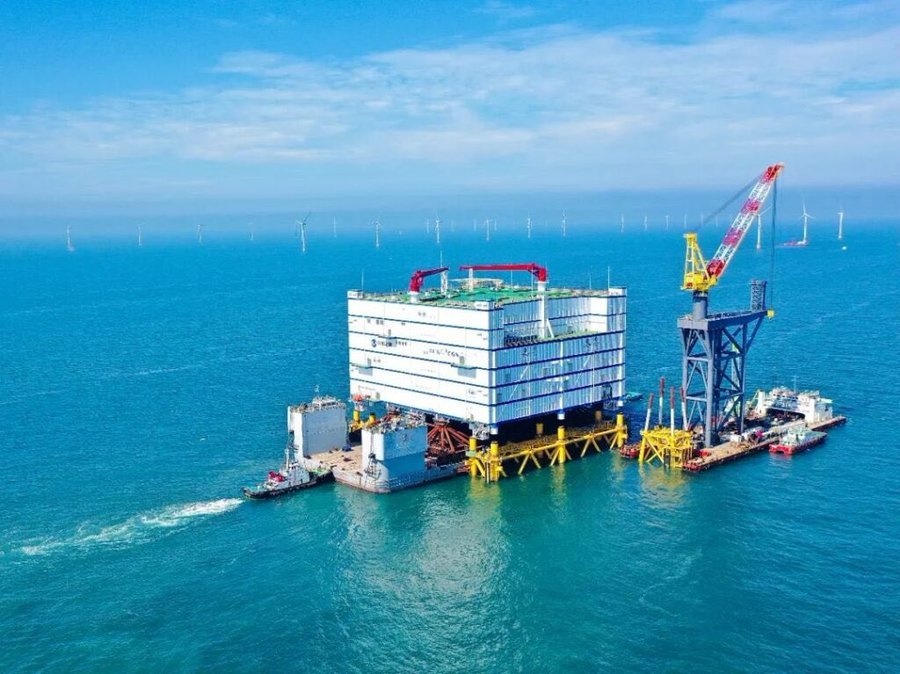
The future of renewable energy is moving farther offshore, and China has just taken one of the biggest steps yet.
In a landmark achievement for marine engineering and power infrastructure, China has launched the world’s largest offshore converter station, a colossal 25,000-ton structure designed to connect massive offshore wind farms directly to the national electricity grid. More than just a piece of energy infrastructure, the platform represents a major breakthrough in how countries can harness deep-sea wind resources at scale.
Measuring 85.5 meters long and 82.5 meters wide, the floating giant will serve as the central transmission hub for two major offshore wind farms. Once installed, it will collect electricity generated by hundreds of wind turbines, convert it, and deliver it efficiently to mainland consumers.
At the heart of the project is another world first. The platform is the first ±500-kilovolt, 2-gigawatt flexible High-Voltage Direct Current (HVDC) converter station ever built offshore.
For energy experts, this is more than a technological milestone. It could fundamentally reshape the economics of offshore wind power.
Solving Offshore Wind’s Biggest Challenge
As offshore wind farms move farther away from coastlines in search of stronger and more consistent winds, transmitting electricity back to shore becomes increasingly difficult.
Traditional Alternating Current (AC) transmission systems lose significant amounts of energy over long subsea distances. Beyond certain ranges, these losses become so large that projects become uneconomical.
This is where HVDC technology comes in.
The new platform acts as a giant electrical processing center in the middle of the sea. It receives fluctuating AC electricity from offshore wind turbines, converts it into Direct Current (DC), and sends it to shore through ultra-efficient high-voltage transmission lines.
According to Elena Rostova, Lead Grid Architect at the Global Maritime Infrastructure Forum:
“What we are seeing here is the definitive solution to the far-offshore transmission bottleneck. When you push past the 100-kilometer maritime threshold, traditional Alternating Current networks fail due to immense underwater capacitive leakage. By anchoring a 2-gigawatt flexible Voltage Source Converter right at the oceanic source, this platform effectively tames the volatile intermittency of deep-sea wind before it ever hits the mainland grid.”
In simple terms, the platform transforms unpredictable wind energy into a stable source of electricity capable of supporting industrial-scale demand.
The Cooling Innovation That Could Change the Industry
Perhaps the most impressive feature of the converter station is not its size, but how it keeps itself cool.
Converting and transmitting two gigawatts of electricity generates enormous amounts of heat. Traditionally, large power facilities rely on energy-intensive air-conditioning systems to prevent sensitive equipment from overheating.
China’s engineers took a different approach.
Instead of using conventional cooling systems, the platform draws on the natural cooling power of the ocean. Seawater circulates through a network of closed-loop titanium heat exchangers, allowing the surrounding sea to absorb excess heat.
The result is an exceptionally efficient system with a Power Usage Effectiveness (PUE) rating of just 1.15.
A PUE close to 1.0 is considered the gold standard in energy infrastructure because it means very little energy is consumed by support systems.
According to Dr. Aris Vance, Senior Marine Systems Engineer and Thermodynamicist:
“The engineering beauty of the project lies in its bold approach to fluid dynamics. Traditional HVAC systems introduce moving failure points that are highly vulnerable to salt-spray corrosion. By treating the deep ocean as an infinite thermal sink, China has fundamentally rewritten the rules of marine asset longevity.”
The design not only improves efficiency but also reduces maintenance requirements in one of the world’s harshest operating environments.
A Major Win for Energy Economics
The efficiency gains have significant financial implications.
Every unit of electricity used to operate a power facility is electricity that cannot be sold to consumers. Reducing these internal energy demands dramatically improves project profitability.
According to Marcus Sterling, Principal Energy Economist at Capital Energy Research:
“The attainment of a 1.15 Power Usage Effectiveness at this scale is a massive victory for project economics. Bringing operational overhead down to just 15 percent means almost every megawatt generated by those offshore turbines is successfully monetized and delivered into the economy.”
In other words, more of the wind energy captured offshore reaches homes, factories, and businesses instead of being consumed by the facility itself.
What This Means for the Global Energy Industry
Beyond the technical achievements, the project highlights China’s growing dominance in large-scale marine infrastructure.
While many offshore wind projects around the world continue to face supply chain disruptions, regulatory delays, and rising costs, China has delivered a first-of-its-kind megastructure capable of supporting the next generation of renewable energy development.
As Liang Chen, Sovereign Risk and Industrial Policy Analyst, observes:
“This 25,000-ton deployment is a stark validation of unmatched industrial momentum and a clear message that the epicenter of heavy marine engineering has anchored itself firmly in the East.”
The implications are significant.
The technology could unlock offshore wind projects located more than 100 kilometers from shore, expand access to previously untapped marine energy resources, and provide a blueprint for future offshore infrastructure such as green hydrogen facilities and floating data centers.
The Bottom Line
China’s 25,000-ton offshore converter station is more than a record-breaking engineering project. It represents a new chapter in renewable energy, one where deep-sea wind can be captured, stabilized, and delivered to national grids with unprecedented efficiency.
As the platform prepares for deployment, it stands as a powerful demonstration of what is possible when advanced electrical engineering, marine architecture, and energy innovation converge.
The race for the future of offshore energy is no longer happening at the shoreline. It is happening far out at sea.
