
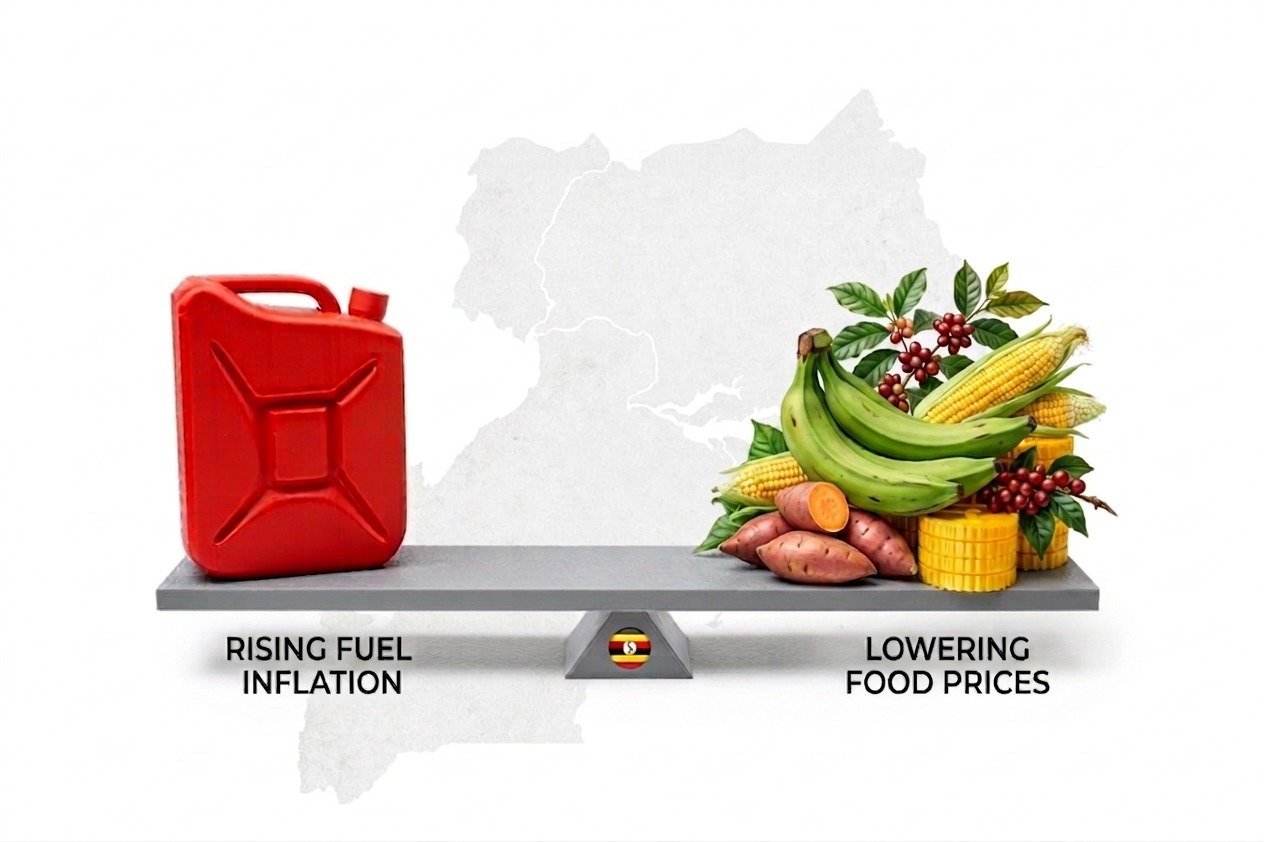
Uganda’s inflation story in May 2026 sits on a delicate fault line between two opposing economic forces, raising a central question for policymakers and markets alike; Can agriculture continue to shield the economy from global oil volatility? On one side is a global fuel shock pushing transport and production costs higher. On the other is a strong domestic harvest pulling food prices down and cushioning households from what would otherwise be a sharper cost-of-living squeeze. The result is an inflation reading of 3.2%, a figure that appears stable on the surface but is being actively shaped by these competing pressures.
According to the Uganda Bureau of Statistics (UBOS), this stability is not the result of uniform price calm, but rather a balancing act between imported inflation and domestic food deflation. Uganda is effectively being pulled in two directions at once, and the economy is holding steady only because these forces are temporarily offsetting each other.
Fuel Shock: The Imported Pressure Testing the Economy
To understand whether agriculture can keep absorbing external shocks, the starting point is the fuel market, where imported inflation is strongest. Uganda, as a landlocked economy, depends heavily on petroleum products transported through regional corridors such as Mombasa and Dar es Salaam. This makes it highly exposed to global oil volatility and regional transit costs.
Liquid energy fuels recorded an annual increase of 16.6%, feeding into Energy, Fuel and Utilities inflation, which rose to 9.1%. Kerosene increased by 25.4%, diesel rose by 21.5%, and petrol increased by 16.6%, all feeding directly into higher transport and production costs.
The critical issue is not just rising fuel prices, but what they mean for the rest of the economy if agriculture is not strong enough to counterbalance them.
“The key issue is not whether fuel prices are rising, but whether a domestic economy can continue absorbing imported volatility without structural damage. In Uganda’s case, agriculture is currently acting as the shock absorber, but that role becomes harder to sustain when diesel remains elevated for prolonged periods.”
— Dr. Aris Vance, Senior Infrastructure & Logistics Analyst, East African Trade Council
The impact of this shock is already visible in transport markets. Passenger road transport inflation rose to 10.6%, pushing the transport index from 3.6% to 6.7% in a single month as operators adjusted fares almost immediately.
“The question of whether agriculture can save Uganda from fuel volatility is already being tested in real time through transport fares. Once diesel crosses key thresholds, operators adjust immediately. That means the economy does not wait for theory, it responds instantly through household budgets.”
— Elena Rostova, Lead Macro-Strategist, Regional Investment Bank
The Harvest Cushion: How Agriculture Is Holding the Line
If fuel is the pressure point, agriculture is currently the counterweight keeping inflation from accelerating. A strong harvest season, supported by favorable rainfall patterns, has increased supply across key food markets and significantly reduced prices.
Food crop inflation slowed to 0.2%, while monthly prices declined by 0.9%. Fresh beans dropped by 30.1%, sweet potatoes by 10.5%, matooke by 3.4%, and sugar by 5.8%. Notably, matooke reversed sharply from +14.1% inflation in April to -3.4% in May, highlighting how quickly agricultural cycles can shift price dynamics.
This is where agriculture’s role becomes central to the title question. Its strength is not just in producing food, but in actively neutralizing external inflation shocks.
“Agriculture is currently doing exactly what policymakers hope for, it is neutralizing an imported shock that would otherwise fully pass through into inflation. But the real question is how long this cushion can last when global energy prices remain structurally high.”
— Marcus Sterling, Principal Agricultural Economist, Capital Research Partners
Because food carries the largest weight in Uganda’s inflation basket, these declines have an outsized effect on overall inflation, effectively offsetting energy-driven pressures.
Why Inflation Stayed at 3.2%
Despite sharp fuel increases, Uganda’s core inflation remained anchored at 3.0%, while headline inflation rose only slightly to 3.2%. This reflects a rare macroeconomic offset where opposing forces are balancing each other out.
In practical terms, the economy is experiencing a split reality. Transport and mobility costs are rising due to fuel prices, while food expenses are falling due to increased supply. The net effect is a partial cancellation of inflationary pressure at the household level.
A Fragile Balance Between Two Opposing Forces
What appears as stability is in reality a temporary equilibrium. Uganda’s inflation performance is not being driven by uniform economic strength, but by two opposing shocks moving in opposite directions.
This is why the question of sustainability becomes critical. If agriculture weakens or fuel prices remain elevated for longer, the balance could quickly shift.
“The bigger risk is assuming this balance is permanent. Agriculture can offset fuel shocks in the short term, but it cannot indefinitely neutralize imported energy inflation if diesel remains structurally high. The system works, until it doesn’t.”
— Lillian Akello, Sovereign Risk Analyst & Monetary Policy Consultant
The Real Test Ahead: When Fuel Pressure Reaches Food Prices
The most important forward risk is whether fuel inflation eventually spills into food prices. While current food prices reflect a strong harvest transported under earlier, lower fuel costs, future production cycles will increasingly reflect today’s higher diesel prices.
“The real stress test of whether agriculture can keep saving Uganda from oil volatility will come in the next production cycle. Every stage of food production, from land preparation to transport, is now absorbing higher fuel costs. That lag is where inflation pressure will eventually re-emerge.”
— Dr. Gerald Mukasa, Senior Macroeconomist, East African Development Analytics
If fuel prices remain elevated, these costs will gradually filter into food prices, particularly in urban centers such as Kampala where transport is a major component of retail pricing.
Conclusion: Agriculture as a Temporary Shield, Not a Permanent Solution
Uganda’s inflation story is ultimately a test of resilience between external pressure and internal capacity. Global oil volatility is pushing costs upward, while domestic agriculture is pulling them back down.
For now, agriculture is successfully saving Uganda from the full impact of global fuel shocks. But this protection is conditional and time-bound. The inflation balance holds today because food is abundant and fuel pressure is still being absorbed. Whether agriculture can continue playing this role depends on how long it can withstand sustained global energy volatility.
