
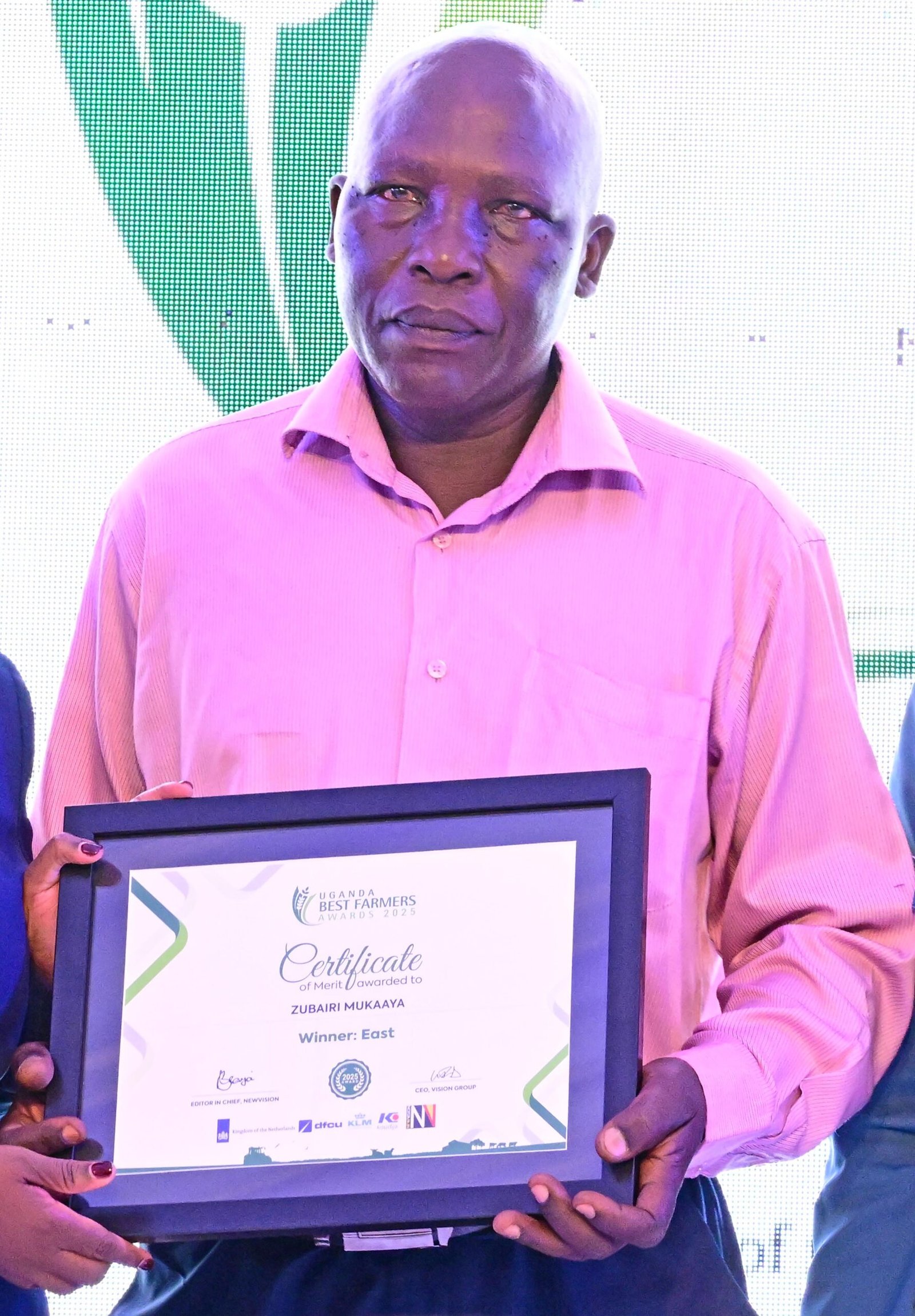
When Zubair Mukaaya started out raising local chickens, he wasn’t thinking about award ceremonies or study trips abroad. He was thinking about building a business. Today, that business produces more than 10,000 birds a week, supports a network of outgrower farmers, and has just picked up one of Uganda’s top agricultural honours: a Best Farmers Award, backed by dfcu Bank and Vision Group.
His story is less about poultry and more about how a small enterprise scales, through partnerships, financing discipline, and a deliberate strategy of pulling other producers into the value chain rather than competing with them.
Growth Built on an Outgrower Network, Not Just Bigger Sheds
Many farms scale by simply adding capacity. Mukaaya’s approach has been different: an aggregation model built around a network of trained outgrower farmers who supply eggs to his facility for hatching and rearing.
“We do not operate in isolation,” he says. “We work with a network of trained farmers who bring their eggs to our facility. We hatch them and nurture the birds alongside our own production until they are ready for market.”
The commercial logic is straightforward. Aggregation lowers the capital Mukaaya alone needs to carry to hit volume targets, while giving smallholder partners a guaranteed off-take channel. It’s a model that scales production without requiring him to own every input.
Financing as a Growth Constraint, and an Enabler
Access to capital is the recurring theme in Mukaaya’s account of the business. “Poultry farming requires constant investment in feed, equipment, infrastructure and working capital,” he explains. “When production volumes increase, the need for financing grows alongside them.”
Structured agricultural financing, he says, has let the business “maintain consistent production, invest in improvements and manage day-to-day operations more efficiently.” Without it, he adds, “scaling a business of this size would be much more difficult.” It’s the kind of unglamorous, working-capital-driven growth that rarely makes headlines but determines whether an agribusiness survives its expansion phase.
The Award as a Business Development Tool, Not Just Recognition
The commercial payoff from winning was immediate, by Mukaaya’s account. “More buyers became interested in our products, more aspiring farmers wanted to train with us, and the visibility of the business increased significantly,” he says. For a business built on aggregation and trust with outgrowers, that kind of credibility signal has direct commercial value. It lowers the cost of recruiting new farming partners and opens doors with buyers.
It also sharpened his expansion target. “We are now working towards doubling production from 10,000 to 20,000 chickens per week,” he says, “and the recognition reinforced our belief that this goal is achievable.”
What the Netherlands Trip Means for the Bottom Line
The award’s study visit to the Netherlands wasn’t a sightseeing bonus. Mukaaya frames it as targeted competitive research. “I was particularly interested in seeing how advanced agricultural systems operate,” he says. “I was also curious about how farms and factories manage their energy needs. In Uganda, energy is a major cost for many businesses.”
What struck him most was how normalised solar energy was across Dutch agricultural and industrial sites. “It was not treated as something experimental or optional,” he says. “It was integrated into operations in a very deliberate way.” For a business where energy is a significant recurring cost, that’s a direct signal for where his own capital expenditure could go next.
Turning Knowledge Into a Second Revenue and Impact Stream
Mukaaya has been mentoring aspiring farmers from his own operation since 2015, a practice that predates the award but now carries more institutional weight behind it. “Young people, aspiring farmers and entrepreneurs regularly visit the farm to learn about poultry production,” he says, and the lessons from the Netherlands trip are ones he intends “to share widely with people who visit the farm.”
This matters strategically. Mentorship and training feed his outgrower recruitment pipeline, reinforcing the aggregation model that underpins the business’s scale.
The Next Five Years: Scale, Energy and Sector-Wide Gaps
Mukaaya is bullish on Uganda’s poultry sector, citing rising demand and room for producers who treat farming as a serious business rather than subsistence activity. But he’s specific about what’s holding the sector back: “more affordable financing for productivity-enhancing investments, greater access to renewable energy solutions and practical training opportunities.”
His own long-term goal folds commercial ambition into sector leadership. “I want to demonstrate that agriculture, when managed professionally, can transform lives, communities and entire local economies,” he says.
